Nikola Tesla remains one of the most mythologized inventors in modern history. That part is understandable. He helped transform the electrical age through his work on alternating-current systems and rotating magnetic fields, and his ideas shaped the infrastructure that still powers the modern world. Because of that genius, almost anything mysterious attached to his name tends to spread quickly. The numbers 3, 6, and 9 are one of the best examples. Tesla is often linked to the idea that these numbers reveal something fundamental about reality, something deeper than ordinary mathematics. Whether or not every quote attributed to him is authentic, the fascination itself reveals something real about the human mind: we are drawn to pattern because pattern feels like meaning.

At the factual level, Tesla was not a mystic floating outside science. He was an engineer, inventor, and systems thinker. He worked with electricity, resonance, motors, transmission, and energy on a scale that changed civilization. The reason people continue projecting cosmic significance onto his words is that Tesla often thought in terms of fields, frequency, structure, and elegant underlying order. That mindset makes it easy for later audiences to connect him to numerical symbolism. But it is important to distinguish between verified history and later mythology. Tesla’s documented legacy in AC power is real. The claim that he left behind a fully formed esoteric doctrine of 3, 6, and 9 is much less certain.
Still, the endurance of 3, 6, and 9 points to something worth exploring. Not necessarily a hidden code in the supernatural sense, but a recurring human intuition that reality may be structured in ways that repeat across scales. Three is one of the oldest organizing numbers in culture: beginning, middle, end; birth, life, death; thesis, antithesis, synthesis. Six often appears as a number of balance, symmetry, and structure. Nine carries the feeling of completion, the end of a cycle before returning to one again. These associations are not proofs of cosmic law, but they are powerful symbols that many traditions independently found meaningful. That alone explains part of their enduring appeal.
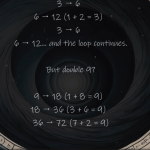
From a mathematical perspective, part of the attraction comes from how these numbers behave in patterns people can easily notice. Multiples of 3 produce repeating digital structures. Six is tied to divisibility and symmetry. Nine has unusual properties in base-10 arithmetic, especially in digit sums, which makes it feel “special” even when the effect is really a feature of the number system we use. This does not mean 3, 6, and 9 are magical. It means human beings often encounter them as memorable anchors in a world already shaped by pattern recognition. What many people call “hidden truth” may sometimes be the mind noticing elegant recurrence and then filling the gap with metaphysical meaning. That is not foolish. It is human.
The stronger interpretation, and the one many spiritual or symbolic thinkers lean toward, is that these numbers represent stages of energetic unfolding. In that reading, three is creation or ignition, six is expansion or harmony, and nine is culmination or return. This is not established physics. It is symbolic philosophy. But symbolic philosophy matters because it shapes how people perceive themselves and the world. Numbers become containers for meaning. They allow people to describe inner experience, cycles of growth, and the intuition that life moves in recurring spirals rather than straight lines. In that sense, the fascination with 3, 6, and 9 says less about Tesla alone and more about humanity’s hunger to find coherence beneath surface chaos.
There is also a psychological reason this theme spreads so effectively online. Modern life feels fragmented. People are overloaded by information but undernourished in meaning. When a simple sequence like 3, 6, 9 is presented as a “key to the universe,” it offers a kind of relief. It suggests that beneath complexity, there is order. Beneath noise, there is signal. Beneath randomness, there is pattern. Whether one interprets that in a mathematical, symbolic, or spiritual way, the emotional pull is the same. A sequence becomes more than a sequence. It becomes a bridge between confusion and coherence. That is why this idea survives even when its historical foundation is shaky.
This is where discernment matters. A wise reading of Tesla’s legacy does not require blind belief or cynical dismissal. It asks a better question: what is useful here, and what is merely projection? Verified fact: Tesla revolutionized electrical engineering and became one of the defining innovators of the modern age. Strong inference: he was deeply attracted to order, repetition, resonance, and elegant design principles. Speculation: that he discovered a secret numerical code explaining the universe in an occult sense. Keeping these layers separate protects both truth and wonder. It allows admiration without mythology and curiosity without surrendering judgment.
There is another level to this discussion that is easy to miss. Even if 3, 6, and 9 are not “the key” in a literal scientific sense, they can still function as a practical key in consciousness. They can remind a person to look for structure instead of drift, cycles instead of panic, and principles instead of distraction. In that sense, the power of the numbers may not be that they secretly control reality, but that they train attention. They nudge the mind to ask: What repeats? What harmonizes? What completes the cycle? This shift alone can change how someone thinks, creates, and lives. A symbol does not need to be scientifically final to be psychologically transformative.
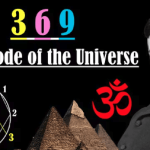
That may be the deepest value in videos like this one. They invite people to pause and consider whether reality is more patterned than they have been taught to notice. Sometimes that leads to superstition. Sometimes it leads to deeper thought. The difference lies in method. If the idea of 3, 6, and 9 makes someone more observant, more reflective, and more disciplined in separating evidence from imagination, it has served a good purpose. If it becomes a substitute for evidence, it turns into another belief trap. The real challenge is not choosing between cold skepticism and mystical certainty. It is learning how to hold mystery and rigor at the same time.
In the end, the secret behind 3, 6, and 9 may not be that they unlock the universe like a hidden password. The deeper secret may be why human beings want them to. We are creatures who sense that life contains layers. We suspect that behind visible events lie invisible structures. Tesla, because of his brilliance and aura, became a vessel for that suspicion. His real achievements gave later generations a reason to believe he might have seen farther than others. Maybe he did in some ways. But the wiser path is not to worship every quote attached to his name. It is to let the question sharpen perception: Where do pattern, energy, and meaning genuinely meet? That is a better key than any slogan.