A thriving city rarely imagines becoming an archaeological site. Its inhabitants buy food, repair buildings, argue about decisions, and make plans for their children. The routines of daily life make the surrounding order feel permanent. The Bronze Age Collapse — Mediterranean Apocalypse, from Fall of Civilizations, invites us to look beyond that assumption. It introduces an ancient world whose connections helped sustain extraordinary achievements, then became part of a much larger crisis.
The documentary’s central question is compelling: how could several established societies experience such profound disruption within the same historical period? Exploring it requires more than finding a dramatic villain. It asks us to consider trade, political organization, environmental pressures, conflict, and the people who kept living after familiar institutions failed.
A connected world before modern globalization
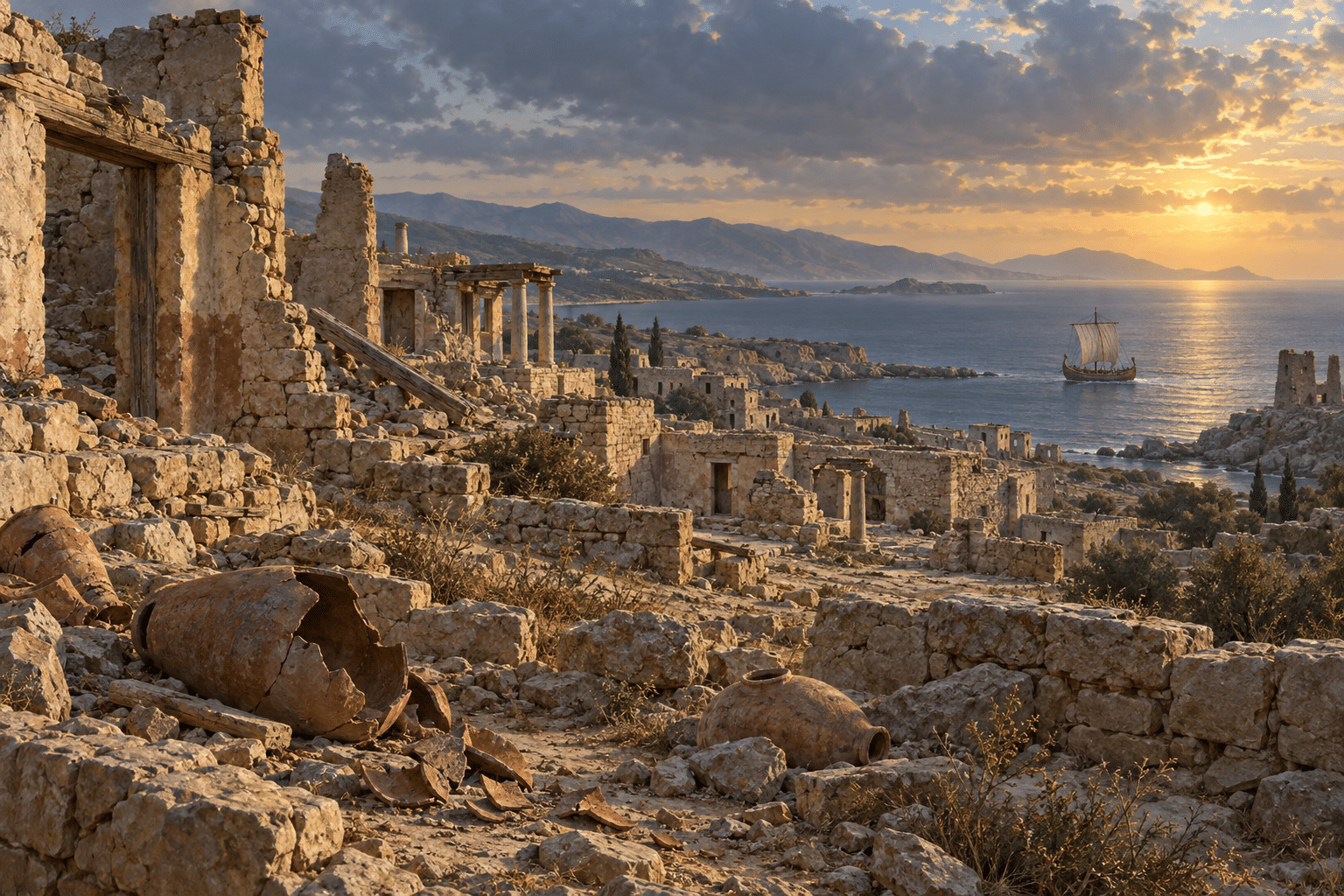
The eastern Mediterranean of the Late Bronze Age was a region of relationships. Courts communicated, merchants transported valuable materials, and craftspeople worked with resources that could originate far from their workshops. The Metropolitan Museum of Art’s research on cultures in contact describes networks linking western Asia, Egypt, and the Aegean. Surviving diplomatic texts and luxury objects reveal exchanges of ideas as well as goods.
It is worth pausing over that picture. Ancient does not mean isolated or simple. A beautiful object might depend on miners, transport workers, sailors, traders, and skilled makers whose lives crossed several political boundaries. Looking closely at one finished piece can therefore change the scale of our imagination. What appears local may be the visible end of a much wider relationship.
A shipwreck makes those connections tangible
The Uluburun shipwreck, off the southern coast of present-day Turkey, offers remarkable evidence of this trade. The Met’s account of a Late Bronze Age copper ingot notes that the wreck carried more than ten tons of Cypriot copper. Copper and tin were combined to make bronze, so transporting these materials mattered to the manufacture of useful and prestigious objects.
Other cargo included glass and valuable raw materials. The museum’s Beyond Babylon exhibition research presents the wreck as a vivid record of intercultural exchange. It predates the collapse; it does not prove why that collapse occurred. Its importance here is different: it shows the kinds of connections whose interruption could carry consequences beyond a single port.
Why one explanation is rarely enough
The phrase Bronze Age collapse can make a complicated transition sound like one event. In reality, places experienced different combinations of destruction, abandonment, contraction, survival, and change. A date used in a book title or documentary should not be mistaken for a universal deadline when every community stopped functioning. The regional picture requires attention to sequence and variation.
Archaeologist Eric Cline’s work emphasizes interacting pressures. In his lecture on survival after 1177 BCE, he discusses drought, famine, earthquakes, invasion, and disrupted trade as contributors to wider breakdown. The useful idea is cumulative vulnerability: several stresses may become more damaging together than any one would have been alone. Their relative importance still needs evaluation in particular places.
The danger of an irresistible villain
The groups commonly called the Sea Peoples occupy a prominent place in popular accounts. They provide a memorable image of enemies arriving from beyond the horizon. Yet the publisher’s introduction to Cline’s 1177 B.C. explicitly rejects the idea that these groups alone explain the region’s breakdown. Conflict belongs within a larger investigation of interconnected failures.
This is a useful lesson in how to watch historical media. A named enemy makes a story easier to remember, but memorability is not the same as explanatory power. Ask whether the proposed cause fits the geography and timing of the evidence. Ask what conditions made communities vulnerable before an attack. A convincing account should help answer those questions rather than simply repeat its most dramatic image.
What a systems failure can mean
Imagine a hypothetical town whose harvest disappoints. It can normally import grain, but its trading partner is also struggling. The local authority spends more defending transport routes, leaving fewer resources for repairs. Delayed maintenance creates additional losses. This example is an illustration of interacting pressures, not a reconstructed sequence for a particular Bronze Age city.
Its value is to show why relationships matter. The same network that shares resources during ordinary times can transmit disruption when several participants are under strain. A system may continue appearing impressive while losing its ability to absorb another shock. Monumental buildings and powerful titles do not necessarily reveal how much room remains for error beneath the surface.
Collapse was not the end of everyone’s story
Ruined palaces can dominate our attention because they leave visible remains. But a political order and the people living within it are not identical. Cline’s later work examines differing paths of adaptation and recovery, including the transformation of surviving societies and the emergence of new arrangements. His account treats the following centuries as a period of invention as well as loss.
That perspective changes the questions we ask. Alongside why a kingdom failed, we can ask which skills endured, where people moved, and how communities reorganized exchange. Recovery may look very different from restoration. People can continue building meaningful lives without recreating the exact institutions that previously claimed to define their world.
Use the comparison with today carefully
Modern readers naturally recognize themes such as supply dependence and institutional strain. Those parallels can be useful prompts, but they are not predictions. Contemporary societies have different technologies, political structures, information systems, and capacities. Ancient history does not provide a timetable for our future. Treating every resemblance as proof of an approaching catastrophe would flatten both periods.
A more productive response is to examine resilience at a human scale. Which arrangements depend on a single point of failure? Where would an alternative help? What knowledge is worth preserving and sharing? These questions can guide a household, workplace, or community without requiring anyone to believe that history repeats according to a fixed script.
Another useful question concerns whose experience a story preserves. A royal inscription, a merchant’s cargo, and a household vessel illuminate different parts of life. None offers a complete view by itself. Paying attention to those differences helps prevent the experience of rulers from standing in for everyone else. It also reminds us that archaeological silence does not automatically mean an absence of people, knowledge, or activity. Sometimes it marks the limits of what has survived for us to examine.
Return to the people behind the ruins
Fall of Civilizations offers an entry into the puzzle; the supporting archaeological sources help us examine it beyond the documentary’s atmosphere. Together they encourage curiosity about how complex societies function, why explanations remain contested, and what survives political upheaval. The most revealing response to the ancient world may be patient attention rather than certainty.
Continue the exploration with our article on Göbekli Tepe and the ancient stones of our forgotten past. Different periods raise different questions, but both reward a willingness to distinguish evidence from imagination. The ruins invite us to remember that stability is built through relationships, and that the people who inherit disruption can still shape what comes next.
Featured video: Fall of Civilizations — The Bronze Age Collapse: Mediterranean Apocalypse.