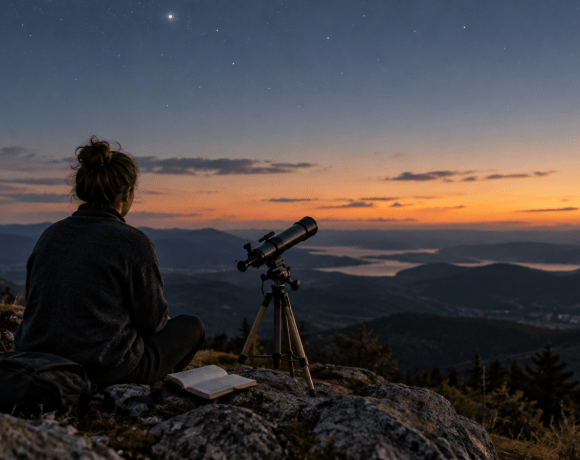

For centuries, humanity has looked up at the night sky with wonder. We have been told that the stars are unimaginably distant suns, suspended in an infinite vacuum, their light traveling across billions of miles before reaching our eyes. We are taught this from childhood and rarely stop to question it.
But what if the story isn’t complete?
What if the greatest discoveries aren’t waiting inside billion-dollar observatories or government-funded space agencies—but in the hands of ordinary people willing to observe the sky for themselves?
This is the question at the heart of The Telescope Conspiracy, a documentary following Canadian researcher Mikey Smith, whose unexpected recordings of the night sky have sparked one of the most controversial discussions in alternative astronomy.
Whether you agree with his conclusions or not, one thing is undeniable:
His videos have forced thousands of people to look up—and think differently.
The Night Everything Changed
On April 11, 2023, in Saskatchewan, Canada, Mikey Smith stepped outside to do what he had done countless times before.
Armed with a smartphone attached to binoculars—a technique known as digiscoping—he pointed his camera toward Sirius, the brightest star visible in the night sky.
What he recorded surprised even him.
Instead of a tiny, featureless point of light, his footage appeared to reveal intricate structures, repeating patterns, flashes resembling electrical pulses, and movement unlike anything he had previously observed.
His immediate reaction was simple:
“I’ve never seen that before.”
That moment would completely change the direction of his research.

Looking Without Assumptions
Most of us never question what we see in astronomy.
We are shown beautifully processed images from space telescopes and observatories and naturally assume that these represent exactly what exists.
Mikey chose a different approach.
Instead of beginning with accepted conclusions, he began with direct observation.
His philosophy was straightforward:
Observe first.
Interpret later.
That simple shift is far more powerful than it sounds.
Throughout history, many breakthroughs began because someone stopped assuming they already knew the answer.

One Star Became Many
Curious whether Sirius was unique, Mikey turned his camera toward other celestial objects.
He filmed:
- Sirius
- Venus
- Vega
- Capella
- Jupiter
Again and again, he reported seeing recurring visual characteristics.
Symmetry.
Motion.
Flashing.
Repeating structures.
Patterns that looked remarkably similar despite observing different objects.
For Mikey, these repeated observations suggested that something about the commonly accepted picture of the night sky deserved closer examination.
Whether these patterns represent optical phenomena, atmospheric effects, or something else entirely remains the subject of debate.
But the recordings themselves inspired thousands of people to conduct their own observations.
The Question of the Firmament
Perhaps the documentary’s most controversial topic concerns what Mikey describes as a textured surface behind the stars.
Within Flat Earth cosmology, this is often referred to as the firmament—a concept found in numerous ancient traditions and religious texts.
The documentary argues that the recordings appear to show stars interacting with a structured background rather than floating in empty space.
Supporters see this as evidence that the heavens may not resemble the conventional model.
Critics argue that optical artifacts, atmospheric turbulence, or imaging limitations provide more conventional explanations.
Regardless of which explanation proves correct, the documentary raises an important question:
Have enough people actually tried to observe the sky themselves before dismissing the possibility?
The Cost of Questioning
History has rarely been kind to people who challenge accepted ideas.
Mikey’s experience reflects this reality.
His videos were dismissed almost immediately.
Some claimed his equipment was inadequate.
Others insisted his camera created distortions.
Many rejected his conclusions without attempting to reproduce his methods.
Interestingly, criticism came from every direction.
Not only did mainstream skeptics object.
Even members of the Flat Earth community questioned what he was seeing.
The documentary suggests this reveals something deeper than astronomy.
People often defend familiar ideas because certainty feels safer than uncertainty.
Then Came Independent Verification
Everything changed when Israeli researcher Samuel Aboukaya decided not to debate Mikey’s work—but to test it.
Instead of arguing online, Samuel repeated the experiment.
Using higher-quality binoculars and the same digiscoping techniques, he began recording the night sky over Israel.
According to the documentary, his observations showed many of the same visual characteristics Mikey had described.
Rotating structures.
Energy-like flashes.
Symmetrical forms.
Reflections appearing behind luminous objects.
To supporters, independent replication strengthened confidence that Mikey’s observations were not isolated anomalies.
To critics, alternative explanations still remained.
Either way, something important had happened:
Someone else had looked for themselves.
Are Bigger Telescopes Always Better?
One of the documentary’s most provocative ideas is that larger telescopes may not always produce the clearest understanding of what we are observing.
This sounds counterintuitive.
Modern astronomy often assumes that more expensive equipment automatically produces more accurate results.
The documentary challenges that assumption.
It argues that simpler observation methods may sometimes reveal characteristics that become obscured through increasingly complex optical systems and image processing.
Whether that claim withstands scientific scrutiny remains open to investigation.
But it reminds us of something important:
Technology is only as valuable as our willingness to question what it shows us.
The Real Message Isn’t About Stars
At first glance, The Telescope Conspiracy appears to be about astronomy.
But beneath the surface, it asks a much bigger question.
How do we know what we know?
Do we accept ideas because we’ve personally investigated them?
Or because trusted authorities presented them to us?
This question extends far beyond the night sky.
It touches history.
Health.
Education.
Media.
Science.
Even our understanding of ourselves.
Awakening rarely begins with finding answers.
It begins with asking better questions.
Observation Before Belief
One of the documentary’s greatest strengths is its emphasis on firsthand observation.
It encourages viewers not to believe Mikey Smith.
Nor to automatically dismiss him.
Instead, it offers a challenge:
Go outside.
Look up.
Record what you see.
Compare your observations.
Discuss them openly.
The spirit of genuine inquiry has always relied on observation, replication, and respectful debate.
Whether investigating astronomy or any other field, this principle remains timeless.
The Search for Truth
Every generation inherits a worldview.
Some parts prove remarkably accurate.
Others evolve as new evidence emerges.
The history of science is filled with ideas once considered unquestionable that were later revised through better observations.
That does not mean every challenge to accepted knowledge is correct.
But it does remind us that questioning is essential to progress.
Curiosity has always moved humanity forward.
The documentary invites viewers to rediscover that curiosity.
Beyond Astronomy
Perhaps the greatest lesson from Mikey Smith’s journey has nothing to do with stars.
It is about courage.
The courage to investigate.
The courage to remain curious.
The courage to continue observing even when others laugh.
Whether Mikey’s conclusions ultimately reshape astronomy or simply inspire better conversations about observation, his willingness to look for himself has already accomplished something valuable.
It has reminded thousands of people that truth should never become a matter of popularity.
It should remain a matter of investigation.
Final Thoughts
The Telescope Conspiracy is ultimately not asking you to abandon everything you know.
It is asking you to pause.
To slow down.
To observe.
To question.
For generations, humanity has relied on experts to explain the heavens.
There is value in expertise.
But there is also value in direct experience.
The night sky belongs to everyone.
No institution owns your ability to look upward and wonder.
Whether Mikey Smith has uncovered something extraordinary or simply reignited humanity’s oldest instinct—to question the unknown—the documentary succeeds in one important way:
It gets people looking up again.
And perhaps that is where every awakening truly begins.