Look closely at a group of birds. They share a species, yet no two are perfectly alike. One has a slightly different beak, another resists a disease better, and a third finds food more efficiently in a particular season. Over generations, differences that affect survival and reproduction can become more or less common. Kurzgesagt’s animated video How Evolution Works makes this process approachable with clear visuals and a simple question: how did life become so varied?
The video was published in 2013 and remains widely watched. Its age is useful to remember: a short animation is an introduction, while research continues to refine the details. The central ideas do not require a dramatic mystery. Evolution is change in inherited traits across populations over generations. Natural selection is one important mechanism of that change, alongside mutation, migration and genetic drift.
Variation comes first
Natural selection needs differences to act on. Some differences arise from mutation, which changes genetic material. Others come from the reshuffling of inherited material in sexual reproduction. A population therefore contains a range of traits rather than one perfect template copied again and again. Many differences have little effect on survival; some matter only under particular conditions.
Picture birds on an island where hard seeds are common. Beak shapes vary. If a certain shape makes those seeds easier to eat, birds with that inherited trait may, on average, leave more offspring. If their young inherit relevant variants, the trait can become more common. The environment does not decide that birds “need” a new beak and then create one to order. Existing variation meets a changing world.
The National Human Genome Research Institute explains evolution in terms of genomic change across generations. The word “population” is essential. An individual bird can grow, learn or lose a feather during its lifetime; that does not mean the individual has evolved. Evolution describes a shift in the inherited makeup of a population over time.
Selection is powerful, but it has no destination
It is tempting to imagine evolution as a ladder pointing toward a final, superior form. That image distorts the process. A trait can be helpful in one environment and costly in another. Thick fur can be useful in cold conditions and burdensome in heat. A beak suited to one food source may be less effective when the available food changes. “Fittest” means better suited to a particular setting, not morally better or destined to win forever.
Selection also works through reproduction, not simply through staying alive. A trait that helps an organism survive but prevents it from leaving offspring will not spread by that route. Conversely, a modest advantage repeated over many generations can change a population markedly. This is why small differences and long timescales matter.
Chance matters too. In a small population, a genetic variant can become more or less common through random events even when it gives no advantage. That process is genetic drift. Migration can bring variants from one population into another. Mutation supplies new variants. The genomics glossary describes these terms separately because no single mechanism tells the whole story of life.
Why the tree of life branches
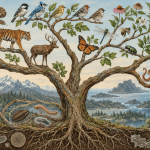
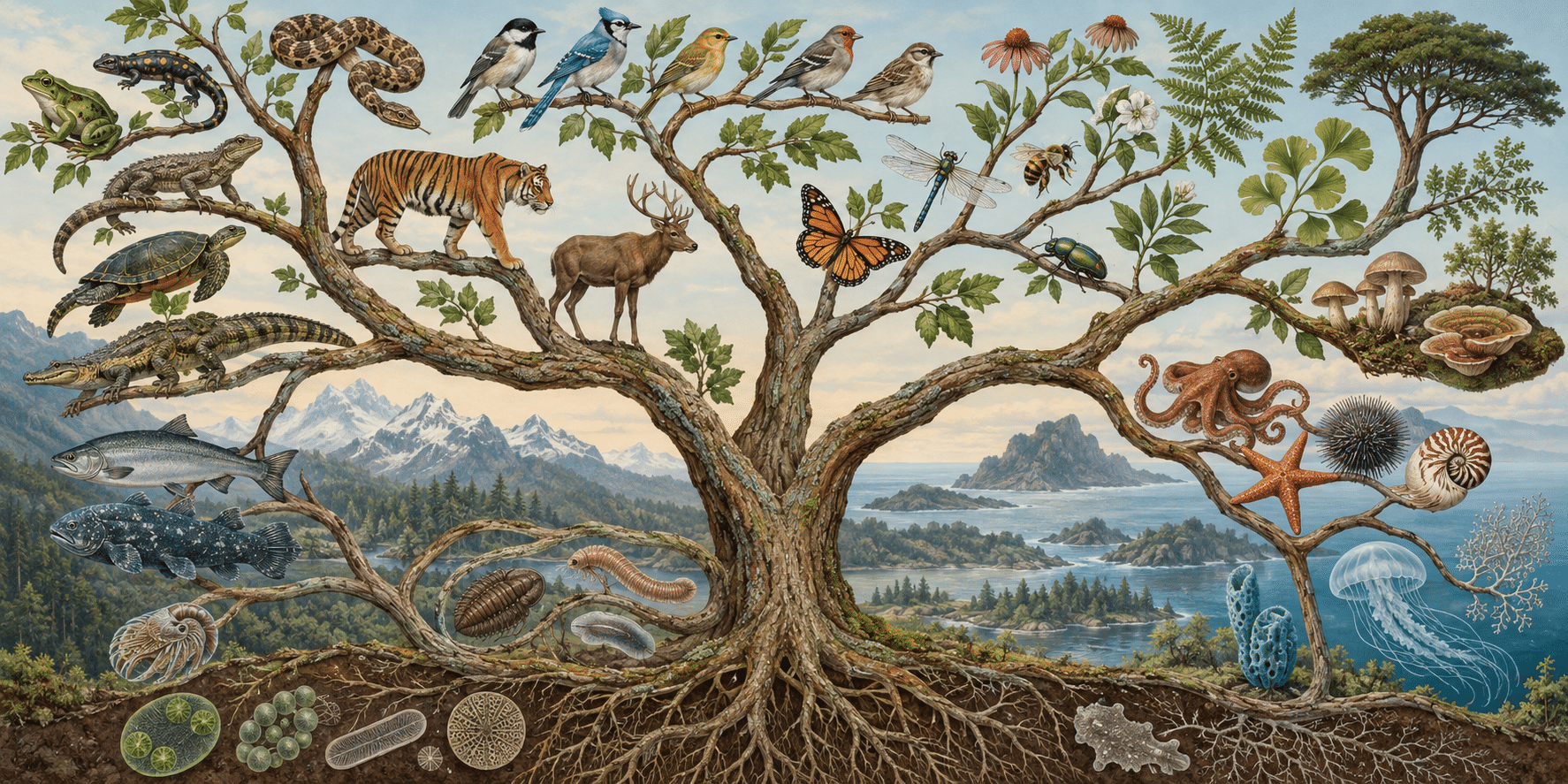
When groups of organisms become separated, their populations may face different environments and accumulate different changes. Over long periods, some lineages become distinct species. The result is better pictured as a branching tree than as a straight march from “simple” to “advanced.” Every living species sits at the tip of a lineage that has survived to the present.
This also helps correct a common misunderstanding about human origins. Humans did not descend from the chimpanzees alive today. Humans and chimpanzees share an ancestral population in the past, and their lineages changed in different ways. The Smithsonian’s Human Origins Program explains human evolution as part of the wider history of life, supported by evidence from fossils, anatomy and genetics.
A tree diagram is a model of relationships, not a ranking of worth. Bacteria are not “failed” versions of animals. Birds did not wait at a halfway point on a road to mammals. Each lineage has its own history. The joy of a branching picture is that it makes kinship visible without pretending that all branches are the same.
How do scientists test the story?
Evolutionary claims can be examined with several independent kinds of evidence. Fossils show organisms in geological sequence and reveal traits that connect or distinguish groups. Comparative anatomy identifies shared structures. DNA allows researchers to compare inherited sequences and build hypotheses about relationships. Observations of living populations show changes unfolding over shorter timescales.
No fossil record is complete, and no single gene contains a perfect family tree. Scientists compare sources of evidence, look for patterns and revise conclusions when new material appears. The Smithsonian’s evidence collection illustrates how new discoveries can sharpen our understanding. Revision is a strength of the method: a scientific explanation grows more precise when it can be tested against what we find.
For a practical example, consider resistance in microbes. When a drug kills susceptible organisms, variants that can survive may leave descendants, making resistance more common. The drug did not teach each microbe how to resist; it changed which inherited variants were more likely to persist. This is one reason evolution matters outside a museum. It shapes medicine, agriculture and conservation in the present.
What a short video can and cannot show
Animation can make invisible timescales feel immediate. It can also make a complicated process appear smoother than it is. Real populations face changing climates, multiple traits interacting at once, chance events and movement between groups. A cartoon may show one trait sweeping through a species in minutes. In nature, the pace varies greatly, and an apparent benefit often comes with a tradeoff.
The video succeeds when it gives us a starting model: inherited variation exists, conditions affect which organisms reproduce, and populations change over generations. The next step is to ask what other mechanisms are operating in a specific case. Is the population small? Did migration occur? What evidence connects a trait to reproductive success? These questions turn a memorable visual into a scientific investigation.
See life as a history still unfolding
Evolution is often spoken of as ancient history, as though it stopped when humans appeared. It has no such finish line. Populations continue to change, sometimes visibly within human lifetimes. The same basic processes link a small shift in a local species to the immense branching history represented by the tree of life.
Watch Kurzgesagt’s film for its clarity and energy. Then look beyond the animation: observe variation in the living world, follow how scientists test a claim, and remember that every branch has a story. The wonder is not that life marched toward us. It is that inherited change, time and circumstance produced a world of forms connected by ancestry.
When a claim about evolution sounds certain, ask what would change the researcher’s mind. A new fossil, a better genetic sample or an observed population may support a familiar account or require a new branch on the tree. That openness is part of why the explanation remains useful. It connects wonder to evidence rather than asking us to choose one over the other.
Featured video: How Evolution Works — Kurzgesagt.