Imagine opening a corroded object recovered from a shipwreck and finding carefully cut gears that represent movements in the sky. The Antikythera mechanism invites exactly that sense of surprise. In Veritasium’s video The Most Powerful Computers You’ve Never Heard Of, the ancient device is part of a wider story about analog computers: machines that use physical relationships to model and calculate. The story complicates the easy assumption that meaningful computation began only when screens appeared.
It is a remarkable artifact without needing an impossible origin story. The National Archaeological Museum in Athens presents the surviving mechanism and the questions researchers still ask about it. What remains is enough to reveal formidable skill, while the missing parts require careful reconstruction rather than certainty dressed as mystery.
What makes a geared device a computer?
Today we often picture a computer as an electronic machine that stores digital instructions. An analog computer works differently. Its physical parts stand in for relationships in the problem being solved. Turn a gear or move a component, and the arrangement produces a corresponding output. The device embodies a mathematical model in material form.
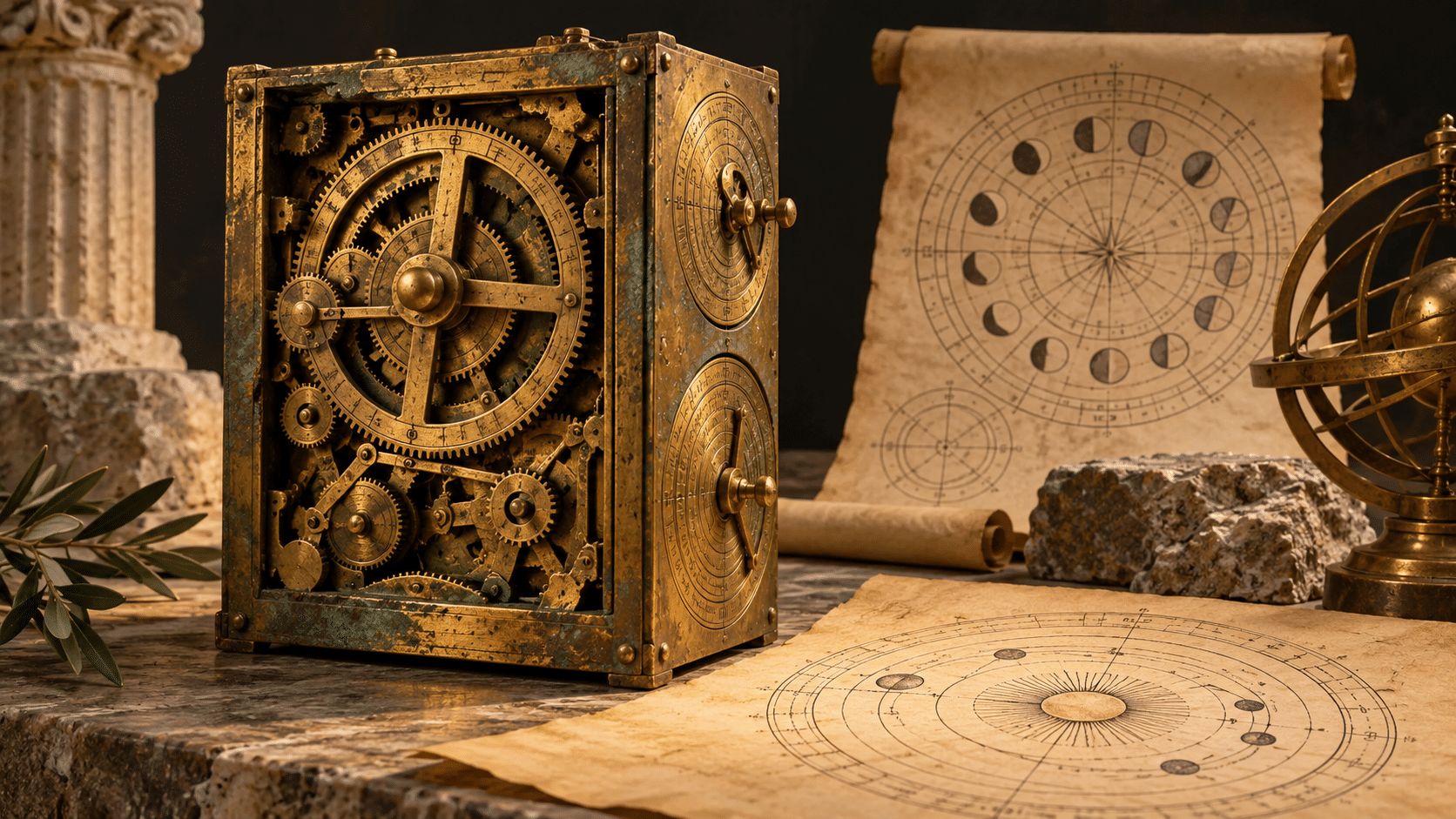
The Antikythera mechanism used interlocking gears and dials to represent astronomical cycles. The museum’s explanation of its functions describes calendars and eclipse cycles. Those functions depended on observation, calculation, and mechanical design. Calling it an analog computer is useful because it points to those linked operations, not because the artifact behaved like a modern laptop.
Veritasium widens the frame beyond ancient Greece. Its video follows analog computing into later machines used to model physical systems. That broader view matters. It prevents the mechanism from becoming a one-off curiosity, isolated from the long human effort to turn patterns in nature into tools for prediction.
The real fragments are the starting point
The museum identifies the mechanism as an object recovered from the sea near Antikythera and now studied across several fields. Its fragments contain gears, inscriptions and evidence of complex displays. Researchers use imaging and physical analysis to read details that corrosion and damage hid from earlier investigators. Each new technique can sharpen a question, but it does not restore the entire object intact.
There is a difference between a surviving fragment, a proposed model and a finished replica. A reconstruction may fit the available evidence while still containing decisions about missing parts. In 2021, a University College London team proposed a model for the front display that brings together physical evidence and inscriptions. The team’s work is a major contribution to understanding the device. It is also a model, which researchers can test and refine as evidence and arguments develop.
This careful separation is more exciting than a claim that the object is simply “unexplained.” It lets us see discovery happening. An inscription yields a clue; a gear count limits the possibilities; a reconstruction tests whether the proposed arrangement could work. Wonder grows when a question becomes more precise.
Prediction is not prophecy
A machine that predicts an eclipse can sound supernatural when its method is unfamiliar. The mechanism’s achievement is more grounded and, in some ways, more impressive. Ancient observers recognized repeating cycles. Designers then translated those cycles into ratios and movements that a user could read from dials. Prediction arose from a model of regularity, not from foreknowledge of a single event.
The museum explains how cycles such as the Metonic and Saros periods relate to calendars and eclipses. These were not invented out of nothing by one isolated genius. They belong to a history of astronomical observation and mathematical exchange. The device shows what can happen when accumulated knowledge meets skilled craft.
This does not mean every proposed detail of the front display is settled. The surviving material is incomplete, and historians debate how some functions were represented. The honest version of the story can hold both truths: the mechanism was extraordinary, and important uncertainties remain.
Why sophisticated knowledge can disappear
We often tell technological history as a staircase: each generation stands higher than the last. The Antikythera mechanism warns against assuming that a surviving object tells the whole story of its era or that later people automatically inherited every technique behind it. Knowledge depends on workshops, teachers, materials, institutions and demand. If those conditions change, a craft can become rare even while other kinds of knowledge advance.
One artifact also cannot tell us how common such machines were. It proves that its makers possessed the ability to build this device. It does not prove that identical machines filled every ancient city, nor that no related objects were ever made. Those are questions for evidence, not for imagination alone.
For a related case of durable ancient engineering, read our article on Roman concrete and lost building knowledge. Both subjects reward the same discipline: begin with the material, ask what it can show, and resist turning an incomplete record into an unlimited claim.
What the video changes about our idea of innovation
Veritasium’s larger analog-computer story helps us see that computation is a method, not a single type of box. A physical system can carry out a calculation when its design preserves the relationship that matters. Electronic digital machines eventually became dominant for many reasons, but their success should not erase earlier forms of problem solving.
There is a useful humility in that history. We inherit devices that make astonishing work look effortless. Ancient makers faced different materials and questions, yet they also sought ways to make the world legible. Their work challenges the habit of dividing people into “advanced” and “primitive” according to whether they had our technology.
Let the mystery stay answerable
The Antikythera mechanism is often introduced with a headline asking how it could possibly exist. A better question is how its makers transformed astronomical knowledge into an instrument that someone could operate. That question points toward evidence: gears, inscriptions, cycles, manufacturing methods and comparative history. It honors the achievement by trying to understand it.
We do not need to remove uncertainty from the story. Missing pieces are real. So is the intelligence visible in what survives. The device invites a form of curiosity that neither dismisses ancient people nor credits them with whatever we wish were true. Look closely at the object, follow the research, and let the next discovery change the picture.
Featured video: The Most Powerful Computers You’ve Never Heard Of — Veritasium.