On a boat, the horizon can look like a simple line. For a navigator, it is also a reference. In Practical Navigator’s short lesson, Christopher D. Nolan introduces the marine sextant by showing how its mirrors bring a celestial object and the visible horizon into one view. The result is an angle that can be recorded along with an exact time and used in a larger navigation calculation. This is a practical craft: looking carefully, handling an instrument, reading a scale, and checking the result. It begins with observation rather than a claim about what the world must be.
Meet the instrument before using it
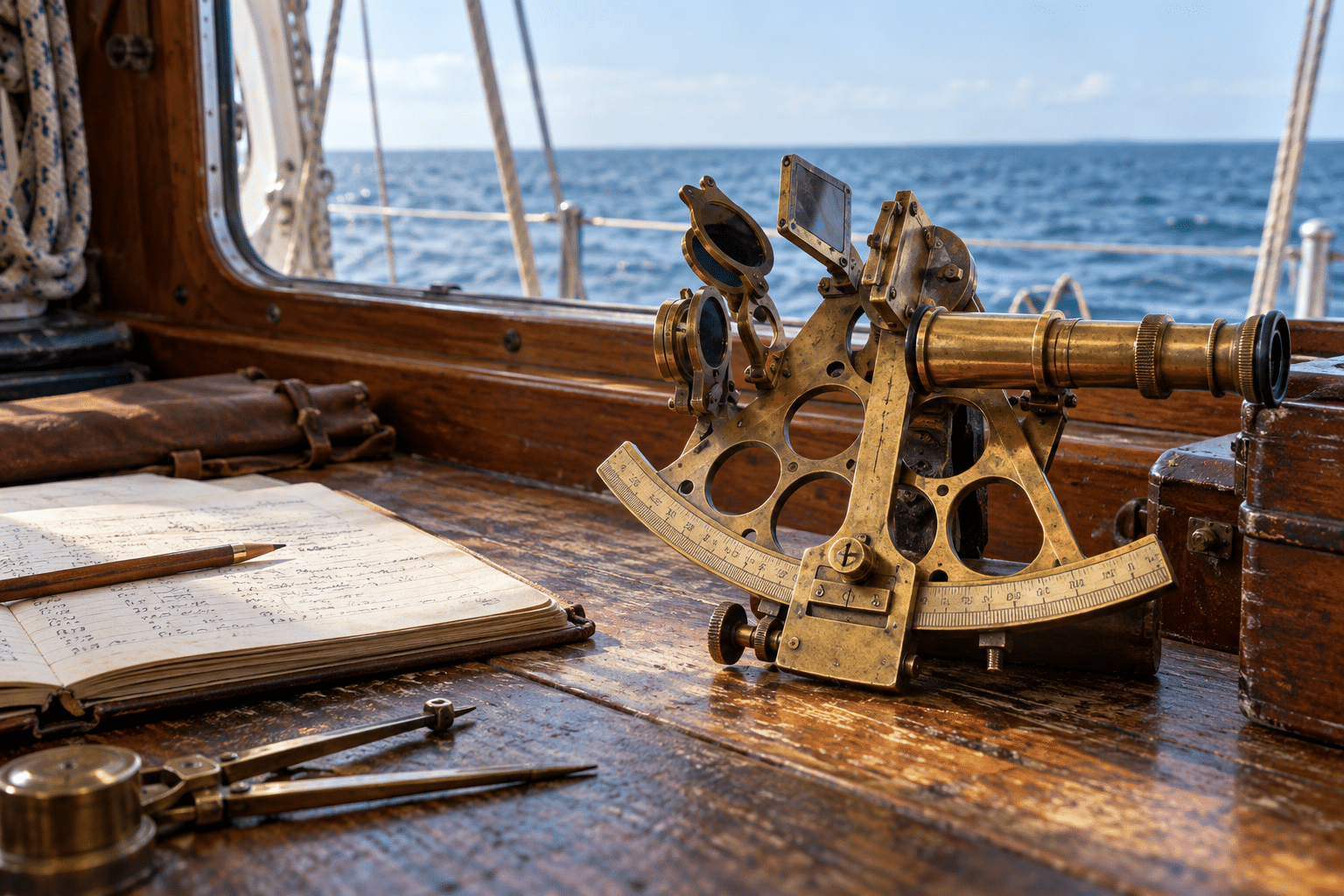
Nolan’s video, Getting Started in Celestial Navigation (The Marine Sextant), is the first lesson in his introductory series. He describes the sextant as a kind of precise protractor. Its frame carries a curved scale; an index arm moves a mirror; a second mirror lets the observer compare two lines of sight. The telescope helps frame the view, and a micrometer drum permits finer adjustment. Nolan points out that the coarse trigger and fine drum have different jobs. Knowing which control you are moving matters as much as knowing the number you hope to read.
The National Maritime Museum’s description of a historical sextant shows how many details can belong to one instrument: frame, index arm, telescope, shades, screws, and carefully divided scales. Models differ. A beginner should learn the layout and instructions for the specific sextant in hand rather than assuming that every scale and adjustment works identically.
What an angle actually records
The lesson centers on the angle between the visible horizon and an object in the sky. Nolan demonstrates with the Sun, showing how a reflected image can be brought down until its lower edge appears to touch the horizon. He then rocks the sextant gently to find the lowest point of the arc and refines the reading. That motion helps the observer avoid an apparent contact caused by tilting the instrument. The reading is an observed altitude, a piece of data rather than a finished position.
His close-up of the scale is especially useful. Degrees and minutes of arc are separate parts of the reading, and a finer scale can show fractions of a minute. Nolan cautions beginners not to become preoccupied with a level of precision their eye cannot reliably support. The lesson is to read carefully, check the number more than once, and understand the limits of the observation.
An angle by itself does not tell the whole story. The navigator also records the time to the second and applies the appropriate corrections and calculations. Height of eye, the visible horizon, the apparent edge of the Sun, and the instrument’s own errors all matter in a real sight reduction. Nolan’s video introduces the physical act of measuring. It should be watched as the beginning of a skill, not as a complete course in finding a position at sea.
Why the horizon matters
A clear sea horizon gives the observer a repeatable visual reference. Without it, comparing a celestial object to a vague boundary becomes harder. Nolan notes that practice can take place at anchor, at a beach, or with an artificial horizon when the sea line is unavailable. That is encouraging for a learner: handling the sextant and reading its scale can become familiar before the pressure of an actual passage.
The horizon is useful because the task is geometric measurement. The video does not establish a broad claim about the shape of Earth, and a sextant reading alone does not settle one. Treating the instrument as a slogan would hide what makes it interesting. It gives a person a direct task to perform and a result that can be compared with another observation, a known position, or a navigation table. The question to ask is whether the measurement was made accurately and interpreted with the right method.
Practice with care
Solar observations require serious eye protection. Nolan discusses the shades on his own sextant and warns viewers against looking at the Sun without proper protection. A novice should never look directly at the Sun, through the sextant, its telescope, binoculars, or any other optical device, without equipment specifically designed and verified for solar viewing and competent instruction in its use. Improvised filters and guesswork are unsafe. Beginners can study the controls indoors and practice with non-solar targets or an instructor before attempting a solar sight.
Even away from the Sun, a good practice session can be deliberate. Identify the index mirror and horizon mirror. Find the zero setting. Move the index arm through a small range and return it to the starting point. Read the degree scale, then the minutes. Write the reading down and repeat it. If the readings disagree, examine the technique before deciding that the instrument is faulty. A notebook turns a fleeting impression into something you can compare.
Observation and interpretation
The most interesting part of this lesson may be its quiet discipline. Nolan does not ask the viewer to adopt a grand conclusion before touching the sextant. He starts with parts, motions, a horizon, an angle, and a time. Each step can be examined. The reading may be wrong because the horizon was indistinct, the sextant was tilted, the scale was misread, or the time was noted late. These are specific errors that practice can reduce.
This approach travels beyond navigation. When we want to learn from firsthand observation, it helps to say what we actually measured, how we measured it, and which conclusions require further work. The honest gap between data and interpretation is where a practical skill grows. A well-kept record can be corrected; a dramatic impression is harder to test.
From sight to a useful record
Imagine two students at the same shoreline. Both report that a bright object appeared above the horizon, but only one records the date, time, exact location, instrument reading, and conditions. The second student has made an observation that another person can examine. If a later calculation does not fit, there is a trail to revisit. Was the horizon obscured? Was the scale read from the correct mark? Was the time synchronized? These practical questions are more fruitful than treating the first number as an unquestionable verdict.
Navigation has long depended on this combination of skill and record keeping. A sextant does not think for the navigator. It gives a disciplined way to gather one kind of evidence. Tables, clocks, charts, and judgment then turn that evidence into a route or position estimate. The craft remains engaging in a world of electronic navigation precisely because each stage can be understood and checked by a person.
A first lesson worth repeating
Watch Nolan’s demonstration once to see the full sequence, then again to follow the movement of the mirrors and index arm. Pause at the scale examples. Notice when he checks the time and reads the sextant again. If you have access to an instrument, begin with its manual and safe, non-solar practice. The reward is not merely a number on a dial. It is the experience of learning how an ordinary horizon becomes part of a careful measurement, and how careful measurements invite better questions.