Before the mind settles, there is the small matter of taking a seat. We lower ourselves onto the floor, arrange our legs, straighten our backs, and discover that the body has opinions. A knee wants support. A shoulder rises. The image of perfect stillness meets the ordinary reality of being human.
A meditation cushion can be useful here, but its value is practical. It offers a place to sit and a reminder to begin. It cannot supply awareness on our behalf. The deeper invitation is to make a little room for attention, using a posture that allows us to remain present without turning the session into an endurance contest.
Begin with the body you actually have
In the video above, Yongey Mingyur Rinpoche guides a practice that moves from the body toward sensory experience, space, and awareness itself. His opening attention to posture gives us a useful starting point: meditation begins with the situation already here.
Tergar’s posture guidance describes both cushion and chair options. The emphasis is on a loosely upright back and a relaxed body. Crossed legs are an option, not an entrance requirement. If a chair suits you, your practice does not become less sincere because your feet touch the ground.
Try looking at your seat as a small experiment. Can your hands rest without effort? Are you holding your shoulders as though someone is inspecting you? Is the position stable enough that you can stop arranging it for a moment? These questions bring attention back to experience instead of an ideal photograph.
What a zafu offers, and what it does not
A zafu is a cushion used for seated practice. Height, shape, filling, and firmness affect how it feels. There is no universal object that makes every body comfortable. A cushion that feels supportive to one person may feel awkward to another, and a familiar chair may be the more useful choice.
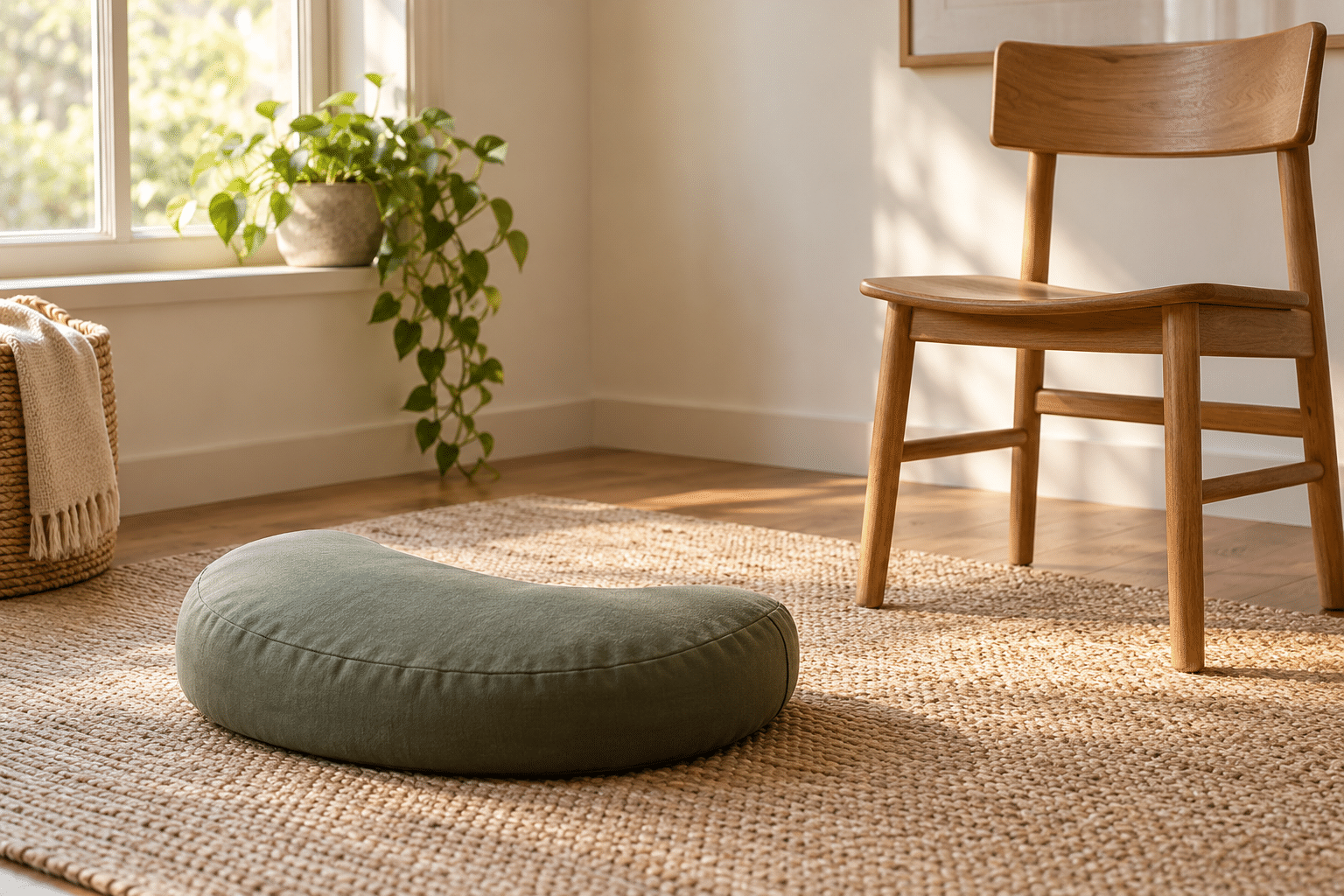
The shop item featured here is a crescent-shaped cushion with adjustable buckwheat-hull filling. That adjustability gives you something concrete to explore: a little more or less firmness, checked against how the seat actually feels. Follow its supplied instructions, keep the filling dry, and make changes gradually. A product description cannot decide your posture for you.
It is also worth separating an object’s symbolic role from a claim about its powers. A dedicated seat may represent intention, just as a notebook can represent a commitment to writing. That meaning comes from use. We do not need to claim that the cushion changes a hidden frequency, opens an energy center, or treats a health condition to appreciate its place in a thoughtful routine.
Build a place to return to
You do not need a separate room. One uncluttered corner can be enough. Put the seat on a stable, level surface and leave enough space to get up easily. Keep whatever you genuinely use within reach. A room can support practice without becoming another project that must be completed before practice is allowed.
Notice the temptation to keep improving the setting. Perhaps the light should be softer, the cushion a different color, the room more silent. Some adjustments help; others postpone the encounter with your own attention. Once the essentials are comfortable, let the imperfect room be part of the session.
A chair, folded support, or cushion is a means of making the pause workable. None is a badge of spiritual progress. If a position causes pain or numbness, change it rather than treating discomfort as proof of dedication. You can begin again in a position that makes more sense for you.
A short practice in arriving
For a first experiment, choose a brief period you can approach without bargaining with yourself. Take your seat. Let the hands rest. Notice where your body meets the cushion or chair. Allow the breath to follow its ordinary rhythm. Nothing needs to become unusually deep, slow, or impressive.
When a thought appears, see whether you can recognize it before following the whole story. When a sound interrupts, notice that hearing is happening. When you realize you have spent the last minute planning dinner, the realization itself is a return to attention. You have something to work with immediately.
This is a simple reflection inspired by the teaching, not a replacement for the teacher’s full instructions. Tergar’s beginner introduction similarly starts with a stable, comfortable posture and awareness of breathing. If you follow the video, take its sequence at your own pace and adapt the seating to your circumstances.
Three checks before you begin
First, check the surface. A seat that slides or rocks asks for attention every time you shift. Place it somewhere steady and make sure a blanket or mat underneath does not bunch unpredictably. Keep the surrounding floor clear. The point is to remove a small practical distraction, not to build a perfect sanctuary.
Second, check your expectations. Decide whether you are following the whole guided session or simply taking a brief pause. Either choice can be deliberate. Starting with an honest commitment is more useful than promising a long session while already planning an escape. Give yourself permission to learn what duration fits today.
Third, check how you will finish. Let the session end with enough time to move gently and look around before returning to the next task. Carry one observation with you: the feeling of contact, a sound in the room, or the moment you noticed a wandering thought. That small continuity matters more than preserving a special mood.
These checks can make the practice repeatable. They also keep the object in proportion. The seat supports the conditions; your attention discovers what happens within them. A useful purchase should serve that relationship, while an existing chair remains a completely valid beginning.
Let consistency remain ordinary
At the end, resist the urge to grade the session as good or bad. Ask a smaller question: what did you notice? Perhaps the body settled after a minute. Perhaps the room was noisier than expected. Perhaps you discovered how quickly a neutral sensation became a story about success or failure.
Write one sentence if it helps. Tomorrow, use that observation to make one sensible adjustment. This keeps the practice connected to reality. You are learning the difference between what supports attention and what merely looks like it should.
The cushion will still be a cushion when you stand up. Its quiet usefulness is that it can be there when you return. Take your place, allow the body some ease, and meet the next moment without requiring it to announce a transformation. Sometimes awakening begins with becoming available to an ordinary experience.