How would you measure the speed of a flash of light? The familiar answer seems almost too simple: record the distance, record the travel time, and divide. Yet the moment we place a clock at each end of the journey, another question appears. How do we know those distant clocks agree? That small complication opens a surprisingly deep conversation about measurement, time, and what an experiment actually establishes.
In Why No One Has Measured The Speed Of Light, Veritasium’s Derek Muller explores this puzzle with Destin Sandlin of Smarter Every Day. The provocative title needs its important qualification: the discussion concerns a one-way speed defined using separated clocks. Light’s round-trip behavior has been measured extensively. The useful invitation is to examine the assumptions inside a measurement, rather than treating the video as evidence that physics has lost its foundation.
The hidden question inside two clocks
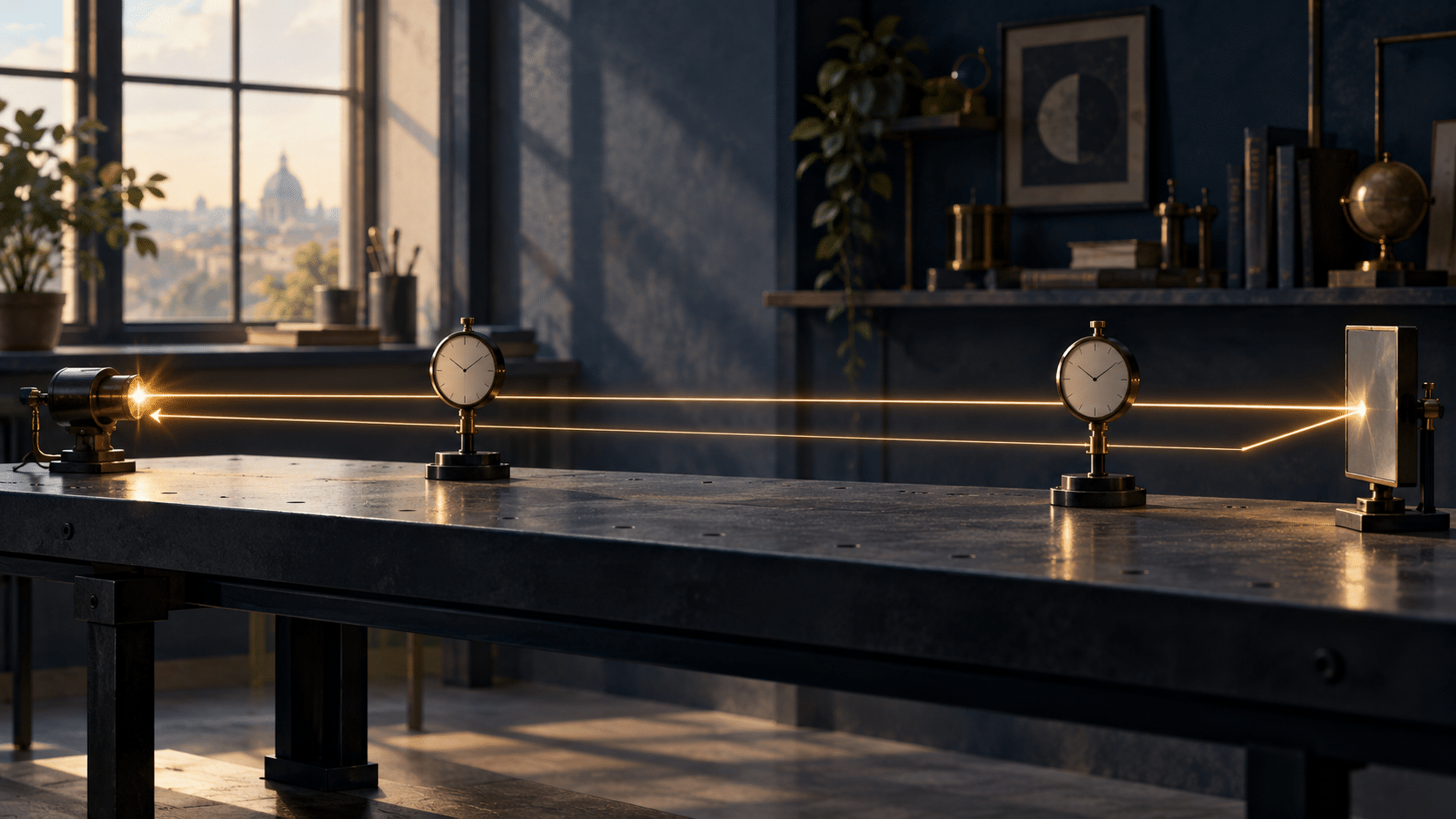
Imagine two recording stations beside a straight vacuum path. The first notes when a light pulse leaves; the second notes when it arrives. Subtracting those readings gives a travel time only after we have established a shared time convention. If the receiving clock is deliberately set a little ahead, the calculated journey appears longer. If it is set behind, the journey appears shorter. Perfectly precise clock mechanisms do not, by themselves, settle that difference in their settings.
Everyday timing usually lets us overlook such details. Two friends can agree to meet at noon without discussing the infrastructure that coordinates their phones. A physics experiment asks more of the arrangement. We must specify which events count as simultaneous at different locations, and how that relationship was established. The question becomes especially revealing when the signal used to synchronize the clocks is the very thing whose travel time we want to determine.
This is why a seemingly obvious measurement can contain a deeper definition. Before asking for a number, we need a clear account of the procedure that gives the number meaning.
What a round trip lets us establish
A mirror offers a simpler arrangement. Send a pulse from one station, reflect it at the other, and record its return using the original clock. The departure and return readings now belong to one clock at one location. With the path length known, we can calculate a round-trip speed without first coordinating two distant clocks.
Consider a deliberately simplified example: a signal travels out and back along two equal paths, and the entire journey takes six time units. The total establishes six units for the combined journey. Assigning three to each leg adds a symmetry convention. Assigning a different split would change how we label the distant reflection event, even while preserving the departure and return readings. The example is bookkeeping for understanding the question, not a claim that light has been observed behaving asymmetrically.
The International Bureau of Weights and Measures defines the metre using the fixed numerical value 299,792,458 metres per second for light in vacuum. Its 1983 resolution records the measurement work behind an earlier form of that definition. Precision in our units and clarity about synchronization address different parts of the same measurement problem.
Einstein made the convention explicit
The opening of Einstein’s 1905 paper, On the Electrodynamics of Moving Bodies, spends time defining simultaneity before developing its wider argument. He describes a light signal leaving one clock, reflecting near another, and returning. The clocks are synchronized by assigning the reflection the midpoint between the departure and return readings.
Under that rule, the outward and return journeys take equal times in the stationary coordinate system being considered. The rule makes distant time comparisons precise and usable. Reading the original discussion reveals a scientist laying out the construction of a concept that ordinary language tends to take for granted.
We should also distinguish a coordinate description from a new physical discovery. Changing the way distant times are assigned requires consistent changes throughout the description. It does not allow us to keep every familiar equation unchanged, announce that messages now arrive instantly, and claim a communication breakthrough. A different set of labels must still reproduce what observers can actually record and compare.
Follow the complete signal path
A useful habit when evaluating an experiment is to follow every route by which information reaches the measuring device. A detector may sit at the far end of a light path, while its electronic output returns through a cable. The final reading can therefore combine the outgoing optical journey, detector response, and returning electrical signal. Correcting those contributions requires justification.
Physicist J. Finkelstein made this point in a 2009 response to a proposed one-way measurement. He argued that treating the return cable’s delay as independently known imports a synchronization assumption into the analysis. Moving the information onto another carrier does not automatically remove the conceptual issue.
This provides a practical way to watch a demonstration. Draw the source, detector, clock, and every connecting path. Then ask what is measured directly and what is supplied through calibration or theory. A neat animation can make an argument easier to follow, but the argument still depends on these details. The most interesting point may be the quiet assumption that the animation leaves between its frames.
A convention leaves room for real tests
It would be a mistake to turn this puzzle into the claim that the directional behavior of light is beyond scientific investigation. Researchers can test precise physical models that predict observable differences. The important distinction is between relabeling time coordinates and proposing a change that alters measurable outcomes.
In a 1992 study of synchronization and light-speed isotropy, Clifford Will analyzed experiments using a test theory of special relativity. His published abstract explains that results expressed in measurable quantities can be independent of the global synchronization method. That is an important companion to a video focused on the conceptual puzzle: definitions deserve scrutiny, and experiments still impose constraints.
When a new claim appears, ask what observation would differ from the established account. Would a recorded interval change? Would a repeatable comparison produce a discrepancy? What uncertainty would the result carry? These questions help separate a physical proposal from an alternative description of the same events.
Let the question improve your way of looking
The broader lesson reaches beyond a beam of light. A statistic, rating, or comparison can look self-explanatory until we ask how it was constructed. Which events were counted? Which reference was chosen? Which adjustments were made? A number becomes more useful when its method is visible.
Try this with one claim that caught your attention today. Write down the observation separately from the interpretation, then identify the assumptions connecting them. Some will be well justified. Others may need checking. The exercise does not demand endless doubt; it gives your confidence a clearer foundation.
Veritasium’s question rewards that kind of attention. Watch the discussion, examine the clock arrangements, and return to the original physics. A familiar constant can lead us toward an unfamiliar question without losing the evidence that made the constant useful. For a truth seeker, that combination of wonder and careful definition is worth keeping.
Featured video: Why No One Has Measured The Speed Of Light — Veritasium.