A favourite cup rarely earns its place in our hands by being flawless. Its glaze may gather unevenly around the rim; its surface may have grown familiar through years of use. Yet we reach for it while the immaculate replacement waits on a shelf. What are we recognising in that ordinary object? The School of Life’s HISTORY OF IDEAS – Wabi-sabi opens a thoughtful doorway into this question through Japanese aesthetics, tea and the passage of time.
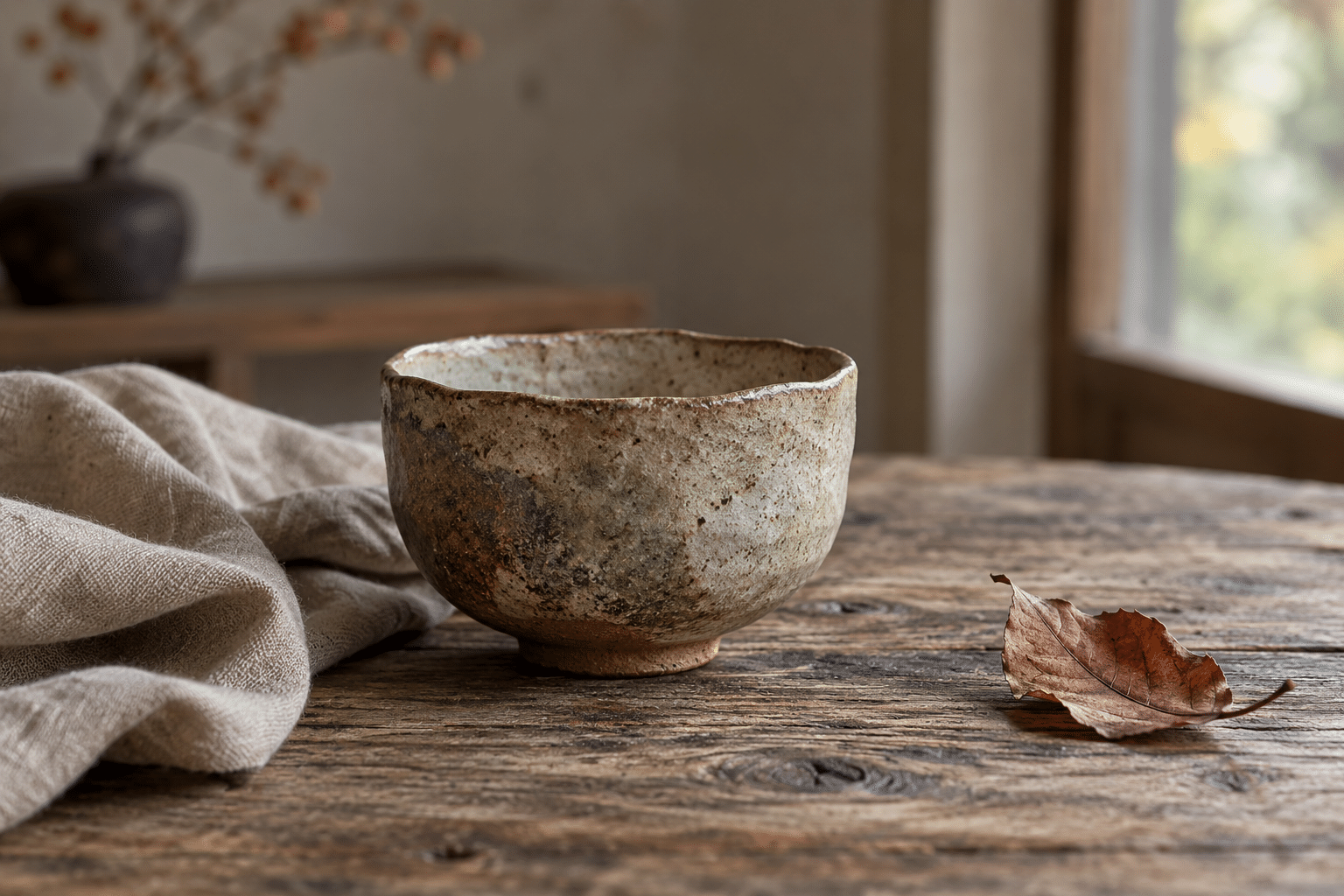
AI-generated editorial illustration inspired by wabi-sabi and the quiet beauty of everyday materials.
The film invites us to reconsider beauty that can be overlooked when polish becomes the only standard. Its subject also offers a practical question for daily life: how might we treat our surroundings differently if familiarity, careful use and modest character deserved more of our attention? The answer begins close to home, with what we already have and how we look at it.
1. Learning to Look Before We Judge
In its opening, the video introduces wabi-sabi through qualities such as impermanence, irregularity and the traces of age. These words describe an invitation to look closely. A bowl’s uneven outline might reveal a pleasing movement. A wooden tabletop might carry a record of shared meals. The same detail that seems distracting in a product photograph can become meaningful through living with an object.
Try separating observation from evaluation. Instead of immediately deciding that a surface is shabby, describe its colour, texture and shape. Ask where it has become smooth, where its edges have softened and what you notice when you turn it towards the light. This is an exercise in attention, with no requirement to like everything you see.
Such a pause makes room for a more personal vocabulary of beauty. Useful, comforting, distinctive and well-loved can sit beside elegant or pristine. We gain more ways to recognise value when a single ideal stops doing all the judging.
2. The Tea Bowl Has a Cultural History
The video’s discussion of tea, beginning around 2:32, provides a useful historical thread. The Metropolitan Museum of Art describes how sixteenth-century tea masters, including Sen no Rikyū, elevated rustic Korean and Japanese vessels alongside treasured Chinese ceramics. Its essay on the Japanese tea ceremony also explains that guests appreciate utensils as both functional objects and works of art.
A small surviving object makes this history tangible. The Met’s bamboo tea scoop attributed to Rikyū, dated to the 1580s, was carved from one narrow piece of bamboo. The museum connects his approach with modest utensils and simpler surroundings. The attribution matters: a museum record distinguishes what is known from what is associated with a historical figure.
These examples deserve to remain connected to their makers, practices and setting. We can learn from them without assuming that one phrase captures every Japanese taste or every person’s experience of beauty. Cultural curiosity becomes richer when it leaves room for detail.
3. Simplicity Requires Care
A quiet room can conceal considerable thought. Someone has chosen what belongs there, cleaned a surface, arranged a seat and considered the visitor’s comfort. In the Met’s Kyoto exhibition guide, the host’s selection of tea utensils helps establish a mood appropriate to a particular season or occasion. Simplicity emerges through decisions and attention.
This is a useful lens for our own spaces. Before buying another object to make a room feel peaceful, we might clear enough space to use the table comfortably. We might mend a loose seam, put a reading lamp where it is needed or give a familiar bowl a place where its shape can be appreciated. None of these choices requires an entirely new room.
Care also asks practical questions. Does the chair support someone properly? Can the cup be used safely? Does the room welcome the people who actually live in it? An attractive irregularity can be enjoyed while a harmful defect is repaired. Discernment belongs within the practice.
4. Making Room for the Marks of Time
Objects gather associations through repeated use. A cookbook may open easily at the meal you make for friends. A jacket may fit comfortably after years of wear. A notebook may become more useful because its crowded margins preserve earlier attempts. In each case, the relationship gives the object something its original appearance could never supply.
This can influence how we approach our own unfinished work. A first drawing does not need to be hidden because a more experienced artist would make different marks. A rough paragraph can remain on the page long enough to reveal the idea inside it. Keeping an early version can help us see what changed through practice.
There is no need to celebrate every loss or turn every difficulty into a beautiful lesson. Some things are painful, and some changes require help or action. The gentler possibility here is allowing ordinary incompleteness to exist without treating it as a verdict on our worth or our capacity to begin again.
5. An Everyday Practice of Attention
For a small experiment, choose one familiar object and give it a few uninterrupted minutes. Notice three details you would normally pass over. Then ask what makes it useful or meaningful to you. Its price, brand and suitability for a photograph can wait while you investigate the object itself.
Next, try one act of maintenance. Clean a tool, tighten a handle or repair something within your ability. If an item has reached the end of its useful life, deciding to release it can also be thoughtful. Appreciation does not oblige us to keep everything indefinitely.
Finally, leave room for an experience that will not be preserved perfectly. Share a meal without rearranging every plate for a picture. Sketch a view without correcting every line. Sit with a friend without turning the conversation into something productive. These are everyday exercises inspired by the article’s theme; they are not instructions for performing a traditional tea ceremony.
6. A Different Measure of Enough
Near its conclusion, the film brings its aesthetic question back to ordinary life. That is where the subject becomes most useful: at the point where an idea changes what receives our attention tomorrow. We can notice the character of a familiar room, enjoy a handmade object or begin a creative project before feeling fully prepared.
The invitation does not demand a new collection of carefully imperfect possessions. It can begin with a question: what deserves more care among the things already here? Consider the work waiting on your desk, the object you were about to replace or the person whose company has become so familiar that you forget to pay attention.
Beauty can emerge through that renewed relationship. A cup remains a cup, a room remains a room, and a day still contains unfinished tasks. Looking more carefully may be enough to make their particular qualities visible.
Video credit: HISTORY OF IDEAS – Wabi-sabi, The School of Life. This article offers independent reflection alongside historical context from The Metropolitan Museum of Art.