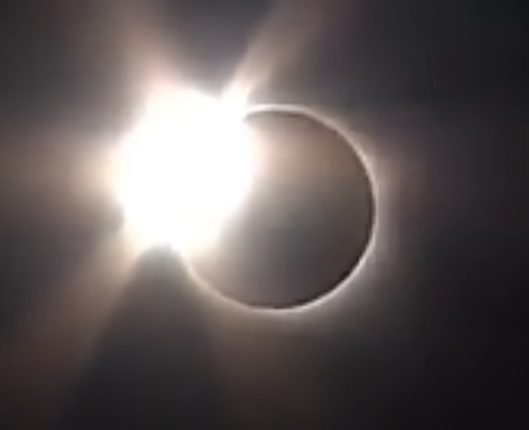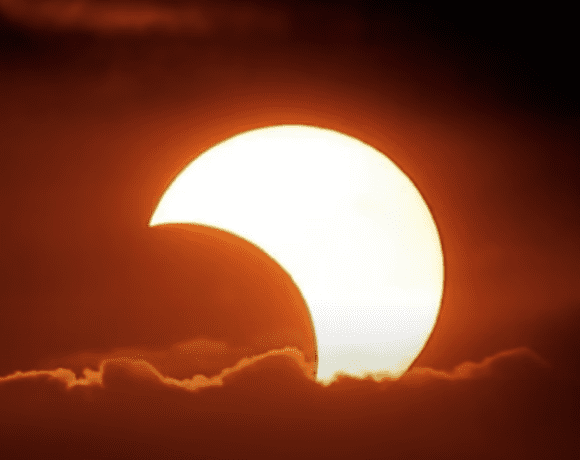
A lunar eclipse near the horizon can make a familiar explanation feel suddenly strange. If Earth is casting its shadow on the Moon, how could someone also see the Sun? It is a reasonable question to pause over, especially when a simple diagram seems to say the two sights cannot belong together.
The phenomenon has a name: selenelion. It describes seeing the Sun and an eclipsed Moon above opposite horizons at the same time. Eric Dubay’s How Eclipses Work on Flat Earth uses this observation to challenge the globe model. The useful next step is to separate the observation from the conclusion being attached to it.
This article examines that particular argument. Earth’s approximately spherical shape is established through measurement; NOAA explains why a slightly flattened ellipsoid describes it more accurately than a perfect sphere. Taking a question seriously means allowing the evidence to answer it, even when that answer differs from the video’s suggestion.
The claim behind the apparent contradiction
In the description accompanying his video, Dubay argues that simultaneous visibility of the Sun and eclipsed Moon invalidates the explanation of a lunar eclipse as Earth’s shadow. He acknowledges the usual explanation involving atmospheric refraction but dismisses it as implausible. The description instead presents eclipses as interactions of the celestial lights without Earth causing the lunar shadow.
That gives us a specific proposition to examine. We need to ask whether a person’s apparent view of a body near the horizon exactly matches its geometric position. We also need to ask how much detail a three-object sketch leaves out. A diagram can be correct for its purpose while remaining too simplified to settle every observing question.
Keep those questions beside you as you consider the featured argument. A confident objection becomes more useful when it identifies a measurable disagreement, rather than treating the feeling of a contradiction as the final result.
What a lunar eclipse involves
NASA’s lunar-eclipse guide describes the Moon moving through Earth’s shadow at full Moon. A partial eclipse takes the Moon through only part of the darker inner shadow, or umbra. During totality, some sunlight passing through Earth’s atmosphere still reaches the lunar surface, producing its reddish or orange appearance.
The Moon’s ordinary phases should not be confused with these events. The changing portion of its sunlit surface visible to us produces the familiar monthly sequence; an eclipse involves the additional alignment that places it in Earth’s shadow. Keeping the two processes separate avoids importing an unrelated explanation into the discussion.
For this question, the important challenge is narrower than choosing an entire cosmology. Can an eclipsed Moon and the Sun appear above an observer’s horizons within the established geometry? That requires considering the view from the observing site, including the atmosphere through which the light arrives.
The horizon is an optical boundary too
The U.S. Naval Observatory’s rise-and-set definitions explicitly include atmospheric refraction. Its standard calculations use an average horizon correction of 34 arcminutes, just over half a degree. Refraction makes a celestial body appear higher than its geometric direction would suggest.
Sunrise and sunset also refer to the Sun’s upper edge, not its centre. The disk’s size therefore matters. Moonrise and moonset calculations include additional complications, including the Moon’s parallax. Observed times vary with atmospheric conditions, local obstructions and observer height.
These details appear in ordinary astronomical calculations, whether or not an eclipse is happening. They give us something concrete to inspect. A drawing that omits them cannot, by itself, rule out simultaneous visibility. The question is whether a calculation appropriate to a particular place and event matches what observers record.
An observing report with an unsuccessful attempt
A useful example comes from J. Kelly Beatty’s 2010 Sky & Telescope account. Watching a partial lunar eclipse near Tucson, he hoped to see the eclipsed Moon and rising Sun together. His attempt failed. Another observer, Ray Brooks, reported success from a mountaintop.
Beatty discusses refraction, the Moon’s movement after mid-eclipse and the benefit of a lower visible horizon from elevation. The contrast between the attempts makes the report valuable. It preserves the practical obstacles instead of suggesting that every observer should see the same thing.
A failed observation deserves a place in the notebook. If a hill hides the Moon before the Sun becomes visible, record the hill. If clouds interrupt the view, retain that information. Removing inconvenient conditions from an account makes the story cleaner but the evidence weaker.
Turn the question into an observation plan
Before planning a selenelion attempt, establish whether a lunar eclipse will coincide with sunrise or sunset at your chosen location. The U.S. Naval Observatory’s data services provide eclipse information and Sun-and-Moon timing tools. Do the comparison before travelling, and avoid assuming that a photograph taken elsewhere predicts your view.
For a useful record, prepare a short checklist:
- Place: record the observing location, elevation and any buildings, trees or ridges along both horizons.
- Time: use a checked clock and note its time zone. Record when each observation was made.
- Visible detail: distinguish a thin upper edge from an entire disk. Describe what you actually saw.
- Conditions: note clouds, haze and interruptions. Keep original photographs alongside any edited copies.
- Prediction: save the calculation you consulted beforehand, including its assumptions, rather than selecting a prediction after seeing the result.
If two people compare observations, agree on those details in advance. “I saw both” is an interesting beginning. A timed record with a clear location and an unobstructed view offers much more to examine. Equally, do not turn an uncertain glimpse into a precise measurement simply because it supports a preferred explanation.
When reviewing someone else’s footage, ask the same questions you would ask of your own. Does the recording identify the date and location? Can you tell whether two views were taken at the same time? Is the horizon visible, and are any parts of the sequence missing? Those questions do not presume dishonesty. They establish what the recording can support. A beautiful image may document an experience without supplying every detail needed to test the explanation attached to it.
Protect your eyes before looking
Never look directly at the Sun without appropriate solar-viewing protection, even near the horizon. Ordinary sunglasses are inadequate. Follow NASA’s solar-viewing safety guidance and use suitable, undamaged viewers meeting ISO 12312-2 for direct viewing.
Do not look through binoculars, a telescope or a camera lens while wearing eclipse glasses. Optical instruments require proper solar filters secured over their Sun-facing ends. If you are unfamiliar with safe solar equipment, observe with an experienced astronomy group rather than improvising.
Let the observation remain interesting
Selenelion is worth learning about because it rewards attention to the difference between an apparent view and a simplified sketch. The observation does not establish a flat Earth. Atmospheric optics and eclipse geometry provide a supported explanation for why the apparent contradiction can occur.
You can enjoy the surprise without demanding that it overturn everything else. Read the claim, check the assumptions and preserve enough detail for someone else to examine the result. Curiosity becomes more rewarding when it leaves room for an explanation to change your mind.