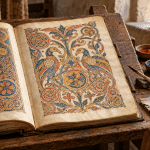
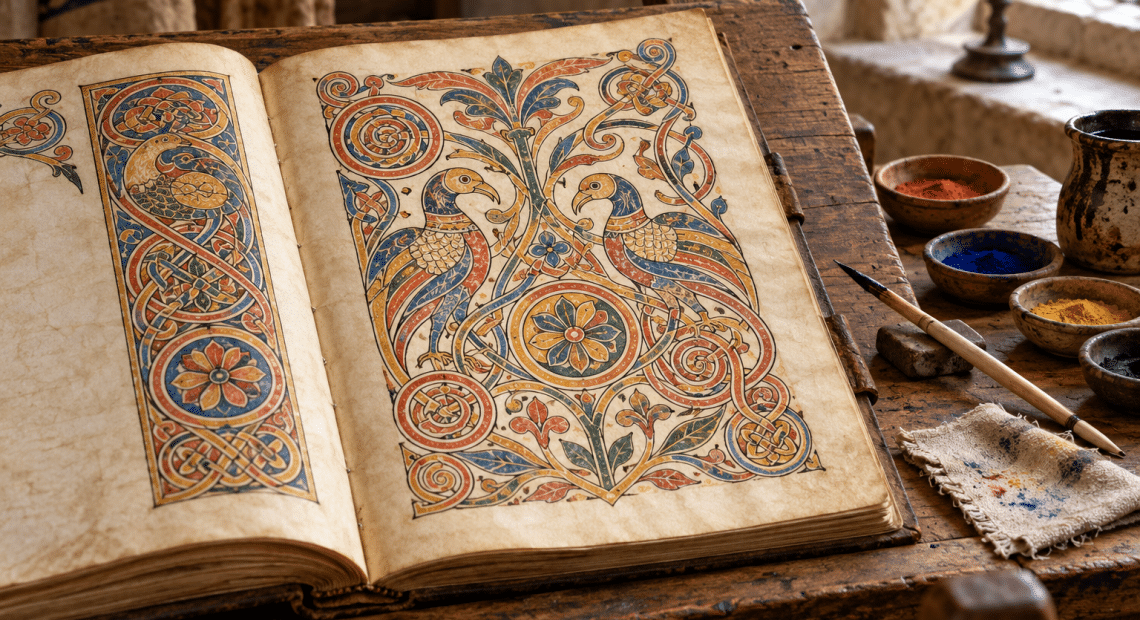
At first, an illuminated manuscript can look like a wall of decoration. A large letter breaks into spirals; a border becomes a creature; a tiny shape reveals itself as a bird. Your eyes move quickly, looking for the single detail that will explain the whole page. The Book of Kells rewards a different pace.
It invites us to look closely without pretending that close looking unlocks every meaning. The book belongs to a particular Christian world, with a history that can be studied and questions that remain unresolved. For a reader interested in awakening and attention, its value need not depend on a hidden code. The visible work is already astonishing.
Begin with the book that survives
The Library of Trinity College Dublin’s collection record identifies the Book of Kells as MS 58, a Gospel manuscript written close to the year 800. It contains the four Gospels in Latin and survives in 340 vellum leaves. A leaf has two sides; the number is not a count of modern pages.
Its place of production remains debated. Trinity describes the strong association with the monastic community of Iona and the manuscript’s later home at Kells, while acknowledging uncertainty about where the work was completed. A careful account can preserve that uncertainty. We do not improve the history by turning a plausible reconstruction into an eyewitness report.
In the Smarthistory video above, Dr. Lauren Kilroy and Dr. Steven Zucker discuss the manuscript’s elaborate pages, Gospel imagery and interlaced ornament. Their conversation provides a useful introduction to what looking can reveal. Watch how they move from an overall form to details that a first glance easily misses.
Decoration that changes the act of reading
A printed book usually makes its structure feel ordinary. Type repeats, margins settle into a rhythm, and the opening of a chapter can be recognized quickly. A decorated manuscript can make the beginning of a passage into an event. A letter becomes a field of shapes that asks you to pause before reading onward.
The celebrated Chi Rho page develops the opening letters of Christ’s name into an elaborate composition. In its Christian context, such ornament belongs to a sacred text and a devotional purpose. We can appreciate the visual intricacy while recognizing that religious significance is part of a tradition’s interpretation, not a property that every viewer must experience in the same way.
Look at a small area before trying to name everything. Follow the edge of one line. Notice where it crosses another form and where your attention loses it. Then look again at the whole. This simple movement between part and whole can reveal how quickly the mind substitutes “I have seen it” for the slower experience of actually observing.
Symbols need their setting
Animals, crosses, letters and intertwined patterns do not become understandable merely because we recognize their shapes. Their placement matters. So do the text, artistic conventions and religious setting around them. A bird in one composition need not carry precisely the same significance as a bird in another work centuries or continents away.
This is where curiosity benefits from restraint. Similar patterns across cultures can raise interesting questions; similarity alone does not demonstrate a secret common organization or a single lost doctrine. Ask first what the particular object and its documented setting support. An explanation should become more precise as evidence accumulates, rather than becoming grander as the evidence thins.
The same discipline applies to our personal response. You may find a pattern peaceful, restless or difficult to follow. That experience is yours to describe. It does not establish what an unnamed artist intended. Keeping those two kinds of statement separate makes room for both scholarship and an honest encounter with the page.
Material evidence can revise an attractive story
The video’s account of blue pigment offers a useful example of why sources should be compared. It mentions lapis lazuli imported from Afghanistan. Trinity’s collection record instead reports research indicating that lapis lazuli was probably not used, and identifies indigo or woad as sources of blue. The older explanation should not be repeated as an established fact.
That correction does not make the manuscript less remarkable. It changes the question we ask about it. Rather than measuring importance through the distance a pigment supposedly traveled, we can look at the skill with which available materials were used. Evidence can remove a dramatic detail while leaving the achievement fully intact.
It can also reveal vulnerability. A manuscript is a physical object, subject to handling, changes of binding and the behavior of its materials. Care is not only an attitude of admiration. It involves decisions about preservation and access, so that an object can remain available to people who have not yet had the chance to encounter it.
A practice in looking without rushing to own
Choose one image from a reliable presentation of the manuscript. Spend a minute describing only what you can see: a color, a line, a repeated shape, an interruption. Avoid beginning with a theory. If you cannot identify a creature or a letter confidently, make the uncertainty part of your description rather than filling the gap with a confident guess.
Next, read the accompanying explanation. Which part of your observation does it support? Which part needs revision? You may discover that what seemed decorative also relates to a passage, or that a detail you took for a separate object belongs to a larger form. Let the new information sharpen the looking instead of replacing it.
Finally, return to the image without the pressure to finish understanding it. Notice one feature you did not see earlier. This is a modest exercise, but it gives curiosity a useful shape: observe, consult, revise, look again. It leaves room for knowledge to grow without requiring an immediate claim of mastery.
Carry the patience beyond the manuscript
There is another temptation worth noticing: turning admiration into an instant demand on yourself. You see extraordinary craftsmanship and decide that your own work must immediately become equally intricate or disciplined. The comparison overlooks the distance between a surviving masterpiece and the many ordinary attempts through which any craft develops. Let the page prompt one careful act rather than a promise of sudden perfection.
You might revise a paragraph more thoughtfully, repair an object you use, or spend a little longer listening before you answer. None of those acts reproduces a medieval scribe’s life. They are present-day applications of your own response to the work. Naming them that way protects the difference between learning from history and claiming that history was created to teach our preferred lesson.
The Book of Kells does not need to become a universal manual for modern life. Its particular history deserves respect. Yet the practice of attending to it can remind us of something ordinary: a first impression rarely exhausts what is present. Another person, a familiar place or a page of writing can also repay a second look.
When you leave the image, keep the habit rather than a grand conclusion. Describe before explaining. Distinguish evidence from the story you prefer. Allow a correction to deepen your interest. Awakening, in this practical sense, can begin with giving something enough attention to let it become more complicated than it appeared at first.