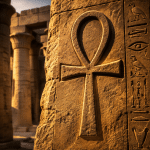
A loop, a crossbar, and a descending stem: the ankh is easy to recognize even when we know little about the culture that gave it meaning. On a wall, its silhouette can stand alone. In ancient Egyptian objects, however, it often belonged to a larger visual language.
Understanding that language gives a decorative piece something more interesting than a mysterious appearance. It connects the shape to a word, to particular objects, and to people who used symbols to express ideas about life and divine authority.
Atum’s “The Ankh – The Symbol of Ancient Egyptian Religion” offers a starting point. Its published chapters move from the word’s meaning through temple art, afterlife beliefs, amulets, competing origin theories, and modern culture. Museum collections provide concrete objects with which to explore those themes.
A symbol that was also a word
The ankh was part of Egyptian writing. The Metropolitan Museum of Art explains that it could write words meaning “live,” “alive,” or “life,” and also functioned more broadly as a symbol of life.
That relationship matters. An ankh is not simply a decorative shape to which modern viewers have attached a meaning. Its connection to life is documented in its historical use.
At the same time, recognizing one sign does not mean we can translate every composition containing it. Its position, the surrounding signs, and the object’s purpose all help determine what a particular arrangement communicates.
A useful first step is therefore to identify the familiar outline. The next is to look around it.
Meet an actual ancient ankh
One example is the Met’s Ceremonial Implement in the Shape of an Ankh, object 30.8.29.
The museum dates it to approximately 1396–1386 BCE, during the reign of Thutmose IV. Its record identifies the material as faience and the findspot as the king’s tomb, KV43, in the Valley of the Kings.
These details turn a general symbol into a particular historical object. It has a material, a recorded location, and a place within a chronology. Its dimensions and photographs can be examined alongside the museum’s description.
For a modern viewer, this is a helpful habit: move from an appealing shape to an identifiable example. An object record offers firmer ground than an image circulating without a caption.
Reading the signs together
The Met’s Pectoral and Necklace of Sithathoryunet with the Name of Senwosret II demonstrates how the ankh could work within an elaborate composition.
Dating to approximately 1887–1878 BCE, the pectoral places two ankh signs beside the king’s name. Cobras, falcons, a sun disk, and other elements contribute to its meaning. The museum interprets the design as a statement about the king receiving life and dominion within a divinely sustained order.
The ankh participates in that message rather than supplying the whole message by itself.
This makes the pectoral a useful companion to a modern wall ornament. A contemporary design may isolate one sign for visual clarity. The ancient example invites us to notice how much additional meaning a surrounding arrangement could carry.
Life alongside stability and dominion
Another Met object combines the ankh, djed, and was signs, associated respectively with life, stability, and dominion.
The museum discusses their use together as a combination of wishes offered between king and deity. It also considers a possible relationship between this type of object and New Year offerings.
The qualification matters: the catalogue presents aspects of that interpretation as uncertain. A careful account should retain that uncertainty rather than turning a possible function into a fixed rule.
This example also discourages treating Egyptian symbolism as a collection of interchangeable icons. Each element contributes something. Learning the distinctions makes a composition more readable and rewards looking beyond the most recognizable shape.
Why does the ankh have a loop?
The meaning of the sign and the origin of its shape are separate questions.
The Global Egyptian Museum’s glossary identifies the Egyptian word’s meaning as life and suggests that the sign may depict a stylized sandal strap. Other proposed explanations appear in discussions of the symbol’s origins.
Atum’s chapter beginning at 9:03 is devoted to different theories about the shape. A theory can be worth considering without being established.
When encountering an explanation, ask what supports it. Is there an early representation, a linguistic connection, or a documented comparison? Or does the argument rely mainly on visual resemblance?
A shape can resemble several things. Historical evidence helps determine which resemblance deserves weight.
Watch illustrations and artifacts differently
The video’s credits disclose a mixture of sourced visual material and some AI-generated images that were subsequently edited.
Illustrations can help explain an idea. They should not be mistaken for photographs of excavated objects or evidence that a particular ancient scene existed.
When an image catches your attention, look for an identifiable object, museum, or publication. A catalogue number is especially useful because it lets you inspect the source independently.
For the objects discussed here, the linked Met records provide photographs and documentation. You can compare the actual artifact with the broader story without needing to accept every visual representation as historical evidence.
From ancient object to contemporary wall art
The Egyptian Ankh Wall Art at Flat Earth Shop brings this recognizable form into a contemporary decorative setting.
Its description as having an antique copper finish should be read carefully. A finish describes an appearance or surface treatment; it does not establish that the piece is an ancient artifact or made from solid copper.
Likewise, a modern object using an ancient symbol is not automatically a reproduction of a specific museum piece. Unless a maker identifies a documented prototype, “Egyptian-inspired” is a more careful way to understand the relationship.
The historical interest lies in the symbol and the questions it opens, alongside the design of the present-day object.
Give the design room to be seen
For display, start with ordinary visual considerations. A plain background can make the loop and crossbar easier to read. Allowing some space around the piece helps its outline remain distinct from neighboring decorations.
Consider the viewing distance, the wall’s color, and the direction of light. These are design choices, not ancient instructions or claims about spiritual effects.
Before installation, check the actual item’s dimensions, mounting provisions, and supplied instructions. Choose support appropriate to its weight and the wall surface.
If you display several Egyptian-inspired motifs together, learning each one’s identity can turn the arrangement into a small, ongoing study rather than a collection of vaguely related shapes.
Personal meaning can stay personal
Someone might choose an ankh because it reminds them to value life, because they are interested in Egyptian history, or because they appreciate its proportions. Those are contemporary reasons for choosing an object.
They need not be presented as the intentions of every ancient person who encountered the sign.
A useful distinction is to say, “This reminds me of renewal,” when describing your own response, and to use historical sources when describing an ancient belief or practice. Both forms of meaning can be discussed clearly.
The same care applies to claims that a decorative object produces physical protection or measurable health effects. Symbolic significance does not establish those outcomes.
Let a familiar shape invite a closer look
The ankh offers an accessible entrance into a much larger subject. One recognizable sign leads to questions about writing, materials, royal imagery, and the ways objects communicate.
A wall piece can keep that curiosity visible. The most rewarding next step may be to open a museum record, examine the surrounding signs, and learn why a particular object was made.
The outline remains simple. The history becomes richer the longer you look.