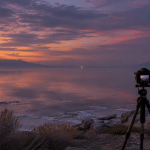
A light flashes across the Great Salt Lake. Observers recognize the signal, excitement builds, and a difficult night’s experiment appears to deliver the result they hoped to see.
That moment is the appeal of Taboo Conspiracy’s “Great Salt Lake Laser Test – 21 Miles and No Curvature.” It presents a hands-on challenge to the globe model through a long-distance observation over water.
The question deserves a precise investigation. What was observed? Which dimensions were measured or estimated? What could the setup distinguish? The video’s account contains useful details for examining those questions, including limitations described by the presenter himself.
Earth’s approximately spherical shape is well established. A particular sighting can still challenge an incorrect calculation or an assumption about the conditions. The task is to identify which claim the observation actually tests.
The reported route and endpoint heights
At approximately 1:37–2:16, the presenter dates the test to January 16, 2021, and identifies Antelope Island and Great Salt Lake Marina as the endpoints. He reports 21.03 miles between them and cameras and lights approximately five feet above the water.
Those are reported values, not independently confirmed survey measurements.
The difference matters because the conclusion depends on the geometry. A reproducible account would provide coordinates, the method used to measure the distance, and the height measurements at both ends. It should also state how accurately those values were known. The video supplies coordinates for the presenter’s position and describes the distance as calculated using Google Maps; independently checking the endpoints remains a separate task.
“Approximately” can be entirely reasonable in a field report. However, uncertainty needs to travel through the calculation. If the setup permits a range of heights, the prediction should reflect that range rather than becoming a single exact-looking number.
Following the obstruction calculation
Around 4:45, the presenter gives a predicted hidden height of 223 feet at the opposite shore, then subtracts the light’s five-foot elevation to reach 218 feet.
To evaluate that argument, first identify what the calculator predicts. A drop below the tangent at one endpoint differs from the height hidden beyond an elevated observer’s horizon. Neither should be confused with the water’s height relative to a line joining two elevated endpoints.
The description links a calculator with inputs of 21.03 miles and a five-foot observer height. Entering those figures documents a calculation, but does not verify the field measurements or establish the atmospheric assumptions.
A useful check would reproduce the calculation, label its reference lines, and show how its answer changes when the input heights vary. Readers should be able to trace every number back to either a measurement or an explicitly stated assumption.
Darkness, temperature, and an interrupted plan
Around 6:05–6:27, the presenter describes rapidly falling temperature after dark, unavailable phone communication, initial mis-aiming, and his son spotting the distant light.
These details make the experiment easier to understand. Fieldwork rarely unfolds exactly as planned. They also identify uncertainties that a conclusion needs to address.
Without reliable communication, observers have fewer ways to coordinate equipment changes, synchronize records, or confirm which configuration produced a particular sighting. A recognizable sequence of flashes can help identify a source, but precise timing and simultaneous footage would strengthen that identification.
Changing temperature is also relevant to an optical experiment over water. An observation should be connected to the conditions during that observation, rather than to a general description of the day.
What the successful sighting establishes
At approximately 8:15, the presenter interprets the sighting as direct line of sight. Around 8:38, he says the communication problem prevented additional tests.
A clearly identified distant source is a real observation worth documenting. However, detecting its light does not by itself determine the path that light followed.
This is where a single yes-or-no result becomes limiting. A camera recording brightness at one location supplies less information than a set of targets with known heights and distances. Additional observations could help establish how apparent positions changed as the camera moved or conditions varied.
The tests that could not be completed should remain an acknowledged limit. They cannot be assumed to have produced the same result as the test that was recorded.
Is the source a laser?
The creator’s description introduces the equipment as “My laser,” but the linked product name describes a blue LED flashlight. This discrepancy needs clarification. It does not establish that every device used at both endpoints was an LED.
An equipment record should identify each source separately. It should include its operating settings, beam characteristics, mounting, and alignment method.
A broad light source can send light in many directions. A laser also has finite beam width and divergence. In either case, seeing light is not enough to show that the camera lies on a precisely established horizontal central ray. The source’s actual characteristics belong in the analysis.
Examining the refraction argument
Around 9:37, a visible section of beam is presented as straight. Near 11:42, the presenter rejects atmospheric refraction; the account does not supply a measured atmospheric profile along the route.
A short visible segment cannot establish the path’s geometry over the entire distance. A photograph also needs sufficient scale and resolution to reveal a small deviation.
The Te Awamutu Space Centre explains that atmospheric refraction and beam divergence complicate long-range light observations. Conditions near the water can alter light paths, while a spreading beam complicates identifying its center.
That does not make the word “refraction” a complete explanation for this particular sighting. A detailed explanation would need to state what atmospheric conditions it assumes, why they are plausible, and whether they quantitatively account for the observation.
Both interpretations need that discipline. Neither an unmeasured atmospheric effect nor an assumption that the effect is negligible should be presented as a finished analysis.
Designing the next test
A stronger follow-up would establish its predictions before collecting the result.
Document the locations and heights, identify both light sources, and arrange dependable communication. Synchronize cameras and preserve unedited footage. Record environmental conditions and distinguish local measurements from assumptions about the rest of the path.
Then add observations that can separate competing explanations. Multiple targets at measured heights and distances provide more information than one bright source. Repeating observations under different conditions can reveal whether the apparent geometry is stable.
The Rainy Lake experiment report is a useful comparison. It describes multiple targets, surveying data, model predictions, and a refraction analysis. Its authors report findings consistent with curvature and provide material readers can inspect.
The point of the comparison is methodological: a persuasive test makes its measurements and reasoning available for independent checking. Any field test must also respect eye safety and local rules, without directing bright lights toward people, vehicles, boats, or aircraft.
Where the conclusion outruns the observation
Around 12:39, the presenter extends the lake result to water generally and declares the globe false.
That conclusion requires more than this record establishes. The test reports an interesting sighting, but uncertainties remain about the equipment, measurements, and optical conditions.
A fair assessment can recognize the effort involved and the value of documenting practical difficulties. It can also keep the conclusion proportional to what was measured.
The most productive next question is specific: under which measured conditions would the competing models predict clearly different outcomes? Designing around that question would turn the excitement of a distant flash into a stronger experiment.