A quiet practice can begin with something very small: a place to sit, a sound you enjoy, and a few minutes you have decided to keep for yourself. You do not need to create a perfect room or wait for a perfectly clear mind. The ordinary room, with its unfinished tasks and familiar distractions, is enough to begin.
The Meditative Mind recording above, OM Chanting + Tibetan Singing Bowls Meditation @ 432Hz, offers one possible setting. Its one-hour length leaves room for an extended session, but you can choose a shorter interval. Here we will use it as a companion to a simple home practice, while keeping its musical presentation, the religious meaning of Om, and any claims about health clearly separate.
Give the practice a clear beginning
It is easy for a meditation recording to become another sound playing behind everything else. You might start it while scrolling, answering messages, and thinking about what comes next. There is nothing wrong with enjoying background music. A deliberate practice simply asks for a different arrangement: choose a brief period when listening has your attention.
Put the phone somewhere you will not keep reaching for it. Sit on a chair or cushion that feels comfortable. Let your hands rest. Choose a comfortable, modest volume before you settle in. There is no need to make the sound powerful enough to fill every corner of the room.
Try five minutes the first time. That is a suggested starting point, not a therapeutic dose or a test of discipline. If you prefer less, use less. A practice that fits your actual life is easier to return to than an elaborate routine you continually postpone.
Meet Om with some understanding
Om has a sacred place in Hindu traditions; it is far more than a convenient syllable for a relaxing soundtrack. The Hindu American Foundation’s introduction to Om explains its relationship to Hindu philosophy, contemplation, and understandings of ultimate reality. Such meanings belong to religious and philosophical traditions. They should be presented in those terms, rather than turned into a laboratory claim about a measurable universal frequency.
You can approach the recording with respect whether you share that faith, are learning about it, or simply wish to listen. You do not need to imitate a religious practice you do not understand. Listening quietly is a complete option. If you choose to chant, do so gently and comfortably, without trying to match another person’s pitch or stretch your breath.
The title’s reference to Tibetan singing bowls does not make every element of the recording part of a single ancient ceremony. Contemporary recordings often bring different sounds and traditions together. Enjoying that combination and acknowledging its distinct roots can sit comfortably side by side.
Let one sound be enough
For the first minute, choose one part of what you hear. Perhaps it is a sustained voice, a ringing tone, or the changing space between sounds. You do not have to identify every layer. Listen to its beginning, its continuation, and the moment your attention moves elsewhere.
When a thought arrives, you can notice that too. Maybe you remember a message you need to answer. Maybe you begin judging whether the session is working. Rather than argue with the thought, return to the sound you selected. You can repeat this many times without treating the repetition as a failure.
A useful question is simply, “What can I hear now?” There is no special answer to discover. The question points back to an experience already available, before you start measuring it against a description of someone else’s spiritual life.
If you have a singing bowl
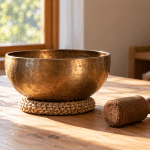
A physical bowl can provide a clear opening and closing gesture. Follow the instructions supplied with your particular instrument, place it on a stable surface, and begin with a gentle strike. Let the sound fade before deciding whether to play again. You can pause the recording while you do this, so the bowl does not need to compete with it.
Try starting with one tone, sitting quietly for a few minutes, then finishing with another. This is a suggested personal routine, not a claim about how a particular religious lineage uses its instruments. Keep the distinction clear, especially if you share the practice with others.
If you want a bowl for a home listening space, explore Flat Earth Shop’s Tibetan singing bowl collection. Compare the individual descriptions, dimensions, included accessories, and delivery eligibility before choosing. The bowl you buy should not be assumed to reproduce this recording’s exact sound or tuning. You can also begin with the recording alone and decide later whether a physical instrument would add something you value.
What to make of the 432Hz label
The creator labels this recording “432Hz.” That is information about how the track is presented, not independent verification of every tone in it or a guarantee of a particular effect on the listener. You may enjoy its character, while another recording suits you better on a different day.
There is no need to make your enjoyment depend on a claim that one number heals the body, clears every emotional difficulty, or unlocks a hidden ability. Notice your own experience without turning it into a promise for everyone else. “I like listening to this” is already an honest and useful observation.
A simple session to try
- Arrive: choose a comfortable seat and a short, realistic interval.
- Listen: start the recording at a comfortable volume, or begin with one gentle bowl tone.
- Return: when distracted, bring your attention back to one sound without grading yourself.
- Leave some space: finish with a brief quiet pause instead of immediately opening another app.
- Continue your day: choose the next ordinary thing you need to do and give it your attention.
If chanting feels natural, include a little. If it feels awkward, you can listen instead. If the experience feels uncomfortable or upsetting, stop rather than forcing yourself through it. You are allowed to keep your eyes open, change your position, or choose another activity.
Keep the benefits in proportion
The National Center for Complementary and Integrative Health describes meditation as a range of practices, some using a sound or mantra as a focus. It also cautions that research on possible harms is limited and negative experiences can occur. Findings about particular meditation programs do not establish the effects of this recording or any singing bowl sold alongside it. Use a listening practice as a personal activity, not a replacement for needed healthcare.
Perhaps the most worthwhile change is modest: you made room for a few deliberate minutes. You listened, noticed when you wandered, and returned. Tomorrow the room may be noisy, your thoughts may be busy, and the session may feel different. You can still begin with one sound and give it your attention.