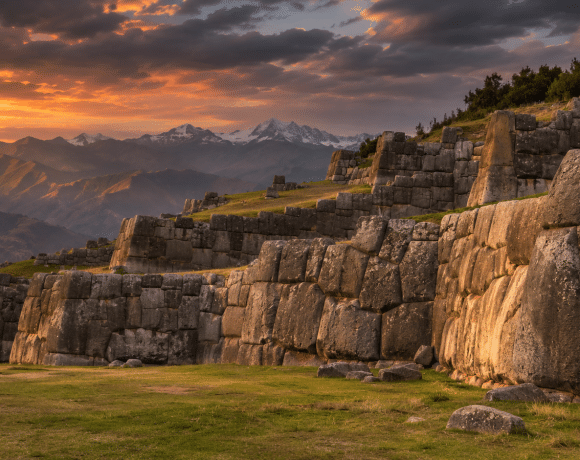
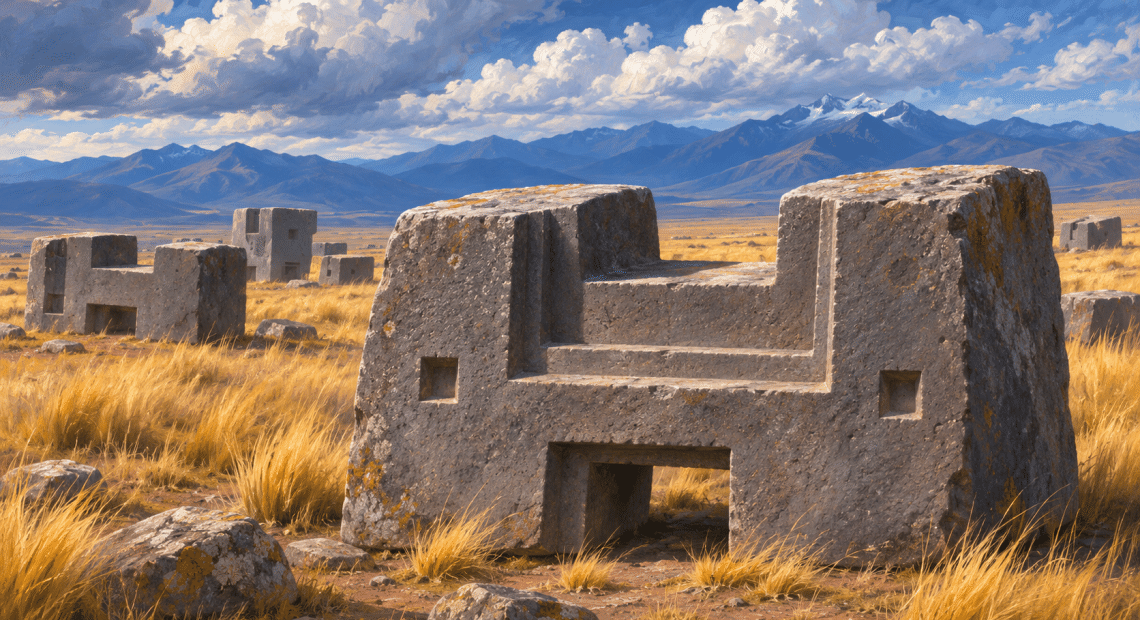
Puma Punku draws the eye toward details: a sharply defined recess, a carefully shaped corner, a block whose purpose is difficult to imagine once it has been separated from a building. Those details invite a fair question. What did the people who made them know, and how much of that knowledge can we recover?
UnchartedX takes that question into alternative history in The Ancient Enigmas of Puma Punku and Tihuanaco! The original June 23, 2019 upload introduces the Bolivian monuments through the creator’s interest in precision stonework. His accompanying description argues that their workmanship is difficult to explain within conventional history. That is the starting argument for this discussion, rather than an established conclusion about the builders.
The most rewarding way into Puma Punku is to keep looking after the first impression. Admiration can lead toward measurements, archaeological records and competing explanations. It need not end with either immediate disbelief or immediate acceptance.
First, put the stones back in their setting
Puma Punku belongs to the archaeological landscape of Tiwanaku. UNESCO describes Tiwanaku as the capital of a powerful pre-Hispanic civilization, reaching its height between AD 500 and 900. Its account places the development of the planned city between approximately AD 400 and 900, while recognizing structures from different periods within the ceremonial centre.
That context matters because the conventional account already includes considerable technical accomplishment. UNESCO describes accurately carved stonework and an elaborate underground drainage system. The archaeological interpretation does not depend on imagining people who could barely build. It asks how a particular society organized skilled labour, materials and ceremonial space. Read UNESCO’s description of Tiwanaku.
For a reader interested in lost knowledge, this opens a useful distinction. The loss of a craft tradition is conceivable without assuming the disappearance of an otherwise unknown industrial civilization. Those possibilities require different kinds of evidence. A striking surface alone cannot tell us which story is correct.
What the UnchartedX argument asks us to consider
In his original announcement, Ben van Kerkwyk describes repeated visits and introduces an investigation of the stonework, layout and historical controversy. His emphasis is the apparent difficulty of explaining the workmanship. It is a clear invitation to examine an alternative interpretation, and readers can assess it against the archaeological material linked here.
There is also a useful qualification in the discussion below that announcement. Asked about machining marks, he replied that he did not recall seeing them at Tiwanaku or Puma Punku. He described very flat, well-finished surfaces, some of which remained rough to the touch.
That qualification deserves as much attention as the larger mystery. A surface that looks precise and a surface carrying diagnostic marks of a particular tool are different observations. Moving from one to the other needs evidence. Viewers should be cautious about importing stronger claims from another video, another monument or a dramatic caption into this specific case.
Reconstructing a building from separated pieces
Archaeologist Alexei Vranich approached Puma Punku through a different practical question: how might the surviving architectural pieces have fitted together? His 2018 study used historical records and three-dimensional modelling and printing to investigate possible arrangements. The published research includes digital models of andesite blocks, sandstone slabs and gateways.
This work offers a way to think beyond a single impressive stone. A recess or repeated shape may become easier to interpret when considered alongside neighbouring components. Historical drawings and photographs also help researchers distinguish what they can observe today from earlier arrangements. Explore Vranich’s reconstruction study.
Reconstruction has limits. A proposed arrangement can explain how components relate without answering every question about their manufacture. Conversely, uncertainty about a cutting or finishing step does not erase evidence about the larger building. Keeping those questions separate makes it easier to recognize real progress without claiming that every mystery has been settled.
A virtual temple, with its uncertainty visible
Ball State University’s Institute for Digital Intermedia Arts has created an accessible virtual reconstruction of Puma Punku, guided by Vranich’s research. The project interprets the carved andesite and sandstone blocks and presents a possible appearance for the temple if it had been finished.
Its value is partly the change of perspective. Instead of treating each isolated object as a puzzle with no surroundings, visitors can explore an architectural proposal. The project explicitly describes an interpretation. That framing should remain attached to the attractive images.
A convincing reconstruction is still a model. Readers can ask which parts follow surviving material, which depend on historical documentation and which fill gaps. The same questions apply to any alternative reconstruction. A cinematic presentation can make an explanation feel complete before its assumptions have been examined. Looking for those assumptions is a useful habit, whichever account initially appeals to us.
What would make an earlier-builder claim stronger?
An earlier-civilization proposal needs a way to distinguish itself from skilled work by the people already associated with the site. Simply describing the stonework as extraordinary leaves that choice unresolved. A stronger investigation would set out what each explanation predicts and then look for observations that could favour one over the other.
- Measured precision: Record the dimensions, surfaces and variation between comparable pieces. Include the method and its uncertainty.
- Manufacturing evidence: Identify traces that a proposed process should leave, then compare them with the actual stone.
- Archaeological context: Explain where an object was found and how it relates to a construction phase, rather than assigning an age from appearance.
- Reproducible tests: Specify materials, tools, time and results so another investigator can repeat the experiment.
These are suggested tests for evaluating claims, not a declaration that every test has already been completed at Puma Punku. They give the conversation somewhere useful to go. An experiment that fails may expose a weakness in that particular attempt. Establishing that a whole class of techniques was impossible requires considerably more.
There is also a question of scale. A claim about one unusually finished block should begin with that block. It should identify the feature at issue, document the observation and explain why competing methods are inadequate. Expanding immediately to the origin of an entire civilization risks leaving the original observation behind. Readers gain more from a modest claim supported carefully than from a sweeping conclusion built on several unresolved steps. That approach gives unusual evidence a better chance of being taken seriously.
Leave room for wonder and for revision
It is possible to appreciate an alternative-history investigation while asking it difficult questions. The same standard belongs in discussions of archaeological reconstructions. Clear measurements, documented contexts and openly stated limits help readers decide how much confidence an explanation deserves.
For now, the sources here support a remarkable Tiwanaku architectural achievement and continuing work to understand its form. UnchartedX’s challenge to conventional explanations remains an argument to examine. The jump from impressive craftsmanship to a lost advanced civilization requires additional evidence that admiration alone cannot supply.
Watch with a notebook if you like. Separate what is shown, what is measured and what is inferred. Then follow the research links and compare the questions each source is trying to answer. Puma Punku is worth that slower attention, because learning more about its builders is more interesting than deciding in advance what they must have been.