What happens when you give one sound your undivided attention? Before collecting instruments, comparing elaborate frequency charts or deciding what a tone means, there is a smaller question worth exploring: can you hear it without immediately turning the experience into a story?
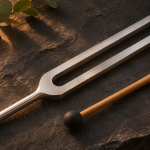
A tuning fork offers an unusually simple starting point. There is an instrument, an action and a fading sound. You can notice what you enjoy, what distracts you and whether the pause feels worth repeating. You do not have to accept an entire system of beliefs before deciding that listening closely has a place in your day.
Today’s video is Eileen McKusick talks about the 174 Hz tuning fork, published on her own YouTube channel. It provides a practitioner’s perspective on an instrument she has used for years. Our focus is the invitation to listen, while keeping her explanations, your personal experience and the claims attached to products clearly separated.
Start with the instrument, then consider the interpretation
In the video’s introduction and chapter guide, McKusick presents her 174 Hz unweighted fork and describes its place in her practice. Later sections introduce her ideas about listening around the body, feedback and ways of working with the instrument. Those ideas belong to her Biofield Tuning approach. The video is a first-person account of that method, rather than independent verification of its proposed mechanisms.
That distinction creates room for a better conversation. You can be interested in the sound without accepting that a practitioner can identify stored memories or diagnose a condition through changes in a tone. You can also value someone’s experience while asking how an explanation could be checked independently.
A useful habit is to pause whenever a demonstration moves from something observable to something inferred. “The sound changed” and “this change identifies a particular emotional blockage” are very different statements. Keep both visible rather than allowing the second to silently replace the first.
Make a listening journal, not a performance score
If you already own an appropriate tuning fork, consider a modest personal project. Choose a quiet moment when you are not rushing. Read the instrument’s instructions, use its recommended activator and avoid improvising forceful strikes or placing it against your body. This is a listening exercise, not a treatment protocol.
Before beginning, write one sentence about the setting. Perhaps the room feels busy, you have just finished work, or you are curious but distracted. Let the sentence remain ordinary. There is no need to label your starting state as blocked, unbalanced or deficient.
Listen at a comfortable distance and intensity, then write down what actually caught your attention. Did you find yourself waiting for the sound to end? Did another noise interrupt it? Did you enjoy the pause or want to get back to what you were doing?
Leave space for an uneventful answer. A journal that says “nothing remarkable today” may be more useful than one in which every session must produce a breakthrough. You are learning what you prefer, not proving that you bought the right object.
Give silence a fair turn
On another occasion, spend a similar short interval sitting quietly without an instrument. Keep the purpose the same: a pause in which you notice your surroundings and your own reactions. You might prefer sound, silence or a different activity altogether.
This informal comparison will not establish a medical benefit. It can help answer a practical question: which version of the pause would you actually choose to repeat? There is a difference between enjoying a ritual and needing a theory to justify it.
Try to avoid changing everything at once. If one session includes candles, a favourite room and an unhurried evening, while another takes place beside a noisy desk, your notes will describe very different circumstances. Record that context. It belongs to your experience just as much as the instrument does.
Personal meaning does not need a medical promise
Some readers will bring spiritual associations to a tone. Others will approach the same object as a musical curiosity. Both can describe their experience honestly without making claims on everyone else’s behalf.
An intention such as “I want to mark the end of the working day” leaves the meaning in your hands. A statement such as “this frequency treats a health condition” requires a different kind of support. The number on an instrument does not supply that evidence by itself.
The National Center for Complementary and Integrative Health’s overview of music and health describes promising research alongside important limitations. It also distinguishes professional music therapy from simply using sound. Findings about a particular music-based intervention should not be transferred automatically to a tuning fork, a different frequency or a retail kit. This article does not recommend forks as treatment or as a replacement for appropriate health care.
A clearly labelled FES option
For readers interested in exploring physical instruments, the Flat Earth Shop 4-Piece Tuning Fork Set with Puck Activator lists aluminum-alloy forks at 128, 136.1, 256 and 384 Hz, together with an activator and user guide.
The distinction matters: this set does not include the 174 Hz fork featured in McKusick’s video. It should be considered a separate option for exploring different tones, not a replica of her instrument, an endorsed product or a way to reproduce her claimed results. Check the live listing for current purchase and delivery details.
Before buying, ask what you want from the experience. Would you enjoy using a physical object rather than playing a recording? Do you want several tones to compare? Will you use the supplied guide? If the appeal is mainly a brief pause, you can explore that habit before purchasing anything.
FES product feature: the shop link above is commercial. The featured video is independent of this product recommendation.
Keep the practice comfortable
A quiet intention does not make every sound exposure harmless. The World Health Organization’s safe-listening guidance explains that both volume and exposure time matter. Keep recorded demonstrations at a comfortable level, take breaks and resist turning the volume up to chase a stronger effect. Persistent ringing or hearing difficulty warrants professional advice.
Treat discomfort as a reason to stop, not as evidence that something beneficial is happening. You can end an experiment without completing a routine or finding a deeper interpretation. Your curiosity does not oblige you to tolerate an unpleasant experience.
Let attention lead
The most useful entry in your journal may be a simple preference: “I liked having one thing to listen to.” That is enough to guide an ordinary personal ritual. It does not need to become a claim about invisible anatomy or a promise attached to a product.
Watch McKusick’s introduction with curiosity. Notice where demonstration ends and interpretation begins. Then decide what, if anything, you want to try within comfortable limits. One sound, a little time and an honest description can be a satisfying place to start.