Some ancient places resist being reduced to a photograph. Karnak is one of them. Its columns overwhelm the human scale, its obelisks draw the eye upward, and its broken surfaces invite a different kind of attention. Beyond asking who commissioned a monument, we begin asking how a person actually worked it: where the first cut began, how a surface was finished, and what happened when an enormous undertaking went wrong.
That is the appeal of the accompanying UnchartedX video, “Obelisks, Witness Marks and 1000-ton Statues! Karnak Temple Walk and Talk.” The creator describes it as an edited version of an early-morning livestream from the temple in Luxor, with repaired audio and additional material. It offers an invitation to explore, rather than a substitute for an archaeological record. UnchartedX’s original video announcement.
The most rewarding way to approach that invitation is with two qualities that belong together: wonder and discernment. We can take the builders’ achievement seriously without assuming every unanswered question points to the same extraordinary explanation.
A Monument Made Across Generations
Karnak is not one building created at a single moment. On the Nile’s east bank at ancient Thebes, now Luxor, it developed into a complex of temples, courts and sacred spaces. Egypt’s Ministry of Tourism and Antiquities traces royal attention to the temple of Amun from evidence associated with Intef II through the Ptolemaic period, with further additions under Roman rule. Successive generations left their own contributions. Ministry overview of Karnak.
This long history matters whenever we compare neighbouring stones. A difference in surface, scale or style might invite a compelling question, but it does not by itself establish a lost civilisation. We first need to know whether we are looking at different materials, different building phases or different purposes.
The question is not simply, “Why do these stones look different?” It is, “What sequence of events would explain the differences?” That shift makes the mystery more precise and the investigation more interesting.
The Obelisk And The Human Problem
Hatshepsut’s standing obelisk gives that investigation an unforgettable focal point. Digital Karnak identifies it as the surviving northern member of a pair originally erected in the Wadjet Hall. Its partner fell; an upper section survives near the sacred lake. The project describes the standing monument as approximately 30 metres high and connects the obelisks’ inscriptions with Hatshepsut’s jubilee celebrations. Digital Karnak’s obelisk record.
A number on a page cannot quite convey the challenge. Imagine planning the work before the finished form existed. Someone had to judge the stone, organise the sequence, allow for mistakes and coordinate people whose individual actions contributed to a result none could achieve alone.
Calling this “ancient engineering” should not become a way of making it ordinary. The word names a field of human ingenuity; it does not explain away the ingenuity itself. Nor does knowing a ruler’s name automatically tell us every practical step the workforce followed.
There is room here for real investigation without beginning from the assumption that the credited builders were incapable of their own achievements.
The Monument That Never Rose
An especially revealing comparison lies outside Karnak, in the granite quarries of Aswan. The Unfinished Obelisk remains there because flaws and fissures brought work to a halt. The Ministry describes its possible commission for Hatshepsut’s temple of Amun at Karnak as a belief, rather than a certainty. Its estimated completed dimensions are extraordinary: roughly 42 metres high and 1,168 tonnes. Ministry record of the Unfinished Obelisk.
Those figures concern an unfinished obelisk in Aswan, not a verified weight for a statue at Karnak. That distinction matters when a dramatic video title mentions thousand-ton monuments. Measurements need identifiable objects and traceable estimates.
The abandoned project also changes the emotional picture. Ancient craftsmanship was not an uninterrupted procession of perfect results. Here, ambition met a material limit. Failure became part of the surviving evidence.
Perhaps that makes the completed monuments more impressive. Their makers were not operating beyond uncertainty. They were working through it.
What A Mark Can Tell Us
A groove, ridge or unfinished patch can feel more intimate than a royal inscription. An inscription presents a message intended for an audience. A working trace may preserve something less deliberate: a stage in making, a correction or an encounter between tool and stone.
But noticing a mark and identifying its cause are separate steps. To investigate an apparent cut, we would want its dimensions, its location, the stone type and a record of neighbouring surfaces. We would also want to distinguish original working from later damage or restoration.
A close-up can begin that process. It cannot always complete it. Lighting may emphasise one feature while hiding another; a photograph without a scale can make a small irregularity appear monumental.
This is not a reason to stop looking. It is a reason to look more carefully. If a proposed explanation involves an unfamiliar tool, it should describe what that tool would leave behind and why the observed evidence fits it better than competing possibilities. “This deserves investigation” is a useful statement. “This proves a forgotten machine” demands more.
Architecture Was Also Experience
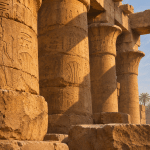
Karnak’s power is not confined to the size of individual stones. Its spaces were composed. The Great Hypostyle Hall contains 134 columns, and its architecture once supported a roof that profoundly changed the light inside. The University of Memphis project describes how high window grilles admitted illumination into an interior far dimmer than the open, sunlit remains visitors encounter today. Karnak Great Hypostyle Hall Project.
That contrast asks us to imagine a different encounter: not just looking upward into blue sky, but moving through a controlled rhythm of shadow, stone and filtered light.
For a modern visitor, such a space can feel meditative or overwhelming. That response is meaningful as experience. It does not, on its own, demonstrate that the building generated a special energy or concealed an unknown technology. We can honour the atmosphere without turning an impression into a historical finding.
Keeping The Question Open
Alternative interpretations are strongest when they make their claims specific enough to test. Which object? Which feature? Which measurement? What evidence would count against the explanation?
The same discipline should apply to familiar accounts. An established label should not prevent a closer examination, and a genuine gap should not be hidden behind confident language. Curiosity becomes more useful when it can distinguish what is documented, what is plausible and what remains conjecture.
As you watch the walk-through, let one detail hold your attention. Instead of rushing to resolve the whole past, ask what you would need to understand that particular stone better. A measured drawing? A quarry comparison? A construction-phase record? Another viewpoint?
Karnak does not need an invented certainty to remain astonishing. Its enduring invitation is simpler: slow down, notice the material reality, and recognise that the people of the ancient world deserve both our imagination and our careful attention.