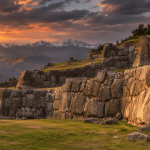
Some ancient places make a modern visitor feel poorly equipped to explain what is in front of them. Sacsayhuaman, above Cusco in Peru, belongs in that category. Its great fitted stones prompt an immediate question: how did people plan, shape, move, and assemble something like this?
A second question often follows. Were the builders the people usually credited with the site, or did a later civilization inherit an achievement already standing?
That possibility attracts much of the attention surrounding Sacsayhuaman. It also demands careful distinctions. A site can contain several periods of activity. A later population can repair earlier work. A remarkable construction method can remain incompletely understood. None of those observations, on its own, identifies an otherwise unknown civilization.
UnchartedX’s “The Megalithic Mystery of Sacsayhuaman – Part 1: Symbology, Location, History” provides a starting point for the alternative-history discussion. The creator’s accompanying article says the film explores the location, Inca symbolism, and the possibility that Cusco and Sacsayhuaman formed one ancient megalithic city.
Separate the questions before answering them
The phrase “Who built it?” can hide several different problems. Who first occupied the location? Who constructed a particular wall? Who enlarged the complex? Who repaired damage? Who gave the site its later ceremonial meaning?
Those questions need not have the same answer.
Imagine finding an old foundation beneath a newer house. That discovery changes the history of the location. It does not automatically date every wall standing above it. Likewise, a repaired surface tells us something happened after its construction, but the repair alone cannot identify the original builder.
For Sacsayhuaman, an investigation should identify the precise feature under discussion. A claim about the whole site is much harder to evaluate than a claim about a specific wall, foundation, joint, or excavated layer.
Why the earlier-builder hypothesis appeals
The appeal is easy to understand. Large stones and close-fitting joints make the work look exceptional. When different masonry styles appear near one another, a sequence of builders seems like a possible explanation.
That is a legitimate hypothesis to investigate. Its strength depends on what happens next.
Does the proposed sequence match excavation evidence? Are the relationships between walls documented? Could differences reflect function, available materials, repair, or distinct work teams? Is the chronology supported independently of appearance?
If several explanations predict the same visible feature, that feature cannot decide between them by itself.
An earlier-builder argument becomes more interesting when it makes a specific prediction. For example, it might predict that one construction phase consistently sits beneath another, or that associated material belongs to a different period. Such predictions invite checking.
Appearance needs context
Photographs can show beautiful details, but they compress a complicated place into a selected view. A close-up of a joint may tell you very little about the surrounding structure. A dramatic camera angle can emphasize scale without supplying dimensions.
When considering a visual argument, ask for a wider view, a measured plan, and a clear identification of the location. If two styles are compared, are they performing similar structural roles? Are they made from comparable stone? Are both surfaces original?
These questions do not diminish the craftsmanship. They help prevent an impressive image from carrying more historical weight than it can support.
A strong visual observation is an excellent beginning. Establishing its meaning requires connecting it to evidence beyond the frame.
What practical experiments contribute
The PBS NOVA transcript for “Secrets of Lost Empires: Inca” describes experiments involving stone shaping, fitting, and transport.
Jean-Pierre Protzen demonstrates work with hammerstones and repeated fitting. The program also discusses Vince Lee’s proposed scribing method, including practical difficulties and the limits of the demonstration. Some work used steel chisels because of time constraints.
That detail matters. A reconstruction can show that a technique is possible without proving that ancient builders used it. Conversely, a reconstruction’s difficulty does not establish that ancient builders needed an unknown technology.
The program is useful because it puts competing ideas into physical contact with materials. Tools leave marks. Stones resist movement. A proposed sequence can succeed, fail, or need revision.
Those outcomes provide more information than declaring the work either impossible or completely solved.
Scale remains a serious question
Working a manageable stone is different from positioning an enormous block. Any explanation needs to account for that difference.
A credible reconstruction should specify the size and mass involved, the terrain, the available working space, and the number of people required. It should explain how workers could control movement, avoid damaging finished surfaces, and make adjustments safely.
There is room to debate these details without jumping to a lost civilization. A historical attribution and a complete engineering reconstruction are separate achievements.
We may have reasons to associate a structure with a known society while still lacking a step-by-step account of every operation. It is also possible to propose a workable engineering method without knowing whether it was the historical one.
Keeping those uncertainties separate makes the investigation more precise.
What would change the historical picture?
An alternative account should explain what evidence would make it stronger.
A securely documented earlier construction layer would matter. So would diagnostic artifacts in a reliable context, consistent dating results, or a clearly established relationship between building phases.
The quality of the connection is crucial. An old object found somewhere near a wall does not necessarily date that wall. Material can be moved or reused. A sample needs a documented context before its age can support a construction claim.
The same standard applies to conventional interpretations. A confident label should be open to revision if better evidence contradicts it.
Historical inquiry works best when explanations compete over observations that others can examine, rather than over which story feels most satisfying.
Be specific about “advanced”
Calling ancient builders advanced can express admiration, but it can also leave the proposed claim vague.
Advanced in which way? Stone selection? Geometric planning? Organization of labor? Transport? A specialized technique? Machinery?
These possibilities imply different evidence. Expertise can produce results that surprise outsiders without leaving the same traces as an industrial process. A proposed machine should have some relationship to the marks, waste, materials, and working conditions it would create.
Instead of asking whether a civilization was generally advanced, ask what capability is necessary for the feature being discussed. Then ask which evidence supports that capability.
That approach leaves room for discoveries while avoiding a label that explains everything and therefore tests very little.
A better way to watch the argument
As you explore the featured video, keep three short lists.
First, record observations: a particular arrangement of stones, an identified location, or a visible relationship between structures.
Second, record interpretations: what the presenter thinks those observations imply about age, builders, or purpose.
Third, record unanswered questions: what information would help you choose between the proposed interpretation and another explanation?
You do not need to interrupt every moment of wonder with a verdict. The point is to preserve the difference between what you saw and what you concluded.
Let the stones remain impressive
Sacsayhuaman does not become less extraordinary if human skill, persistence, and organization explain its construction. Nor does respecting ancient builders require pretending every technical question has been settled.
The earlier-builder hypothesis deserves a clear statement and a fair examination. It also needs evidence capable of distinguishing it from the alternatives.
The most productive question is therefore more focused than whether the official story should be believed or rejected. Which part of the construction history can we establish, which part remains uncertain, and what observation would move the investigation forward?
That is how curiosity becomes research.