A giant stone can make the past feel suddenly unfamiliar. Standing beside a block longer than a bus, we can understand its weight as a number and still struggle to imagine the people who shaped it. At Baalbek in Lebanon and Aswan in Egypt, that gap between measurement and imagination has inspired questions about forgotten techniques, extraordinary coordination, and the possibility of an earlier advanced civilization. The stones deserve our attention. So does the difference between what they show and what we hope they might reveal.
Why the questions are worth asking
UnchartedX explores these questions in Quarrying and Moving Ancient Monuments! Evidence for Ancient High Technology, Part 3! The video’s premise invites viewers to reconsider whether familiar accounts adequately explain the scale of ancient stoneworking. It belongs to a wider argument that some monuments may preserve the achievements of a lost technological culture.
There is value in slowing down over an explanation that sounds too easy. Saying that workers used ropes, stone tools, or sledges leaves many practical questions unanswered. Which materials? How many people? What working space? How was a dangerous load controlled?
Those are productive questions when we turn them into things that can be investigated. They become less useful when our difficulty picturing a method becomes proof that the method was impossible. A convincing alternative needs evidence of its own.
Baalbek’s quarry changes the question
Baalbek’s monumental sanctuary has a long history, and earlier occupation matters. UNESCO’s account of the site describes its great temple complex as an outstanding achievement of Imperial Roman architecture, developed over more than two centuries. It also acknowledges earlier remains and enormous stones in the raised platform.
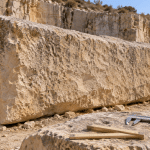
Nearby quarry giants add another layer. A German Archaeological Institute excavation report records a block uncovered in 2014 measuring approximately 19.6 metres long, six metres wide, and 5.6 metres high. The report explicitly states that this block remained in the quarry. It was never transported to the Jupiter temple.
That distinction matters. A stone incorporated into a building demonstrates a completed move. An abandoned quarry block demonstrates work toward a project, with later stages left uncompleted. Combining the two produces an inflated picture of what was achieved.
The same report identifies Roman quarrying traces and anchor holes interpreted as evidence for lifting equipment or winches. These findings cannot reconstruct every operation, but they give investigators physical clues against which proposed methods can be tested.
Aswan preserves an unfinished ambition
At Aswan, the Unfinished Obelisk offers a similarly important distinction. Egypt’s Ministry of Tourism and Antiquities describes a monument that would have stood around 42 metres tall and weighed approximately 1,168 tonnes if completed. It is believed to have been commissioned under Hatshepsut, and work stopped after flaws and fissures appeared in the stone.
The conditional wording matters. This giant was never a standing obelisk. Its enormous intended size tells us about ambition, planning, and the risk of investing labor in a material that could fail.
An unfinished monument can be unusually revealing precisely because the process stopped. Finished surfaces conceal earlier stages of work. An abandoned project can preserve the trenches, working faces, and problems that a successful monument would leave behind. Failure becomes part of the historical record rather than an inconvenience to remove from the story.
Hard stone still carries clues
Granite presents a serious challenge. It is reasonable to ask how ancient workers shaped it, especially when a photograph makes the work appear effortless or strangely smooth. The next step is to examine the material and the marks closely enough to compare possible techniques.
The Metropolitan Museum of Art’s study of the New York obelisk discusses quarry evidence and the probable use of tough dolerite stones to pound granite. Its account also acknowledges uncertainty about the exact working procedures. Surviving clues support an explanation without providing a complete recording of the work.
We should ask the same demanding questions of every proposal. Does a suggested tool produce comparable marks? Can the process remove the required material? What assumptions are being made about time and labor?
A small experiment can demonstrate that a technique works under particular conditions. Establishing an entire quarrying operation requires more. Equally, an unsuccessful demonstration by an inexperienced modern team cannot establish the limits of skilled ancient workers.
Transport was a sequence of problems
Moving stone involves more than generating enough pulling force. A proposed reconstruction must consider the route, slope, ground stability, load support, available space, and final placement. A method suitable for one stone on one surface may be unsuitable elsewhere.
One useful example comes from University of Amsterdam experiments with sledges and sand. Researchers found that the right amount of moisture reduced the pulling force in their laboratory setup. They also discussed the Egyptian tomb scene showing liquid being poured ahead of a sledge carrying a large statue.
This establishes a relevant physical principle. It does not, by itself, explain how Baalbek’s largest installed blocks reached their positions, or settle every question about Egyptian obelisks. Different sites require their own evidence.
The Met’s obelisk study also discusses transport along the Nile. Thinking in stages, including quarry work, land movement, water transport, and erection, gives us a more useful starting point than imagining a single spectacular lifting event.
What would a lost civilization need to explain?
An earlier advanced civilization is a historical claim that can be examined. To move beyond possibility, it needs evidence that identifies the proposed people, places them in time, and connects their techniques to the monuments in question.
Useful evidence might include securely dated workshops, distinctive tools, production waste, or a consistent sequence of related sites. A proposed machine should help explain the marks we observe. A proposed earlier construction phase should fit the site’s archaeological relationships.
Stone size alone cannot provide that chain. Neither can the resemblance between monuments separated by great distances. Similar challenges can encourage similar solutions, while a convincing case for contact requires further support.
There is also a question of fairness. If conventional explanations must account for every practical detail, an alternative should face comparable scrutiny. Calling a technique “advanced” does not yet explain how it worked, who used it, or why its traces would take the forms we find.
Keeping wonder open to discovery
We can enjoy the searching spirit of UnchartedX while keeping its conclusions open to examination. Curiosity is strongest when we can name an unresolved question and also recognize the evidence that already bears on it.
Baalbek and Aswan invite us to take ancient expertise seriously. They also remind us that people could plan boldly, encounter material limits, and leave work unfinished. These possibilities make the sites more human without making them less impressive.
When watching the featured video, try one simple practice: separate the observation from the interpretation. A huge block, a quarry trench, or a surface mark is an observation. A claim about its maker or technology is an explanation to investigate. Holding that distinction leaves plenty of room for wonder, and gives future discoveries a fair chance to change our minds.