Some ancient places draw us in through what survives. Eleusis also draws us through what remains beyond reach. A sanctuary, a sacred story, scattered testimony, and images of two goddesses lead toward an experience whose central rites were kept secret. We can approach that history with curiosity without pretending we have recovered every word spoken in the darkness.
The featured Let’s Talk Religion video, Mystical Initiation in Ancient Greece: The Eleusinian Mysteries, offers an introduction to this world. The most useful question is not simply what the secret was. It is how we can understand a religious tradition through the different kinds of evidence it left behind, while recognizing where explanation gives way to uncertainty.
Demeter and Persephone: a story of separation and return
The Homeric Hymn to Demeter, translated by Gregory Nagy, supplies a foundational story. Persephone is taken by Hades against her will. Her mother searches in grief, eventually coming to Eleusis in disguise. Later, Demeter reveals herself and calls for a sanctuary where she will teach her rites. The poem joins divine drama to a particular place.
Persephone’s return is qualified rather than complete: part of her existence remains bound to the underworld. The hymn’s account connects the fate of mother and daughter to the earth’s capacity to nourish life. It also closes with a distinction between those who have experienced the rites and those who have not. This is sacred poetry, not an observer’s transcript of an initiation.
Reading the story closely prevents it from becoming a decorative slogan about seasonal renewal. There is longing here, resistance, separation, and an accommodation that does not simply erase what happened. For a modern reader, that complexity may be more moving than an easy promise that every loss will be reversed. That is a response to the poem, not a claim about every ancient participant.
A public journey with a private center
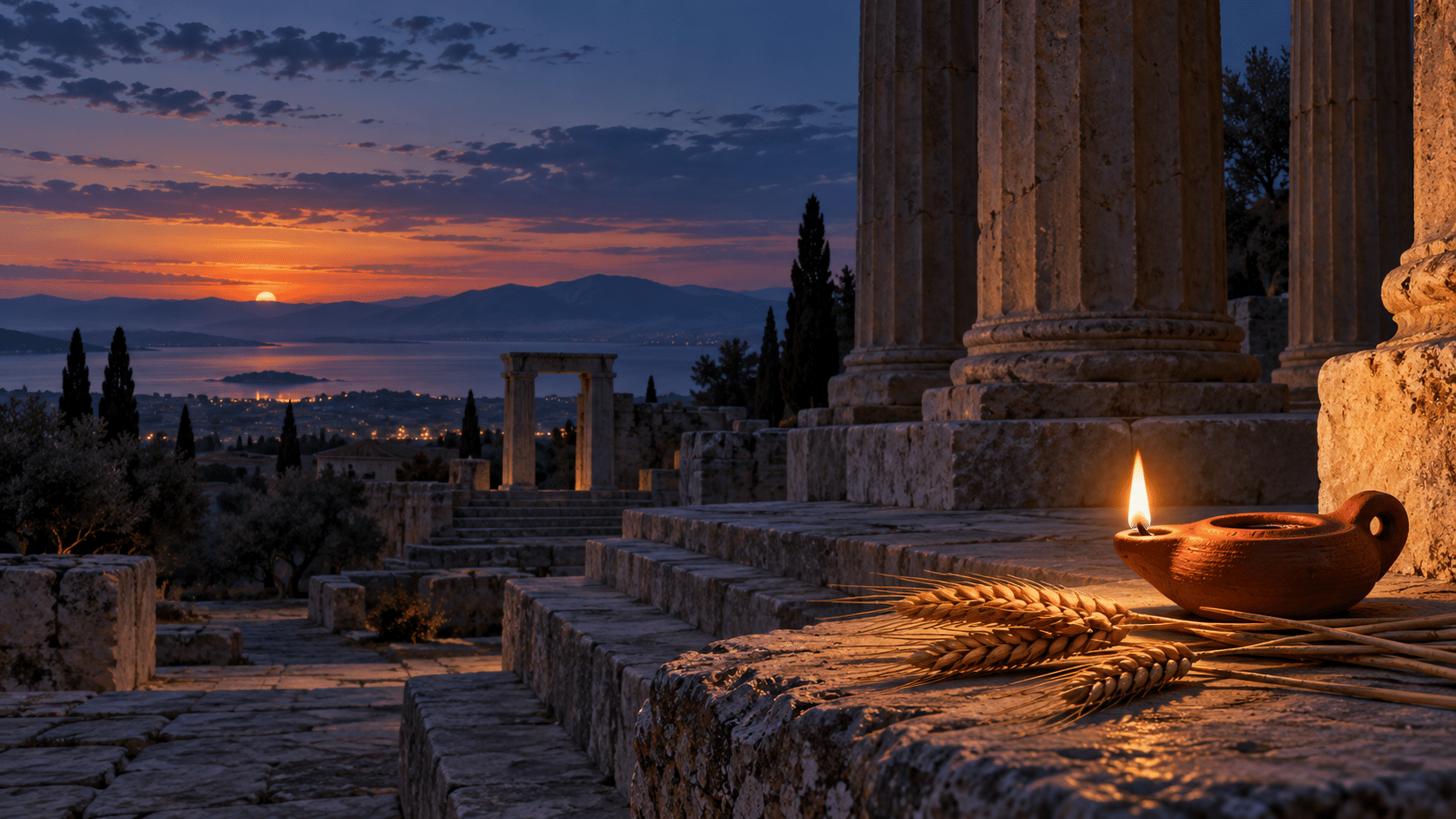
In The Metropolitan Museum of Art’s overview of mystery cults, the Eleusinian tradition centers on Demeter and Persephone. A procession traveled from Athens to Eleusis along the Sacred Way. The sanctuary’s central initiation hall was the Telesterion. The public festival and the restricted rites belonged to the same religious world.
The Met also notes the breadth of participation: the mysteries admitted women, enslaved people, and non-Athenians as well as Athenian male citizens. This matters because it complicates an assumption that ancient religious importance always followed the boundaries of citizenship. It does not mean the wider society was equal, or that every practical barrier to participation disappeared.
Public and private are therefore useful questions to keep separate. A procession can be visible to people who will never witness the central rite. A sanctuary can be famous while some of its practices remain restricted. Secrecy need not mean a tradition was invisible to its neighbors. At Eleusis, public recognition and protected experience could exist together.
What one surviving relief can tell us
Look at the Met’s Ten marble fragments of the Great Eleusinian Relief. The Roman fragments, dated approximately 27 BCE–14 CE, are mounted within a cast of the surviving Greek original. The composition brings Demeter and Persephone together with a young figure generally identified as Triptolemos, associated with the gift of grain cultivation.
There is already a lesson in the object’s presentation. What we see combines ancient material and a modern means of displaying its relationship to another work. The Met’s description distinguishes the fragments from the cast and explains the connection to the original relief. Paying attention to those layers makes the object more interesting, not less authentic.
The relief gives us figures, gestures, clothing, and a religious association. It does not give us the complete sequence of an initiation. A symbol can belong to a tradition without functioning as a diagram of everything that happened within it. When looking at ancient art, ask first what is present, then what the interpretation adds.
Why the gaps deserve our attention
The Met cautions that surviving accounts of mystery cults can be late and shaped by their authors’ aims. That is a useful reminder whenever a striking quotation is presented as the final answer. Who wrote it? How close was the writer to the event? Were they explaining, defending, criticizing, or comparing? The answers change the weight a passage can carry.
Different evidence answers different questions. A building can show where people gathered and how space was organized. A poem can reveal a sacred narrative. An image can preserve an association or a visual convention. A written account can describe an experience or argue about its meaning. Bringing these together requires judgment; they do not automatically form a seamless film of the past.
It also helps to distinguish what we know from what we find plausible. A proposed explanation may connect several clues convincingly and still leave alternatives open. The proper response is to state the proposal and its limits clearly. Uncertainty does not make every theory equally persuasive, but it does ask us to explain why one interpretation deserves more confidence than another.
Resist the temptation of one hidden mechanism
Modern discussion sometimes seeks a single ingredient that would explain the entire force of the mysteries. Psychedelic interpretations are among the debated possibilities. They should be identified as hypotheses rather than treated as a recovered ritual recipe. A claim about what could have produced an experience is different from evidence establishing what happened at a particular historical ceremony.
Nor does ancient secrecy establish a chain of modern secret control. Such a connection would require its own evidence across time, institutions, and people. Similar imagery or a shared word cannot supply that history by itself. We can investigate continuities where evidence supports them without making every unknown part of the same enormous story.
These distinctions leave plenty of room for wonder. They allow the ancient participants to remain people with their own religious lives, rather than characters enlisted to confirm a theory we already hold. The desire for an answer is understandable. The discipline is to let the available evidence shape the answer’s size.
How to watch with both openness and care
As you watch the video, keep three simple notes: a claim supported by a surviving source; an interpretation that connects the evidence; a question still unresolved. Pause when an object, text, or place is named. Following even one reference closely can give you a more substantial understanding than collecting a dozen dramatic claims without checking their foundations.
Eleusis remains compelling because its surviving traces bring us close to enduring human concerns: nourishment, separation, mortality, belonging, and the hope that experience might change how life is understood. We do not have to pretend those concerns were identical to ours. We can listen across the distance while allowing the distance to remain.
Perhaps that is the most rewarding way to approach these mysteries today. Let the story move you. Look carefully at the objects. Ask what each source can support. And when the evidence falls silent, leave space for the question instead of filling it with certainty.