
Begin with the question beneath the argument
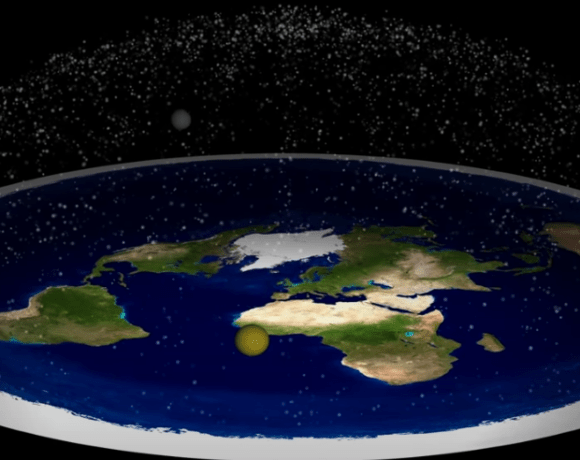
What does it mean to know something for yourself? Eric Dubay’s Flat Earth Philosophy opens with that question in the language of observation, experiment and inherited belief. The documentary argues for a stationary, flat Earth and challenges the way established explanations gain authority. Its philosophical appeal is easy to recognize: many people want a more active relationship with knowledge than simply repeating what they have been told.
The video above comes from Dubay’s own channel. This article examines the opening argument and offers a way to approach the wider film with a notebook rather than a verdict prepared in advance. It is a reading of a particular viewpoint, not a certification of its claims. Independent geodetic measurements support an approximately spherical Earth, more precisely an irregular ellipsoid. Asking serious questions about knowledge does not make the competing physical models equally supported by evidence.
Observation is the doorway
In the opening minutes, Dubay contrasts a hypothesis-led approach with what he calls the zetetic method: begin with a question, look closely, and investigate. The attraction is immediate. An observation feels tangible. A distant explanation may feel abstract. If the ground beneath us appears still and the horizon looks level, those experiences deserve to be described accurately before anyone asks us to interpret them.
The next step is where the real work begins. An observation and its explanation are different things. Saying that a landscape looks flat describes an experience from a particular position. Saying that the entire Earth is flat proposes a model extending far beyond that view. The second statement needs additional measurements. This distinction protects the value of direct experience while preventing a local impression from silently becoming a global conclusion.
Can we remove every assumption?
The documentary suggests that avoiding an initial hypothesis can remove the bias introduced by that hypothesis. It is a useful challenge to premature certainty, but the promise needs examination. Choosing what to measure already involves expectations. So does selecting a camera, defining level, setting a distance or deciding which result would count as surprising. A question does not become free of assumptions simply because its author avoids calling them a hypothesis.
A more practical goal is to make assumptions visible. Write down the observer’s height, location, equipment and conditions. State what you expect each proposed model to predict before examining the result. Invite another person to repeat the procedure. This creates something stronger than a claim to perfect neutrality: a record that other people can inspect, criticize and improve.
Common sense has a scale
The film repeatedly returns to the sense of standing on a stable foundation while the sky moves overhead. That experience is familiar and meaningful. It explains why a claim about Earth’s motion can initially feel counterintuitive. Yet feelings of motion depend on circumstances. We should distinguish the experience itself from a conclusion about every motion that an instrument could detect.
The same care applies to scale. A small patch of a much larger curved surface can appear nearly flat. This is a statement about geometry, not an instruction to disregard what you see. The useful question is how large an area is being measured, at what precision, and against which prediction. A close view can be accurate while remaining insufficient to describe the whole object.
Give a claim a fair, specific test
Choose one proposition from the opening rather than trying to settle every subject in a single conversation. The film’s discussion of the horizon, for instance, can lead to questions about height, distance and viewing conditions. Record the timestamp and paraphrase the claim in language that the speaker would recognize. Then ask what measurement could distinguish the proposed explanations.
This approach also changes the tone of discussion. Instead of asking whether someone is awake or indoctrinated, ask which detail would make a difference to the conclusion. If no possible result could count against a model, the conversation has moved away from testing. That standard should apply to every participant. It is especially useful when a video makes disagreement feel like evidence that the viewer has failed a personal test.
Read the strongest available sources
For Earth’s physical shape, geodesy provides a useful comparison because it concerns measurement rather than the popularity of an image. NOAA’s National Geodetic Survey distinguishes a mathematical reference ellipsoid from the physical surface associated with Earth’s gravity field. These terms describe different tools for different questions. The presence of an approximation in a technical document does not mean that every other geometry is equally accurate.
Read a source far enough to understand what it is defining. A model may deliberately simplify one part of a problem while retaining the features needed for its purpose. To challenge it effectively, identify the quantity it predicts and compare that prediction with the measurement. A phrase extracted from its technical setting can sound dramatic while telling us very little about whether the method works.
The social pull of a worldview
Flat Earth discussion is also a discussion about trust. A viewer may arrive after disappointment with an institution, frustration with dismissive teaching, or a desire to find people willing to ask unusual questions. Those experiences are worth hearing. They help explain the appeal of the conversation without establishing the geometry of the planet.
It is possible to offer someone respect while examining a claim closely. It is also possible to question a powerful organization without treating every alternative speaker as reliable. A healthy inquiry leaves room to disagree with a creator you otherwise enjoy. The ability to revise one conclusion without losing your identity or community is a strength worth protecting.
A notebook practice for the full documentary
Make three columns: what the speaker claims, what evidence is presented, and what remains to be checked. Keep the entries short enough to revisit. Mark quotations that need their original context. Separate a philosophical preference from an empirical statement. For example, wanting direct experience is a preference about inquiry; a claim about a measurable distance has to meet a different kind of test.
You do not need to complete the whole film in one sitting. Pause after a single argument and follow it carefully. Read a source that disagrees with it and explain that source’s position fairly before responding. The most useful outcome may be a better question, a corrected assumption or a clearer understanding of a measurement. Curiosity becomes more durable when it can tolerate those modest results.
Let curiosity remain accountable
The invitation in Flat Earth Philosophy is to reconsider the relationship between experience and explanation. We can take that invitation seriously while challenging the documentary’s conclusions. Neither confidence nor outsider status makes a proposition true. What matters is whether the reasoning is sound, the evidence is relevant and the result survives careful comparison.
Watch, pause, describe and investigate. Keep direct observation close, and give it the context needed to support a conclusion. The freedom to question becomes more valuable when it includes the freedom to discover that an appealing argument does not hold. That is a form of independent thinking available to every viewer, whatever brought them to the video.