Some ancient objects seem to look back at us. The Sutton Hoo helmet has that presence: a severe face, dark eye openings and details that become stranger the longer we look. It is easy to imagine a complete personality behind the metal. Yet the face we recognize also contains an extraordinary modern story of fragments, patient assembly and decisions that remain open to revision.
In the British Museum video above, curator Sue Brunning brings the helmet out from behind the familiar museum view. Her close attention offers a useful invitation: see the object first, consider its possible meanings next, and leave room for what cannot be recovered. An encounter with the past becomes richer when fascination and care for evidence grow together.
Begin with the burial, not a legend
The helmet was discovered in 1939 at Sutton Hoo in Suffolk, within a richly furnished early seventh-century ship burial. The National Trust’s history places the burial around AD 625 and describes a collection that included weapons, metalwork and objects connected with feasting. Such a setting speaks of exceptional status. It does not supply a written biography of the person buried there.
Rædwald, a king of East Anglia, is a leading proposed identity, rather than an established identification. Keeping that distinction changes the questions we ask. Instead of treating every object as a detail in a named ruler’s life, we can examine what the burial communicates about rank, memory and the community that assembled it. The absence of certainty is part of the history, not a gap we are entitled to fill with a confident story.
The familiar face is also a reconstruction
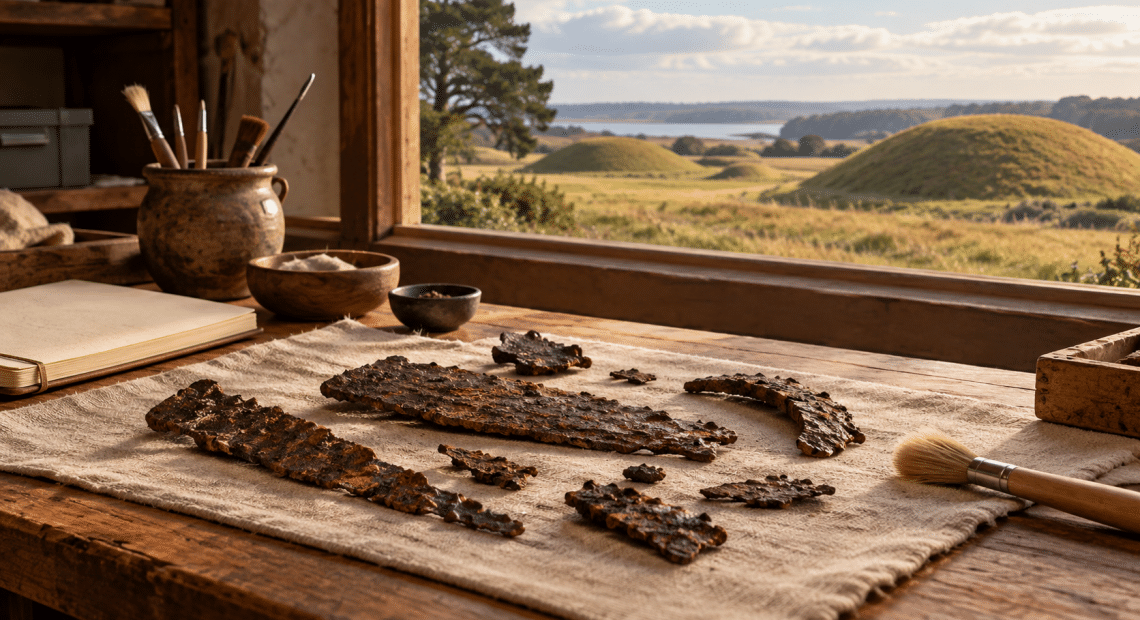
The British Museum’s collection record identifies the current reconstruction as completed in 1971. The surviving material had been recovered in fragments. In the video, Brunning distinguishes original corroded pieces from the smoother modern support between them. She explains that the reconstruction can be taken apart if future evidence calls for a different arrangement. It is an assembled argument, not an untouched object lifted whole from the ground.
This does not make the helmet less remarkable. It gives us another achievement to notice: the discipline of restoring intelligibility without pretending that all the losses have disappeared. A museum display can make a finished outline seem inevitable. Learning how it was built restores the difficult questions behind it. We begin to see the work of conservation as a conversation with surviving material, conducted under limits that no amount of enthusiasm can erase.
Look for the animals within the face
Brunning draws attention to a creature formed by the facial fittings: the eyebrows become wings, the nose a body and the moustache a tail. Boar heads appear at the ends of the eyebrows, while a two-headed serpent follows the crest. These details show how a familiar human face can contain other forms. The effect rewards slow looking rather than a quick glance at the famous outline.
Try following one contour before naming what you think it represents. Then look again at the face as a whole. You may find that the human and animal readings alternate, each changing the other. That experience belongs to your encounter with the design. It does not prove that you have recovered the maker’s entire intention. Seeing a motif clearly and explaining all its historical meanings are different tasks.
Give an interpretation the right amount of confidence
The video discusses a proposal linking differences in the eyebrows’ garnet backing to Woden, the deity better known in Norse tradition as Odin. Brunning presents this as an interpretation. It is intriguing because it connects a material detail with a religious story, but the connection should not be turned into a settled identification or a claim that the helmet carried supernatural power.
A useful habit is to ask what would remain true if a preferred interpretation changed. The surviving fittings would still deserve attention. The burial context would still matter. The craftsmanship would still be extraordinary. An explanation can deepen our interest without becoming the only reason the object is worth seeing. This helps us stay open when historians disagree or when new research changes the balance of possibilities.
A local burial with a wider horizon
The National Trust places Sutton Hoo within a North Sea world connected with Scandinavia, while also describing finds associated with much longer journeys. The collection challenges the image of an isolated early medieval England. The helmet’s form has been compared with examples from Sweden and with earlier Roman helmets. Comparison helps establish relationships between objects; it does not automatically establish one simple route for every influence.
For a modern viewer, this is a reminder to question the borders we unconsciously place around the past. People can borrow forms, adapt inherited designs and value things made far away. We need not invent a single lost civilization to appreciate those connections. The documented objects are already enough to disturb a small, tidy picture of how cultures develop and how ideas move between communities.
That wider horizon also changes what we mean by a familiar object. A design can become an emblem of one place while carrying relationships that reach beyond it. When we use an ancient image to represent belonging today, we choose which parts of that history to emphasize. It is worth asking whether the symbol has become simpler in our hands than it was in its original setting. Let the connections complicate the picture before asking the object to stand for one modern identity.
Consider the person without pretending to become them
It is tempting to imagine putting the helmet on and understanding its world at once. Imagination can make a distant object approachable, but it cannot replace the missing person’s experience. Their expectations, loyalties and fears are not available to us simply because we recognize a face. We can acknowledge that someone inhabited this material world without supplying their thoughts as if they were recorded testimony.
Notice the difference between an invitation and a conclusion. Asking how an imposing helmet might affect an encounter is a good question. Declaring exactly how everyone responded to it goes further than the evidence allows. The space between those statements is where historical empathy can remain honest: attentive to another life, aware of its distance, and willing to be moved without claiming complete access.
Keep three kinds of statement apart
When you watch the close-ups, try making three brief notes. First, describe something visible. Second, record a historical explanation offered by the curator or collection record. Third, write your own response. Perhaps you notice an animal form, learn about the reconstruction, then feel surprised by the object’s intensity. All three notes matter, but they carry different kinds of authority.
This small distinction can enrich any museum visit or encounter with a historical image. It protects personal wonder from being mistaken for documentation, while protecting documentation from becoming lifeless. The Sutton Hoo helmet asks us to look at what remains, respect the work that makes it understandable and resist completing every mystery. Its reconstructed face can hold our attention precisely because the past is still larger than the story we can tell about it.