One clear tone can make an ordinary room feel newly present. The sound begins, hangs in the air, and slowly gives way to the small noises that were there all along. A tuning fork offers a simple way to explore that change. You do not need to believe that a particular frequency carries a hidden power. You only need a little time, a comfortable sound level, and a willingness to listen without demanding an extraordinary result.
A practical doorway into sound
In the video above, The Why and How of Tuning Forks for Sound Healing, Eileen McKusick introduces the instruments from her own practice. Her channel is the original source of this recording. Watch the handling of the forks and listen to how she describes their sound, while keeping a distinction between a demonstration you can observe and the therapeutic or energetic explanations she offers.
The title uses the language of sound healing. Here, our invitation is narrower: a reflective listening ritual. The video is not clinical evidence, and its claims should not be treated as proof that tuning forks diagnose, heal, or release a stored condition. You can find a sound interesting or personally meaningful without accepting every explanation attached to it.
What a tuning fork actually gives you
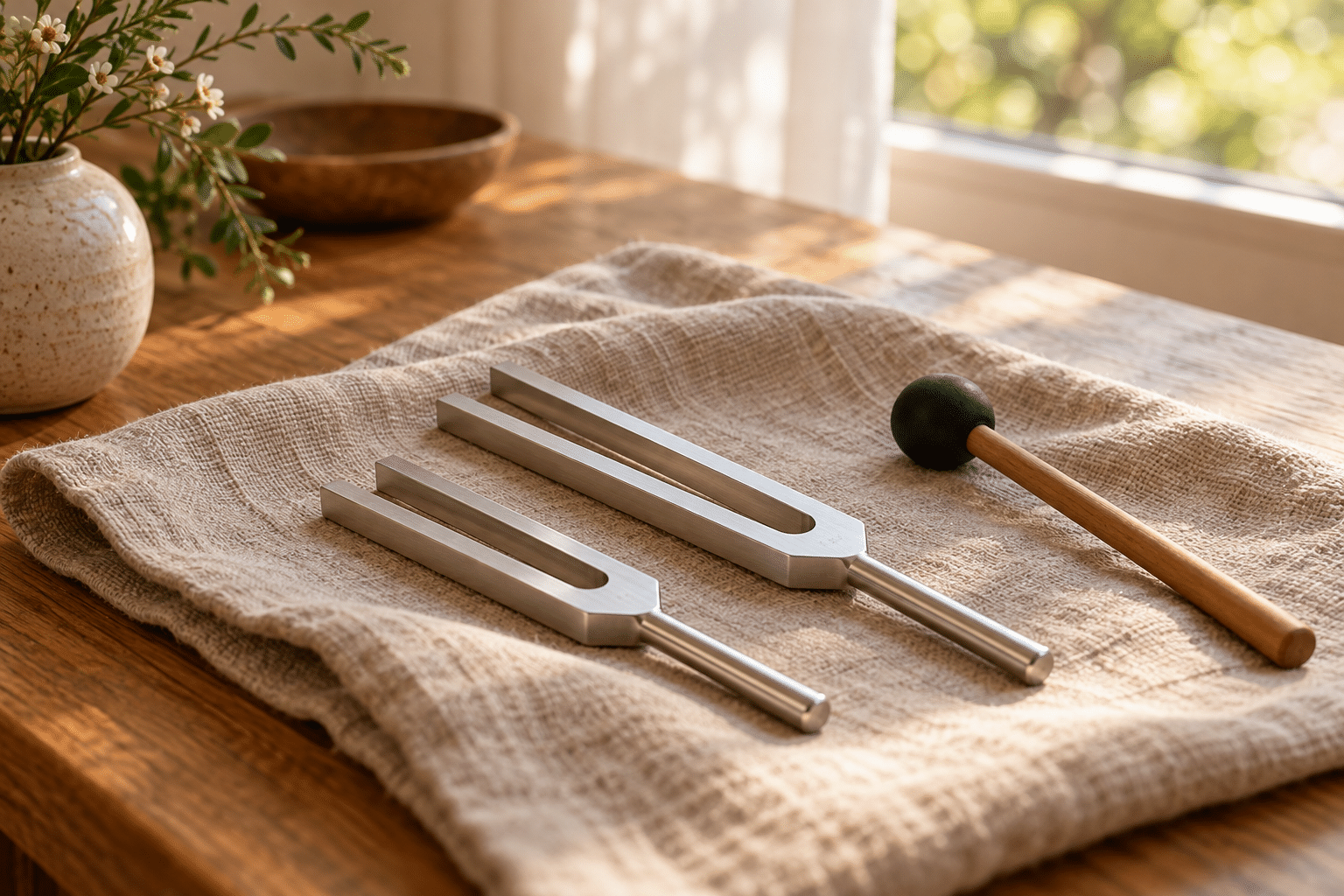
A tuning fork is a metal instrument whose two prongs vibrate when gently activated. That movement produces a tone. The number printed in hertz describes a frequency: cycles per second. It does not, by itself, describe a spiritual quality or a medical effect. A lower or higher number is a difference to hear, rather than a ranking of how beneficial an instrument must be.
Forks vary in construction, pitch, loudness, and the way they respond to an activator. Follow the instructions for your own instrument instead of assuming that every technique in a video fits every model. For the practice here, there is no need to place a vibrating fork on your body. Listening at a comfortable distance is enough.
Begin with the room you already have
Choose a place where you can sit without interruption for a few minutes. Let your feet rest comfortably and leave your breathing natural. Put the phone aside after watching the demonstration. You are making a small space for experience, not preparing for a performance. There is no special posture you must achieve to deserve a quiet moment.
Before making a tone, notice three ordinary sounds. Perhaps a refrigerator is humming, someone is walking nearby, or wind is moving outside. This first minute matters because it prevents the instrument from becoming the only thing you consider worthy of attention. The room is already full of information. The fork simply gives you one clear place to begin.
A short ritual of intentional listening
- Hold the fork by its stem as its maker directs, keeping your fingers away from the vibrating prongs.
- Activate it gently with a suitable mallet or activator. Avoid hard surfaces and forceful strikes.
- Keep it away from your ears and listen at a comfortable distance. More intensity is not a better practice.
- Follow the tone as it becomes quieter. Notice when your attention wanders and return without criticism.
- Allow a pause after the sound fades. Hear the wider room again before deciding whether to repeat.
Try one or two rounds first. You may feel absorbed, restless, curious, or unmoved. Those are experiences to notice, not grades. If the sound is unpleasant, stop. The National Institute on Deafness and Other Communication Disorders explains that loudness, distance, and exposure time matter for hearing. Keep the practice gentle; do not hold a sounding fork close to an ear or turn up a recording to chase a sensation.
Let the pause have a place
It can be tempting to strike again as soon as a tone becomes faint. Instead, remain for a moment with the absence of that particular sound. You may discover that silence is less like a blank space and more like a change in what you notice. A distant bird or the texture of your breathing becomes easier to recognize when nothing is competing for the center.
This is a personal interpretation of the exercise, rather than a measured promise about the nervous system. Some people enjoy a repeated tone; others prefer a walk or a quiet cup of tea. Respecting that difference keeps a ritual honest. A useful practice should make room for your actual experience, including the possibility that it is not for you.
Frequency, symbolism, and careful language
Contemporary spiritual communities sometimes associate particular pitches with chakras, intention, or states of being. Such associations can function as symbolic frameworks. They should be introduced as beliefs or interpretations, rather than universal facts established by the number on a fork. An attractive story does not become a demonstrated biological mechanism because it includes the word frequency.
You might choose an intention such as listening before replying. Let the intention guide your behavior after the session: pause during a conversation, ask a better question, or give someone time to finish. That connection is concrete. The tone can remind you of a commitment; it does not make the commitment happen for you.
A Flat Earth Shop recommendation
Shop recommendation · Flat Earth Shop: If you want several pitches to compare, the 174–963Hz Tuning Fork Set — 10 Piece, Multicolor is a relevant option for acoustic exploration and personal listening. At our October 18 check, its live product page listed US$197, eight items in stock, and an active Add to cart button. Availability and price can change, so confirm them on the product page before ordering.
Shipping is to United States addresses only. The store’s shipping policy lists free standard shipping for orders of US$80 or more. This recommendation concerns the ten-piece multicolor set, not the separate four-piece 128–384Hz set. The instruments are offered for listening and exploration; no healing, treatment, or guaranteed energetic effect is promised. You also do not need to buy anything to try paying closer attention to everyday sound.
Carry the listening into your day
Afterward, write a sentence about something you actually noticed. “I wanted to strike again before the sound ended” is more useful than forcing a dramatic account. It names a habit you can recognize elsewhere: rushing to fill a pause, reaching for the next stimulus, or assuming that quiet must be improved. Keep the observation small enough to remain true.
Tomorrow, you might listen to the same fork and notice something different. Or you might leave it on the shelf and practice through a conversation. The deeper invitation is not to collect impressive experiences. It is to meet an ordinary moment with enough patience to hear it. A tone begins, changes, and ends. For a few minutes, you can let that be enough.