Imagine the Sun reduced to the size of a small mark on a page. Now imagine an object whose boundary, drawn at the same scale, would swallow the page, the desk and the room around you. Kurzgesagt’s viral video The Largest Black Hole in the Universe – Size Comparison uses animation to make that unsettling scale visible. Its procession of black holes is a powerful way into astronomy, provided we ask what the circles represent.
A black hole is not a dark planet with a solid surface. Its defining feature is an event horizon, a boundary beyond which light cannot escape to a distant observer. The larger the black hole’s mass, the larger that horizon can be. When a comparison shows one black hole dwarfing another, it is usually comparing a size derived from mass, not a photographed edge that someone traced with a ruler.
What does “size” mean for a black hole?
For a simple nonrotating black hole, physicists use the Schwarzschild radius: the distance from the center to the event horizon. NASA’s black hole education guide gives a useful scale: an object with the Sun’s mass would have a radius of roughly three kilometers if compressed into a black hole. Multiply the mass by ten, and that radius grows by ten. Real black holes can rotate, so the full geometry is more complicated, but the basic link between mass and horizon scale explains the video’s escalating circles.
This is also why a giant black hole need not look like a giant black sphere in a telescope image. The famous bright ring around M87’s black hole was made from radio observations of hot material and light bent by gravity. The Event Horizon Telescope collaboration describes the dark central shadow as an effect of light capture and gravitational bending. The image is a scientific achievement, but it is not a snapshot of a solid surface.
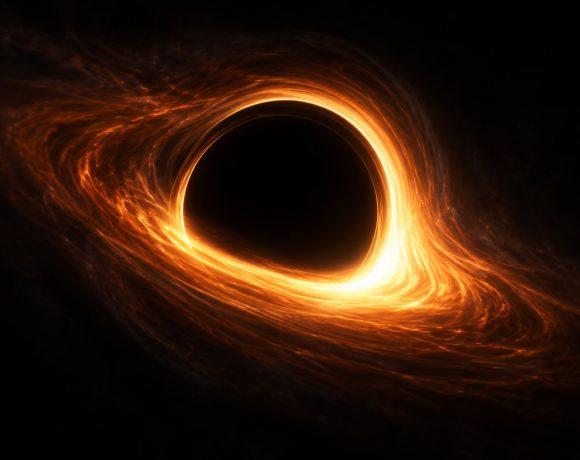
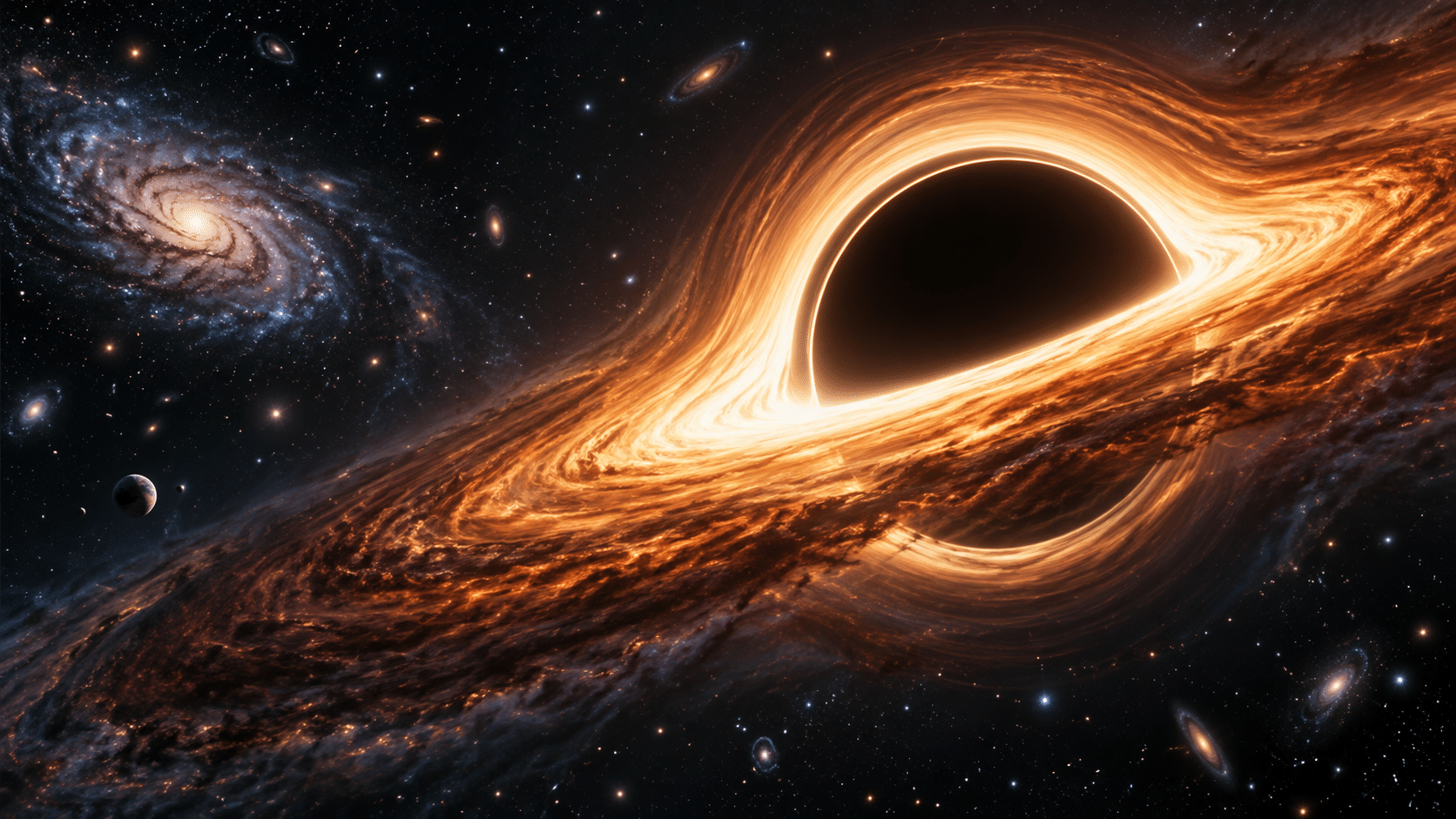
Nor does every black hole shine. The dark object itself does not emit light from within the horizon. Nearby gas can become extremely hot as it spirals inward, forming a bright accretion disk. Some systems also produce powerful jets from the region around the black hole. An artist’s glowing orange whirlpool is therefore a useful illustration of a possible environment, not a universal portrait of every black hole.
From collapsed stars to galactic centers
Black holes occupy an astonishing range of masses. Some form after massive stars die. At the centers of many galaxies, astronomers find supermassive black holes with masses measured in millions or billions of Suns. The objects in the video help viewers cross that range without losing sight of the proportions. A stellar remnant and a galactic giant share an event horizon, yet they inhabit very different cosmic neighborhoods.
Our Milky Way’s central black hole, Sagittarius A*, is a useful anchor for the imagination. NASA describes a visualization based on an object of about 4.3 million solar masses. That is immense by human standards, yet comparisons with the most massive known candidates make it appear modest. The word “known” matters: astronomy is a survey of what we have detected and measured, not an inventory of every object in the universe.
As telescopes improve, estimates change. A black hole’s mass may be inferred from the motion of nearby stars and gas, from light emitted by surrounding material, or from other observations interpreted through physical models. Different methods carry different uncertainties. A list of record holders can therefore change without overturning the underlying physics. The dramatic final image in a size comparison should inspire curiosity about measurement, not a claim that the universe’s ultimate champion has been found forever.
Does greater size mean greater danger?
The enormous scale can make black holes seem like cosmic vacuum cleaners. That picture is misleading. Far from the event horizon, a black hole’s gravitational pull behaves like the pull of any other object with the same mass. A black hole does not reach across the universe to suck in everything it sees. Other stars and gas can orbit a galactic center for vast spans of time.
The danger becomes extreme when something gets too close. NASA explains tidal forces: gravity pulls more strongly on the near side of an object than on the far side. That difference can stretch and tear the object, a process nicknamed spaghettification. The details depend on the black hole’s mass and on the path of the falling object.
There is a surprising twist. At the horizon of a very large black hole, the difference in gravitational pull across a person can be less severe than it is at the horizon of a small black hole. That does not make crossing the horizon safe; escape remains impossible. It shows why the question “Which black hole is more dangerous?” needs a location and a scenario. Size alone is not a complete answer.
What the animation leaves out
Every visual comparison has to simplify. An event horizon is shown as a clean boundary, while real observations involve distant light, intervening material and the limits of our instruments. Distances between objects are compressed so several examples fit into one sequence. A black hole might be illustrated beside the Solar System even though it lives in another galaxy. These choices help convey scale, but they should not be mistaken for a literal map.
The video’s most valuable effect is the feeling of surprise that sends us back to evidence. NASA’s black hole overview describes how astronomers study invisible objects through their effects on surrounding matter and light. The Event Horizon Telescope shows how many observatories can work together to resolve a tiny region on the sky. Mathematics turns those observations into estimates; new observations test the estimates again.
That chain of reasoning is more interesting than a simple superlative. When we say a black hole is billions of times the Sun’s mass, we are describing a conclusion reached from light and motion across vast distances. The numbers are extraordinary, but the method that makes them knowable is extraordinary too.
Look up, then ask a better question
After watching the video, try replacing “How can something be so huge?” with “How do we know how huge it is?” The first question captures wonder. The second turns wonder into investigation. Ask which quantity is being compared, how it was measured, and what uncertainty remains. That habit works beyond astronomy wherever a striking image condenses complicated research.
Black holes remind us that the universe can be both stranger and more orderly than our first impressions suggest. The dark boundary is real in the theory and supported by observation; the glowing illustration is a visual model; the rankings are provisional. Holding those distinctions together lets the animation do its best work. It makes scale felt while leaving room for the next discovery.
There is another lesson in the scale comparison: the universe does not become meaningful only where humans can visit. Most of these objects will remain far beyond any journey we could make, yet careful observation lets us learn from them. A radio telescope, a measured stellar orbit and a tested equation can extend our reach without pretending that distance has vanished.
Featured video: The Largest Black Hole in the Universe – Size Comparison — Kurzgesagt.