A shadow is an ordinary thing with an extraordinary ability to start an argument. Place a stick in sunlight, measure what falls beside it, and suddenly questions about the shape of the world become questions about what a measurement can actually tell us. Before deciding that a demonstration proves everything, or proves nothing, it helps to ask which assumptions connect the observation to the conclusion.
The featured Eric Dubay video about Eratosthenes challenges the familiar account of measuring Earth through shadows. Its central objection deserves a precise answer: different shadow angles can arise on flat ground beneath a nearby light. That possibility is real. Establishing that Earth is flat, however, requires much more than reproducing two angles in another arrangement.
What the ancient measurement set out to do
The American Physical Society’s historical account describes Eratosthenes estimating Earth’s circumference around 240 BCE. The familiar reconstruction compares an overhead Sun at Syene with a shadow in Alexandria at summer-solstice noon. An angle of roughly 7.2 degrees represents about one-fiftieth of a circle. Multiply the estimated distance between the locations by fifty, and the spherical model gives a circumference.
The method assumes effectively parallel sunlight and suitable geographical alignment. The cities were not perfectly aligned, and the ancient unit of distance has an uncertain modern equivalent. Presenting the result as an exact modern survey would overstate the historical evidence. Its achievement was a useful estimate built from accessible observations.
A numerical Earth–Sun distance is not a direct input to that circumference calculation. What matters is the approximation that sunlight arrives from effectively the same direction at both sites. Questioning whether that approximation is justified is legitimate. Claiming that the arithmetic requires inserting a particular solar distance confuses the assumption with the calculation.
The nearby-light objection has a limited reach
Imagine two upright pencils on a tabletop and a small lamp above one of them. The pencil beneath the lamp can have little or no sideways shadow while the other casts a longer one. Nothing about the tabletop has curved. This simple arrangement shows why the phrase “different shadows prove curvature” needs more care than it sometimes receives.
It also reveals an obligation for anyone proposing a nearby Sun. The lamp has a definite position. Once that position and the pencil locations are fixed, the arrangement predicts every other pencil’s shadow. You cannot move the lamp separately for each observer while claiming that all observers measured the same light at the same moment.
Two observations may leave competing explanations available. Further observations can make those explanations disagree. The useful next step is to find where the disagreement becomes measurable, rather than treating the existence of an alternative sketch as the end of the investigation.
Make each model predict the next shadow
Consider a coordinated measurement across several widely separated locations. For a flat-plane proposal, specify where the sites lie on that plane, where the Sun is above it, and how light travels. For the spherical proposal, specify the sites on a sphere, the Sun’s direction, and the corresponding local verticals. Both descriptions must be clear enough to calculate expected shadow lengths and directions.
Use part of the observations to establish the proposed arrangement, then reserve other locations as a check. Can one nearby solar position explain those additional observations at the same instant? Does the spherical calculation match them within the measurement uncertainty? Repeating the comparison on another date tests whether the explanation works beyond one convenient example.
The independence of the test matters. If every new observation leads to a new exception, a changed map or an unspecified bending of light, the explanation becomes difficult to evaluate. Additional mechanisms can be investigated, but they need their own measurable rules. A model should tell us what to expect before we see the answer.
Why rays through clouds can look misleading
The video also appeals to sunlight apparently spreading through clouds. This can look like a nearby lamp shining into a room. Appearance alone, however, does not establish the three-dimensional direction of every visible beam.
The National Weather Service’s Storm Courier discussion of atmospheric optics, on page six, describes crepuscular rays as parallel rays made visible through obstruction and scattering. Perspective can make parallel paths appear to converge, as the edges of a straight road seem to meet in the distance. Tracing lines across a photograph therefore does not automatically locate a nearby physical source.
A useful question for any striking sky image is what information the picture leaves out. Where was the observer? Which direction was the camera facing? How far away were the clouds? A visual impression can suggest a question while still lacking the distances needed to answer it.
An angle is only part of a distance measurement
The video’s appeal to sextants and plane trigonometry raises a related issue. Measuring an angle does not, by itself, supply a distance. A triangle requires enough independently established information before its unknown sides can be calculated.
If a calculation begins by placing observers on a common plane and choosing a point directly beneath the Sun, its resulting solar height depends on those choices. The mathematics may follow correctly while the physical assumptions remain untested. The same demand for independent checks applies to a spherical calculation. Consistent arithmetic cannot rescue an arrangement that fails to match further observations.
This is a useful habit beyond debates about Earth. Whenever a confident number appears, ask which quantities were measured, which were assumed, and whether someone else could repeat the procedure without already accepting the conclusion.
A careful observation is worth keeping
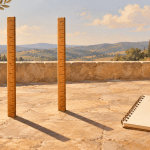
You can explore shadow measurements without looking at the Sun. Use an upright stick on a level surface and observe the shadow only. For a coordinated comparison, agree on a shared instant rather than assuming that noon on different clocks means the same thing.
- Record the location, date and exact time, including the time zone.
- Measure the stick’s exposed height, shadow length and shadow direction.
- Check the stick’s vertical alignment and record any uncertainty at the shadow’s edge.
- Keep the original measurements, including results that disagree with your expectations.
- Compare clearly specified predictions before deciding which explanation fits.
A cloudy interval or a tilted stick is a reason to improve the measurement. It should not become a convenient excuse used only when a result is unwelcome. Apply the same standard to the explanation you prefer and the one you doubt.
Curiosity can survive a firm conclusion
Modern knowledge of Earth’s shape does not depend on one ancient shadow experiment. NOAA describes Earth as an irregular ellipsoid and explains that geodesy measures its shape, size and gravity field. The globe is a useful approximation to a measured world with an equatorial bulge and local irregularities.
Dubay’s objection identifies a limitation of an isolated two-location demonstration. It does not overturn the wider evidence or establish a successful flat-Earth model. We can acknowledge the limitation without giving the competing claims equal evidential weight.
The most productive response is to keep asking for predictions that can fail. Let the shadows remain observations, let the assumptions remain visible, and let an explanation earn confidence by working beyond the example that first made it appealing.