Few events invite the imagination as strongly as Apollo 11. A human voice crossed the distance between Earth and the Moon; millions watched a grainy picture arrive through an unfamiliar chain of cameras, antennas, and television equipment. More than half a century later, the achievement still invites questions about how we know what we know. In a long conversation on The Joe Rogan Experience, filmmaker Bart Sibrel argues that gaps in the Apollo archive deserve far more suspicion than they usually receive. His account is provocative. It also makes a useful test of a more careful habit: separating a missing original recording from a missing event.
Why an archive can feel unsettling
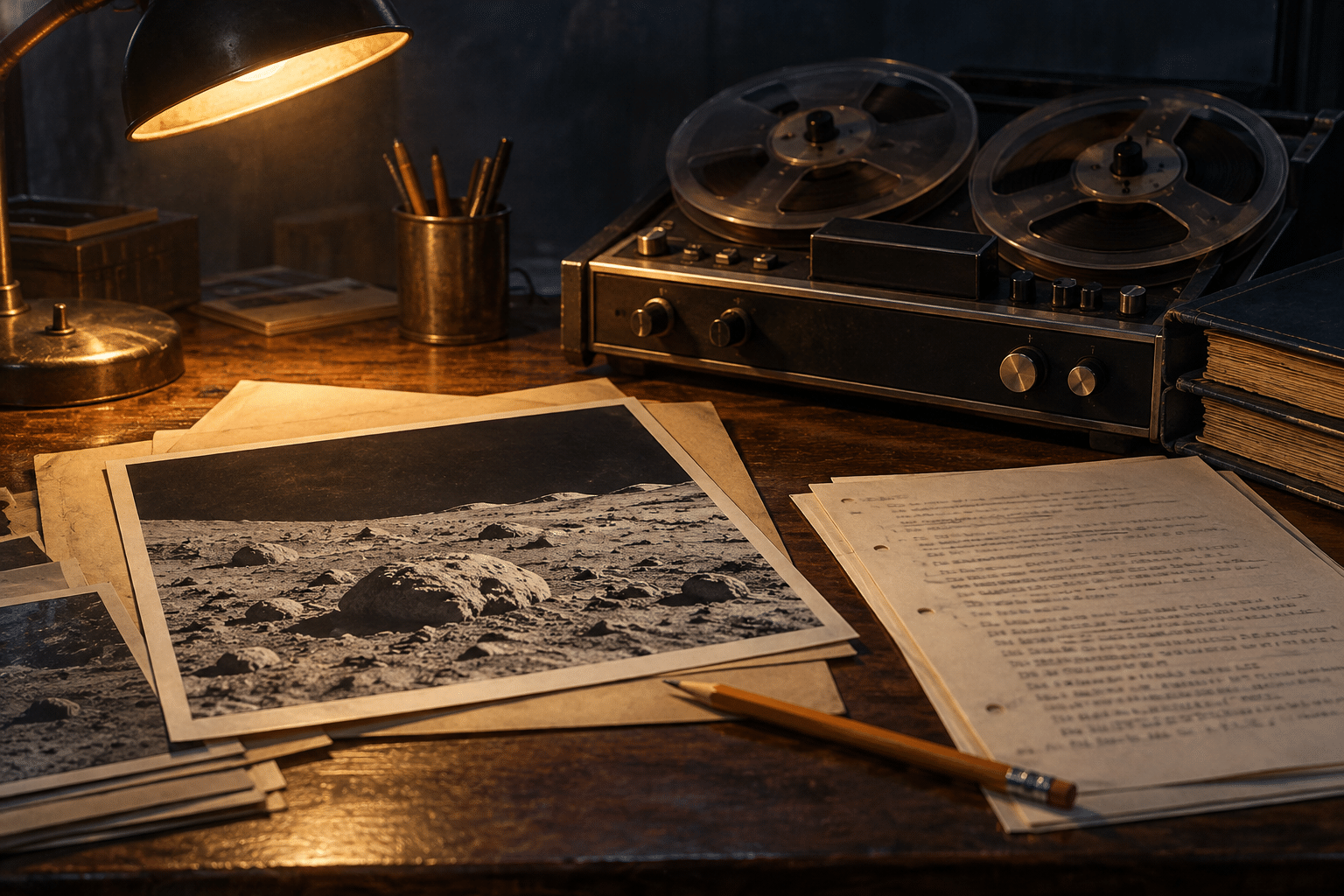
In the interview, Sibrel presses questions about original Apollo 11 video tapes and the quality of the surviving images. A viewer who has only seen the familiar broadcast may be surprised to learn that the original one-inch telemetry tapes, which held the slow-scan television signal received from the Moon, were not found when NASA searched for them decades later. That is a real archival loss. It is reasonable to ask why material of such historical importance was not preserved with more care.
Yet the next step in the argument matters. “The original tapes are missing” is a narrower statement than “there is no surviving moonwalk footage.” NASA’s account of its restoration project describes several other recordings: a copy made at the Sydney switching center, CBS tapes of the broadcast feed, and kinescopes held at Johnson Space Center. Technicians used those sources to create a clearer presentation of the live transmission. The surviving record is imperfect and mediated, but it is not empty.
This distinction is easy to lose in conversation, especially when a dramatic claim arrives faster than its supporting detail. An original master can disappear while copies, logs, photographs, and independent observations remain. Historians face this problem often. The question is not whether every desired artifact survives; it is whether the surviving evidence, considered together, supports the account being told.
What the video offers, and what it cannot settle
Rogan’s interview gives Sibrel room to explain the questions that have shaped his work. It is worth watching as an example of how a skeptical case is built: a detail is isolated, an institutional explanation is challenged, and the audience is asked to decide what the gap implies. The conversation is not itself an independent audit of the Apollo program. Sibrel is presenting an allegation, and the listener still has to compare his claims with primary records and observations outside the interview.
One helpful comparison comes from Jodrell Bank Observatory in Britain. Its scientists were tracking the Soviet Luna 15 spacecraft during the Apollo 11 mission. The observatory’s archived recordings include the voices of Apollo astronauts and show how observers followed events unfolding near the Moon while also watching Luna 15. This does not answer every question one might ask about every photograph or equipment item. It does show why Apollo’s evidence cannot be reduced to a single NASA tape cabinet.
The wider record also includes mission communications, physical lunar samples studied by researchers, images from different stages of the flight, and observations made by organizations beyond the agency that launched the astronauts. Evaluating any one of these requires care. Treating a lost master tape as proof that all of them are fabricated requires a much larger argument than the loss itself supplies.
The difference between doubt and a conclusion
Good questions can begin with discomfort. Why were original tapes reused or misplaced? Which version of a broadcast are we seeing? What does a restoration change, and what does it leave untouched? Those questions deserve direct answers. But doubt becomes less useful when it quietly changes the standard of proof. If every surviving copy is dismissed because it is not the master, and every independent observation is set aside because it does not show the whole mission, no historical event could satisfy the demand.
There is also a temptation to treat institutions as either perfectly reliable or wholly deceptive. Neither posture helps us read an archive. NASA’s failure to retain a valuable original deserves criticism. Its detailed account of the search and restoration is also evidence that can be checked. A public error in stewardship is not a logical demonstration that an entirely different story occurred. The responsible response is to record the limitation precisely and then look at corroboration.
The Apollo story is especially vulnerable to all-or-nothing thinking because it carries symbolic weight. For some, the moonwalk represents courage, technical skill, and cooperation. For others, it has become a test case for distrust of powerful institutions. Those feelings can shape what seems plausible before a document or recording has been examined. The task is to notice the feeling without letting it write the verdict.
How to watch a persuasive conversation
Try keeping two columns while watching the featured interview. In one, write the claim as narrowly as possible: an original recording was not located, an image appears unusual, an explanation seems incomplete. In the other, write the conclusion the speaker wants you to draw. Then ask what additional evidence would be needed to cross from one column to the other. This simple discipline protects curiosity from turning into certainty too quickly.
It also makes room for fair criticism. If NASA’s archive practice was poor, say so. If a particular interview claim overstates what was lost, say that too. Independent verification is strongest when it can accommodate both sentences. We do not need to pretend that every institutional account is flawless to reject a leap that the evidence does not support.
Notice the sources a speaker names. Are they original documents, later retellings, or interpretations of an image already circulating online? Is a quote given in context? Does the argument consider an ordinary explanation before reaching for a sweeping one? These are not special rules invented for Apollo. They are the everyday tools of historical reading, and they apply just as much to official narratives as to challenges against them.
Wonder survives careful checking
Perhaps the deepest value of revisiting Apollo 11 is not the thrill of winning an argument. It is the chance to practice a form of wonder that can withstand scrutiny. The transmission from the Moon was technically complicated and visually strange to modern eyes. The archive is incomplete. Those facts make the history more human, not less worthy of study. They invite us to learn how signals traveled, how records were kept, and how separate observers understood the same moment.
Sibrel’s interview may leave a viewer with new questions. Let those questions lead to the records rather than stand in for them. The lost telemetry masters are a genuine loss; the surviving broadcasts and independent observations are genuine evidence. Holding both ideas at once is more demanding than choosing an instant side, and far more rewarding. A remarkable event deserves neither blind trust nor reflexive dismissal. It deserves the patient attention we give to anything that matters.