How much of your day happens between the places you mean to be? There is the walk to the kitchen, the corridor before a meeting, the path from the bus stop to your front door. These small journeys are easy to overlook. In On Walking Meditation, Zen teacher Thich Nhat Hanh invites us to give them our attention. His short teaching, shared by Plum Village App, brings meditation into something wonderfully ordinary: placing a foot on the ground.
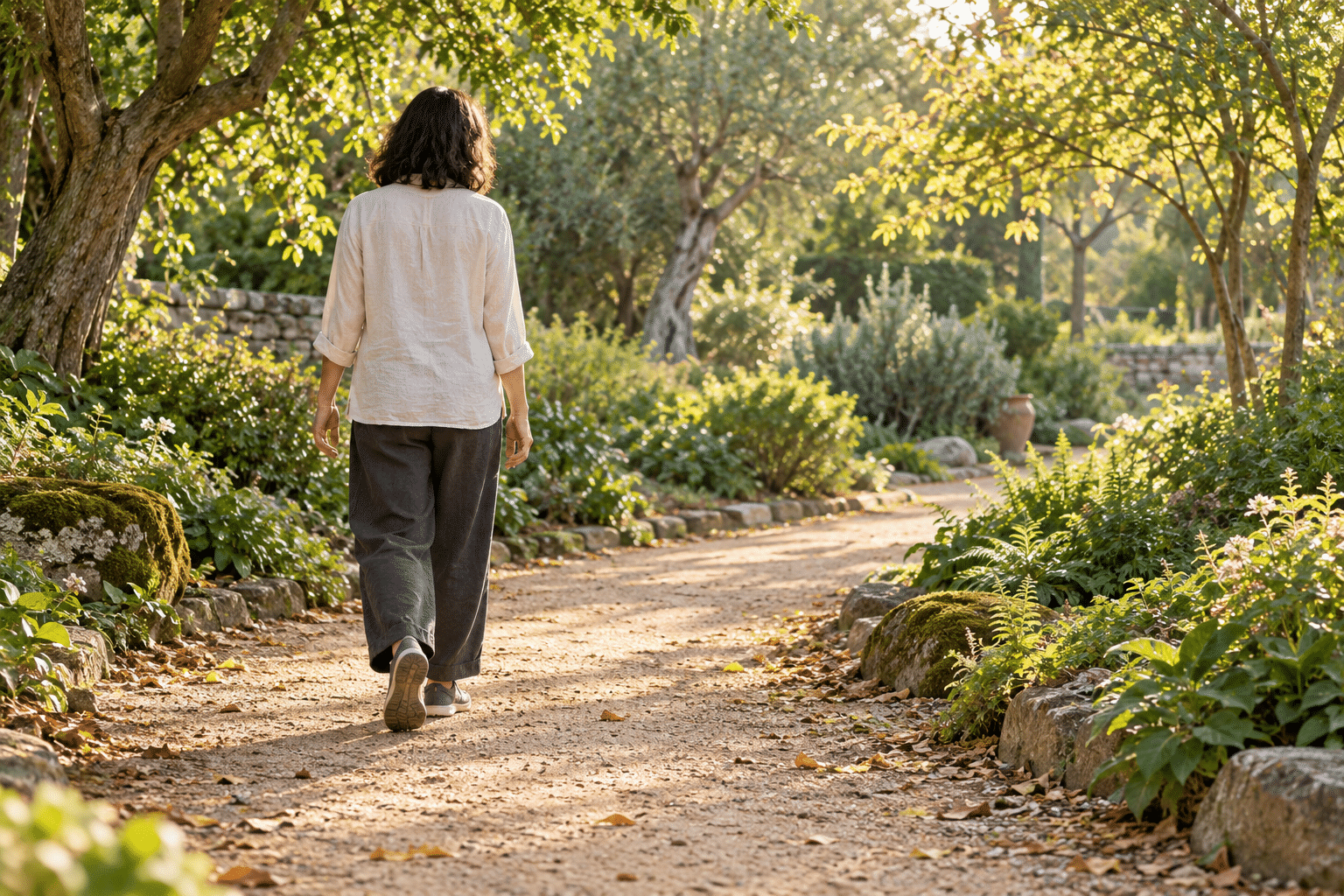
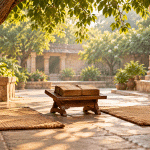
AI-generated editorial illustration of an adult walking along a sunlit garden path; an imagined setting rather than a photograph of Plum Village.
The appeal of walking meditation is its closeness to daily life. You can explore it on a familiar route without waiting for a retreat or a perfectly quiet morning. The video offers a few practical instructions, then connects them with gratitude for the Earth. Together, they raise an interesting question: what changes when the journey itself deserves the care we usually reserve for the destination?
Give an ordinary step your full attention
Think of a journey you make almost automatically. Perhaps you have walked it hundreds of times while composing a reply or mentally rehearsing the next task. What would you notice if, for a short stretch, you gave that movement the same attention you would give a piece of music? The shift in weight, the pressure through a shoe, the texture and slope of the path all become available to experience.
Plum Village’s guide to mindful living places walking alongside eating, resting and other everyday activities. Its approach begins with awareness of the body and of what is happening around us. That makes the practice concrete. There is an action already taking place, and we can meet it more closely.
This is a useful invitation for anyone who treats the minutes between appointments as empty space. A corridor can contain the sound of your steps, changing light and the presence of other people. You still have somewhere to go. You can also experience the journey while it happens.
Let the rhythm fit the body
At around 1:50 in the featured teaching, Thich Nhat Hanh explains how steps and breathing can accompany one another. The number of steps changes with the person. An inhalation and an exhalation may suit different counts. His emphasis is on listening to the body rather than enforcing a fixed rhythm.
For a first attempt, begin with a comfortable pace and let your breathing remain easy. Notice how many steps fall within a breath before trying to coordinate anything. If counting becomes awkward, return to the sensation of walking. Plum Village’s breathing guidance explicitly encourages allowing the breath to be as it is.
The practical question is whether the counting helps you pay attention. You do not need to carry a particular number home as an achievement. A rising path, a pause to let someone pass or a change in pace may change the rhythm. Making room for those ordinary adjustments keeps the exercise connected to the actual walk.
Gratitude begins underfoot
Earlier in the video, Thich Nhat Hanh describes teaching children in France with two words: oui and merci, or yes and thank you. Later, he directs attention toward the soles of the feet and uses the image of gently kissing the Earth through our steps. His language connects mindful movement with affection and care.
You might try a simple word as an accompaniment, then see whether it feels meaningful. Gratitude can also begin with a specific observation: the shade of a tree, a maintained public footpath, a bench where someone can rest. Such details give appreciation somewhere to land. They invite us to notice how much supports an apparently private activity.
The teaching’s closing references to healing belong to its spiritual language. One grounded way to respond is to consider the relationship between appreciation and conduct. If a place offers us beauty or shelter, how do we treat it? Staying on a marked path, leaving a garden undisturbed or taking our litter home are modest ways to carry that question into action.
Try one small stretch of walking meditation
Choose a short, safe stretch where you can move without obstructing anyone. A few minutes can give you space to experiment. The following sequence is a simple everyday adaptation of the practice, rather than a requirement to reproduce the video exactly.
- Pause before moving. Notice where you are, the available space and the ground ahead. Give yourself permission to take this short stretch at a comfortable pace.
- Feel a few steps. Attend to the foot meeting the surface and the transfer of weight. Let the next step offer a fresh point of attention.
- Include the breath if it helps. Allow an easy rhythm to emerge. Keep breathing naturally; leave counting aside whenever it becomes a distraction.
- Notice the surroundings. Keep your eyes open and your attention available to people, traffic and changes underfoot. You can include a sound or a patch of light without needing to label everything.
- Finish deliberately. At the end of the stretch, pause briefly and notice one detail you might otherwise have missed. Then continue with your day.
Choose a form that suits your mobility and surroundings. Plum Village App’s walking-meditation collection also includes wheelchair and forward-moving practices. The opportunity to attend to movement should leave room for different bodies and ways of getting around.
Make room at the thresholds of your day
Once you have tried a short practice, consider where it might naturally belong. The final few steps before entering your home could become a moment to notice your surroundings. The walk away from a desk could offer a clear ending to one activity before another begins. Choose a familiar transition that is easy to remember.
There is a subtle difference between deciding to remember and deciding to perform. If every walk becomes an assessment of how mindful you are, the practice may start to feel like another demand. You can keep the invitation smaller: on this particular stretch, notice what walking is like today. Curiosity leaves room for variation.
Plum Village UK’s practice manual describes walking meditation as walking for the experience of walking, with the present moment as its destination. In everyday terms, that can mean allowing some part of a journey to have value before you complete it. You need no exceptional scenery to begin experimenting with that possibility.
A different way to take the next step
Watch Thich Nhat Hanh’s teaching for its gentle specificity. The instructions keep returning to things you can encounter directly: a step, a breath and the surface beneath you. From there, the practice opens into a question about how attentively and gratefully we inhabit a place.
For your next ordinary journey, choose a small stretch to experience more fully. Feel the movement, look around and let the destination wait for a few steps. The kitchen, meeting room or front door will still be there. Along the way, there is also a life already happening, close enough to touch with your feet.
Featured video: On Walking Meditation | Thich Nhat Hanh, published by Plum Village App on January 16, 2020.