A familiar song begins with a handful of chords. Then a guitarist shifts a note, leaves a small gap and adds a phrase that seems to belong there. The tune remains recognisable, yet the performance has acquired a particular voice. Musical improvisation can look mysterious from the outside, especially when the player seems to discover each choice without hesitation. Where does that freedom begin?
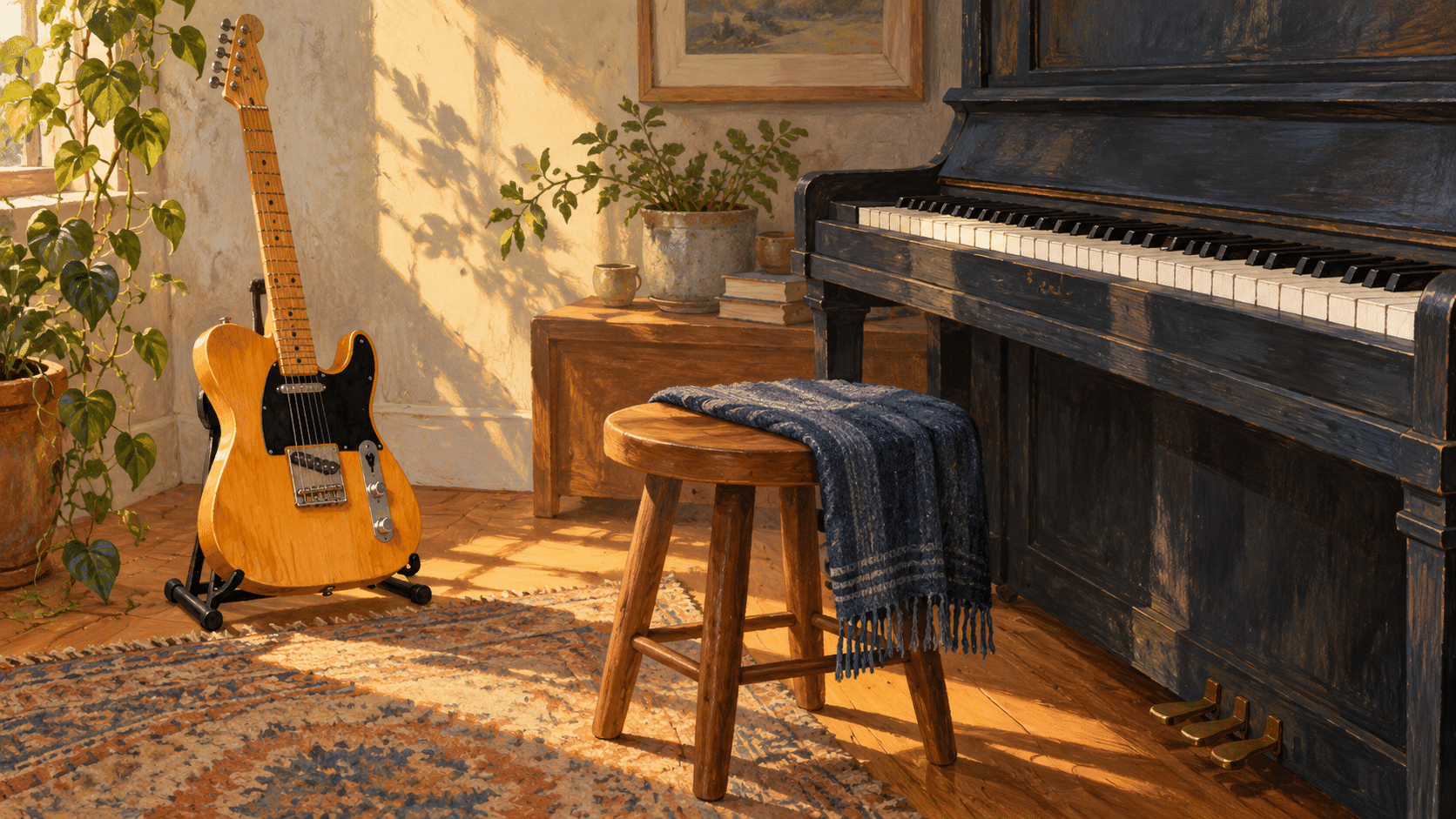
AI-generated editorial illustration of a guitar and piano in a sunlit practice room, inspired by the possibilities of musical improvisation.
In How to Improvise Without Overthinking (feat. Mateus Asato), pianist and composer Nahre Sol explores that question with guitarist Mateus Asato. Their conversation moves between explanation and demonstration, making room for the small decisions beneath an expressive performance. It offers an inviting starting point for anyone who plays an instrument, and a useful perspective for listeners curious about how musicians turn familiar material into something personal.
1. Begin with the melody you already know
Around 1:34, Asato uses “How Deep Is Your Love” to explain his starting point: identifying the melody before decorating it. That order matters. When the tune is clear, an added note has something to relate to. The listener can hear both the familiar shape and the performer’s departure from it.
Try humming a short tune you know well. Notice which notes seem essential to recognising it, and where the line pauses. Then sing it again, allowing one note to last a little longer. You have made a choice about the phrase without needing a dramatic new idea or an impressive run of notes.
There is an established teaching approach behind starting small. In his lesson on melodic improvisation, Berklee educator Matt Glaser begins with a tune’s essential notes and develops variations around them. His method gives the learner something definite to preserve while other details change. A familiar melody becomes a place to explore.
2. Let the rhythm make room
Asato’s answer to where an embellishment belongs centres on rhythm. Later, around 8:28, he explains that a longer-held chord offers room for a fill that a quicker chord change might not allow. The available space helps shape the decision.
This is a useful question to bring to any recording: what is happening underneath the most noticeable part? Listen for a steady pulse, the movement of the bass and the points where a singer takes a breath. An instrumental phrase may answer the vocal line, lead into a new section or simply let a chord linger.
For your own playing, choose a short passage and repeat it with fewer additions. Then introduce one small response in an existing gap. Does the passage still move comfortably? Can you hear the melody clearly? These questions make the experiment concrete. You can decide whether the addition helps by listening to what it does to the whole phrase.
Leaving a gap is also a musical choice. It gives the next sound an entrance and allows the previous one to settle. A performance can feel generous when each part has enough room to be heard.
3. Get to know the choices inside a chord
At about 5:17, Asato discusses learning triads and inversions across the guitar neck. Beneath the apparent ease is familiarity with the instrument. Knowing several ways to reach a sound gives the performer options when a melody or a chord change calls for a different shape.
Some terminology helps here. A triad is a three-note chord whose notes can be arranged in thirds. C major, for example, contains C, E and G. An inversion places a chord member other than the root at the bottom. Open Music Theory’s explanation of inversion makes the important distinction: changing the lowest note leaves the chord’s root unchanged.
On a keyboard, you could compare C–E–G with E–G–C, played from low to high. The note names belong to the same chord, but the arrangement has changed. Listen to the upper note as well as the lower one. When you move to another chord, consider how those individual lines travel.
This brings theory close to an ordinary act of attention. A label helps you recognise and repeat an option. Your ear helps you decide where you want to use it. Start with one chord you can play comfortably and discover a second way to arrange it.
4. Change one detail and hear what happens
The interview builds its examples in stages. That suggests a manageable practice experiment: keep most of a short passage familiar while changing one feature. The exercise below is an application of that idea, rather than a prescribed routine from the video.
Choose two or three chords you already know. Play them slowly enough that you can listen while moving between them. On the first pass, keep everything simple. On the second, change the rhythm of one chord. On the third, return to the original rhythm and try another arrangement of its notes.
Next, add a short melodic response in one gap. Give that response a clear ending, then return to the pattern. If you lose your place, reduce the number of changes. The aim is to hear what each decision contributes, including the decision to leave a passage alone.
A brief recording can help you compare these versions. Listen back with one question: which moment would I like to keep? Naming a specific detail, such as a pause or a gentle arrival on a note, gives the next session a starting point. An experiment can produce useful material even when the whole take feels unfinished.
5. Make listening part of the practice
Near 10:41, Asato emphasises making even a scale exercise sound musical. That is his artistic priority, and it poses a worthwhile question for practice: what are you trying to express with the notes you can already play?
You might give a short pattern a shape by beginning quietly and letting it grow. You might play it evenly once, then change where the accents fall. You might imagine the line as a question and find a different ending for its reply. These are choices you can investigate at a comfortable speed.
Listening becomes especially important with another player. In Playing in the Moment, Berklee guitarist and educator Jon Damian describes exercises built around responding to dynamics, rhythm, melodic direction and articulation. His teaching draws attention to musical events that can be overlooked while a player concentrates on delivering a prepared idea.
Try a simple exchange with a willing partner: one person plays a short phrase, and the other answers after listening. Keep the phrases small enough to remember. Notice whether your response echoes a rhythm, follows a direction or deliberately leaves more space. The interest comes from the relationship between the two contributions.
6. Let a small discovery be enough
The most encouraging way to approach this conversation is with an instrument nearby, or a tune in mind. Pause when an idea seems usable. Return to a demonstration and ask what changed between its simpler and more decorated versions. There is no need to absorb every technique in one sitting.
Musical improvisation leaves room for many tastes. You may prefer a spare phrase, a warm chord or a playful rhythmic interruption. Finding that preference requires opportunities to try, listen and choose again. A small discovery can give an ordinary practice session a direction of its own.
Watch the original How to Improvise Without Overthinking (feat. Mateus Asato), created and published by Nahre Sol on March 23, 2024, featuring Mateus Asato. Their musical demonstrations are the heart of the lesson: listen for how a few considered choices allow the song to remain clear while the player’s character comes through.