What survives when a great capital loses its power? At Angkor, the first answer seems obvious: towers, carved faces and long galleries of stone. Yet those famous silhouettes can draw our attention away from the people who built, used and cared for them. Looking closely at the Khmer Empire opens a larger story about royal ambition, everyday work and the ways a sacred place can keep finding new meaning.
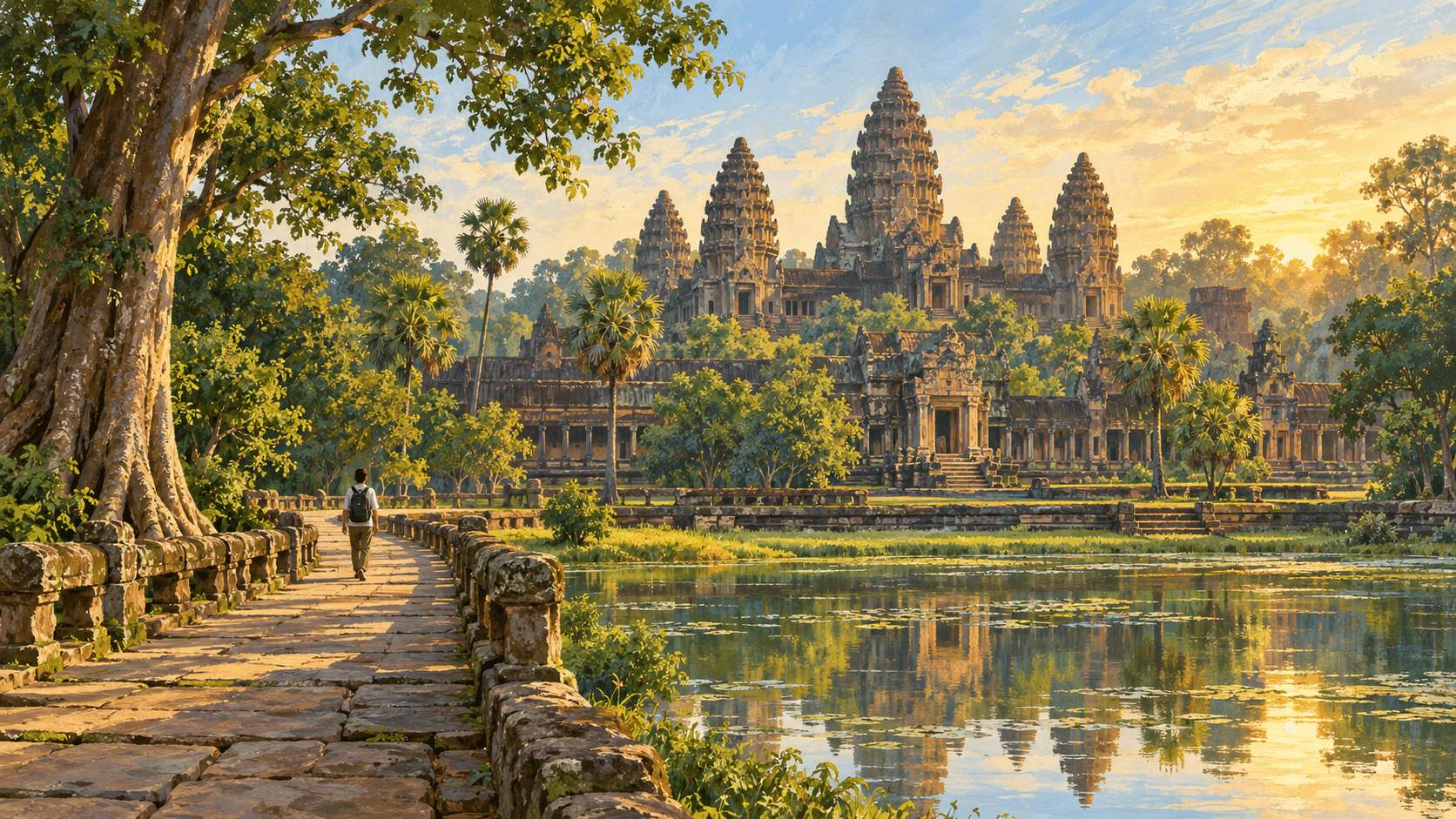
AI-generated editorial illustration of an imagined present-day scene inspired by Angkor, Cambodia; the architecture and setting are interpretive.
Paul Cooper’s Fall of Civilizations documentary, “5. The Khmer Empire – Fall of the God Kings,” offers an absorbing introduction to that world. Its sweeping narrative follows rulers, temples and the pressures surrounding Angkor’s decline. Watching it alongside Cambodian heritage sources raises an equally compelling question: how much can the end of an empire tell us about the lives and traditions that continued afterward?
A city larger than its famous temple
It helps to begin with a simple distinction. Angkor Wat is one temple complex within the much wider Angkor landscape. UNESCO describes the protected park as containing remains of successive Khmer capitals from the ninth to the fifteenth centuries. Angkor Wat, the Bayon, other temples, roads and settlements belong to this larger historical setting.
The distinction changes how we picture the past. A temple is often photographed in isolation, with visitors waiting for the moment when nobody crosses the frame. That makes a beautiful image. It also removes the activity that gives a place meaning. Every royal building invites practical questions: who supplied its food, carried materials, trained craftspeople and passed skills between generations?
Those questions bring the capital back into human scale. A ruler’s name may survive while the names of thousands of workers disappear. We can admire the achievement and still recognize how unevenly history distributes recognition. The building becomes more interesting when we make room in our imagination for the people beyond its patron.
How royal power became visible
Angkor Wat was commissioned in the early twelfth century by Suryavarman II and dedicated to Vishnu. Its rising galleries and central towers evoke Mount Meru, the sacred mountain of Hindu tradition, according to Cambodia’s Angkor Enterprise. Architecture gave religious ideas a setting that people could enter, move through and experience bodily.
There is also a political dimension to such magnificence. An immense sacred building can make the authority behind it feel enduring. Its scale offers a public demonstration of resources, organization and prestige. This is one useful way to read royal monuments, while remembering that devotion can be sincere and political at the same time.
Around 29 minutes into the documentary, Cooper makes a helpful observation about royal inscriptions: extravagant praise reveals how rulers wished to be remembered. That gives us a useful reading habit. When an inscription celebrates a king’s unmatched greatness, ask who commissioned it, who was expected to encounter it and whose version of events remains unheard. Confidence carved into stone still deserves questions.
The people beneath the royal story
Some of Angkor’s most revealing images bring us closer to ordinary activity. The APSARA National Authority’s account of the Bayon describes reliefs showing market stalls, workers and food preparation alongside grander subjects. Small human gestures share the monument with warfare and sacred imagery.
These scenes reward a slower kind of looking. A market stall suggests exchanges, skills and relationships that a list of kings cannot capture. A worker suggests a task someone had to learn. The carvings are composed representations, so we should avoid treating every scene as an unfiltered record. Even so, they widen our attention to the daily activity that sustained the capital.
Another perspective comes from Zhou Daguan, who arrived with a Chinese diplomatic mission in 1296. The publisher of a modern translation of his account lists subjects ranging from clothing and housing to trade, boats and royal processions. His curiosity helps us imagine a functioning society. His position as a visitor also matters: an eyewitness sees from somewhere, with particular expectations and limits. We gain a fuller picture by reading different kinds of evidence together.
A sacred place can acquire new meanings
Angkor’s monuments hold traces of changing religious life. The Bayon was the state temple of the Mahayana Buddhist king Jayavarman VII. Later Hindu and Theravada Buddhist rulers altered it according to their religious preferences, as Angkor Enterprise explains. Angkor Wat, originally dedicated to Vishnu, also became an important Buddhist sacred place.
APSARA records inscriptions at Angkor Wat from the sixteenth to eighteenth centuries commemorating pilgrims’ religious acts, including those of royal visitors. These later voices deserve attention alongside the founding patron. A subsequent image, shrine or devotional practice can become part of a monument’s meaning. Looking only for its original purpose can leave centuries of experience out of view.
The documentary gives religious change a major role in its explanation of political decline. That is an interpretation to examine carefully. A transition between traditions cannot, by itself, establish why royal authority weakened or why people moved. The surviving monuments invite more patient questions about how communities used inherited spaces, what they changed and what they continued to value.
What the word “fall” can hide
Historical storytelling needs turning points, and 1431 is commonly associated with an Ayutthayan attack and Angkor’s political decline. Yet a date can make a long transition seem like a single ending. A study led by Alison Carter and colleagues describes a more extended reorganization, involving shifting political power and continued occupation and religious importance around Angkor Wat. The temple was never completely abandoned.
Cooper himself acknowledges a gradual decline around 1:20:50, although other passages evoke a much emptier landscape. Holding those different emphases together makes for more attentive viewing. We can be moved by the narrative without assuming every district, household and sacred site followed the same timetable.
For a royal court, leaving a capital could mark a profound loss of power. For another community, remaining nearby or continuing to visit a shrine could sustain a connection across that change. The word “collapse” becomes more useful when we ask exactly what collapsed: a dynasty, a political center, an institution or a way of organizing life. Each question may have a different answer.
Learning to see a living heritage
Angkor remains a place of communities and cultural practices. UNESCO’s account describes villages, agriculture, ceremonies, music and craft traditions within its living heritage. That present-day life deserves a place in our understanding alongside the celebrated monuments. People who inherit a site also inherit the work of caring for it and the question of how it should be used.
As you watch the documentary, try carrying three questions with you. Whose perspective is shaping this scene? What evidence supports the explanation? What continued after the apparent ending? These questions deepen the pleasure of a good historical story by making us active participants in understanding it.
Angkor’s lasting fascination includes both achievement and change. Its temples allow us to consider how people express power, preserve beliefs and adapt inherited places to new lives. Looking beyond the ruined-capital image leaves us with a more generous understanding of history: generations can lose an old political order while continuing to create meaning from what remains.
Featured video: “5. The Khmer Empire – Fall of the God Kings” by Fall of Civilizations, written and presented by Paul Cooper.