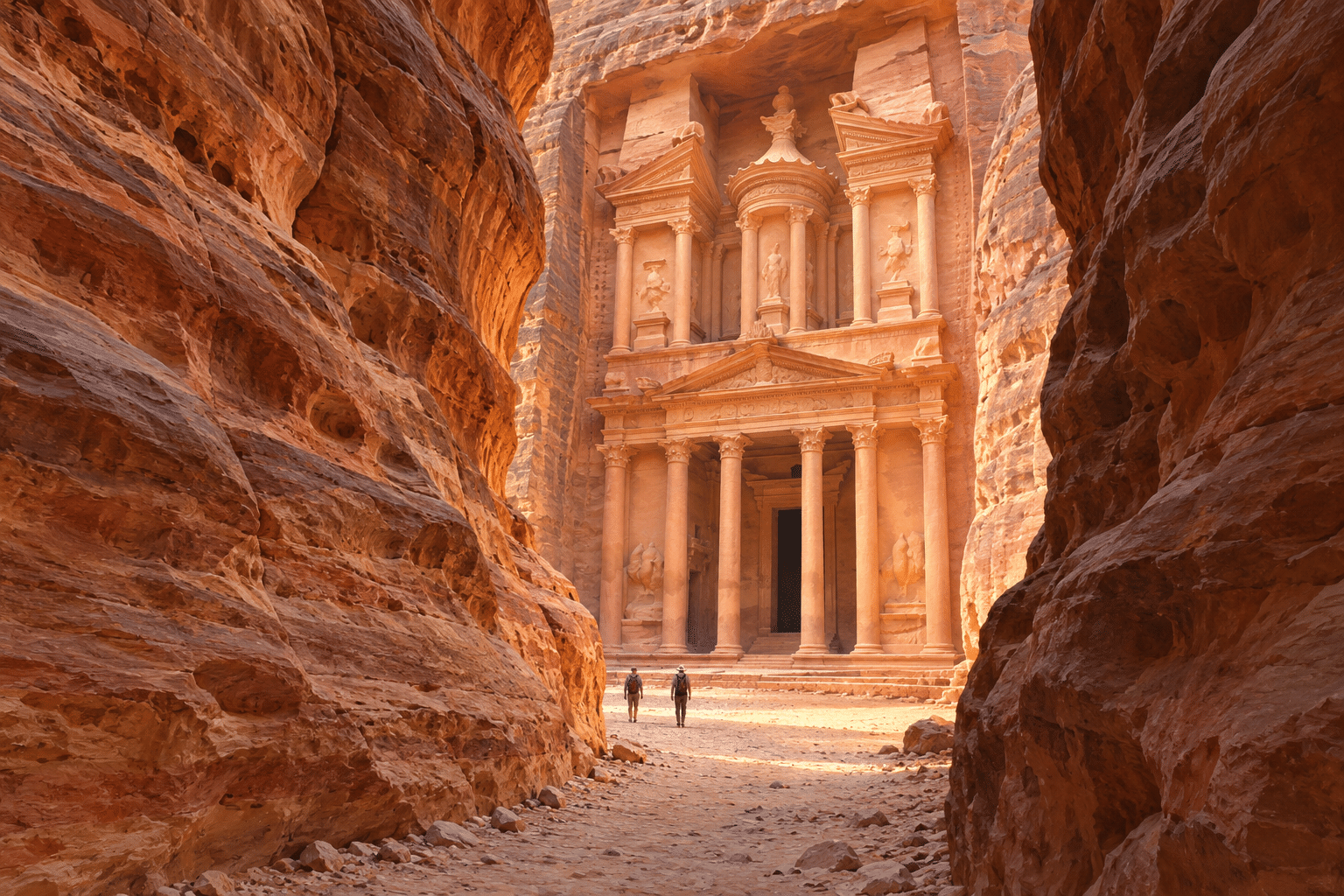
A narrow passage, tall sandstone walls and then a carved facade opening into view: Petra offers one of those encounters that can make a photograph feel suddenly inadequate. Yet the famous image is only a beginning. Behind the beauty is a history of people, movement and cultural exchange. National Geographic’s original film Stunning Stone Monuments of Petra, above, gives us a brief visual introduction. This article looks at the city as a meeting place, then offers some reflections on how to approach ancient heritage with attention rather than treating it as a backdrop for our own story.
A city at the crossroads
Petra lies in present-day Jordan. The Metropolitan Museum of Art’s account of the Nabataean kingdom describes a merchant realm connected to caravan routes linking Arabia and the Mediterranean with wider networks reaching India and China. Its capital, ancient Raqmu, was a place of exchange. The kingdom was incorporated into the Roman province of Arabia in 106 CE.
That setting changes the way we look at the stone. A facade need not represent a culture sealed away from everyone else. The Met identifies Egyptian, Mesopotamian and Hellenistic elements in Petra’s architecture. Local traditions and outside influences could occupy the same building. The people who shaped the city were participants in a connected world, rather than characters waiting to be discovered by later visitors.
Our interpretation of this history is that a crossroads can be a creative place. Meeting something unfamiliar does not have to erase what is already ours. It can produce a new form, provided we look closely enough to see the contributions involved. Petra makes that possibility visible, although its ancient relationships were more complex than any simple lesson about modern openness.
Look beyond the celebrated facade
UNESCO’s description of Petra includes tombs, temples, religious places and remains from successive periods. It also recognizes the channels, cisterns and reservoirs that supported settlement in an arid landscape. Petra became a World Heritage Site in 1985. Its significance extends beyond the single monument that most readily comes to mind.
A useful way to watch the film is to notice your own attention. Do you wait only for the recognizable view? Does the surrounding landscape become empty scenery while you search for the famous structure? There is no need to scold yourself for recognizing something beautiful. The invitation is simply to allow the edges of the frame to matter as well.
Try pausing on a wide scene. Follow the relationship between the doorway, the height of the cliff and the space around it. Imagine the ordinary tasks that any inhabited place requires: arriving, carrying, preparing, waiting and meeting. These imagined activities are not evidence of exactly what happened at that location. They are a way of remembering that a city is more than its most photogenic surface.
Respect begins with the names we use
“Lost city” is an evocative phrase, but it can make a place sound as if it vanished from everyone’s knowledge. A more careful vocabulary asks: lost to whom? Remote from whose familiar routes? The question is valuable even when we do not know the full history of a particular community’s relationship to the site.
Petra’s heritage belongs within Jordan’s living cultural landscape. Visiting, reading or watching from elsewhere does not make us the center of that story. The phrase “discovery” can sometimes describe a documented encounter, but it should not automatically imply that nobody knew the place before the traveler arrived.
For us as readers, this is an opportunity to practice a quieter kind of curiosity. Begin with the people who made the place and the people who care for it now. Learn the names that the sources provide. Notice when a dramatic title is doing the work of a historical explanation, and resist filling a gap with an attractive certainty.
The patience inside a beautiful object
Stone invites us to think about time. We see the finished outline, while the countless decisions that made it possible remain difficult to picture. A carved edge is also a record of attention: where to begin, what to remove, when to stop and how to work with a material that cannot simply be reset.
That observation is a reflection on craft, not a claim about the exact methods used for every monument at Petra. Still, it offers a way to appreciate heritage without inventing mysteries. We can admire skill even when we cannot reconstruct all of its stages. Incomplete knowledge can make a question more interesting without making a speculative answer more true.
The same patience appears on a smaller scale in things around us. A repaired garment, a carefully shaped cup or a well-built shelf carries decisions we may never notice. When we slow down enough to see them, beauty becomes connected to work. It stops being only a quality we consume and becomes something another person helped bring into the world.
Bring questions, leave the fantasy behind
A powerful image often prompts a powerful story. It is tempting to move directly from “this is astonishing” to “there must be an extraordinary hidden explanation.” Historical curiosity works better when we keep observation, established context and personal interpretation distinct.
- Observation: describe what you can actually see, such as color, shape or the relationship between a facade and its setting.
- Context: check what museums, heritage authorities and relevant scholarship establish about the place.
- Interpretation: name the meaning you find without presenting it as a fact about the builders’ intentions.
This distinction leaves room for wonder. It also makes wonder more generous: the real people and the surviving evidence can surprise us, instead of being forced into a story we brought along. A question can remain open while our appreciation grows.
A small practice in looking carefully
After watching the short film, choose one ordinary object near you and give it a minute of undivided attention. Notice a join, a worn patch or the way it catches light. Ask which features are useful and which express care. Then ask one question about its maker or history that you could actually investigate.
The exercise does not equate your household object with a major archaeological site. It connects two habits: appreciation and inquiry. Both improve when we stop requiring something to be spectacular before we look closely. We may discover that an object we barely noticed has been serving us faithfully for years.
Petra deserves attention on its own terms: a remarkable heritage site shaped by Nabataean lives and wider cultural connections. Our contemporary lesson is modest. Look beyond the iconic view, be careful with the stories you tell, and let admiration lead to better questions. A meeting place carved in stone can still invite a meeting between curiosity and respect.
Sources and further viewing: National Geographic’s original video appears above. Historical context comes from the Met’s Nabataean Kingdom and Petra and UNESCO’s Petra entry. The discussions of attention, craft and everyday objects are original interpretation.