A small game board can bring the ancient world unexpectedly close. Before anyone explains a dynasty or translates an inscription, you recognise the situation: two people facing each other, counters waiting to move, a throw that may help or undo a plan. Across thousands of years, the pleasure of wondering what happens next remains familiar.
The Royal Game of Ur invites that encounter without asking us to pretend the past is completely recoverable. There is a surviving object, there are later written clues, and there are modern interpretations of how to put them together. Keeping those layers distinct makes the story more interesting. We can enter a reconstructed game while remaining curious about what has been lost.
Look closely at the surviving board
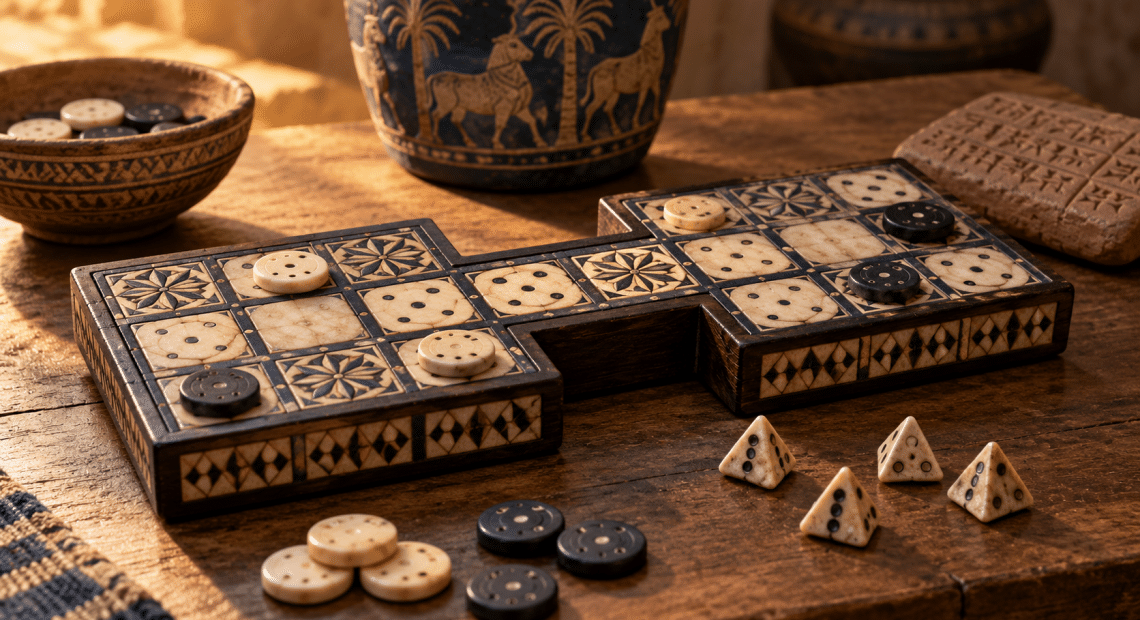
The British Museum’s catalogue for game board 120834 dates it to approximately 2600–2400 BCE. It records wood and shell, twenty square plaques and patterned inlay. The findspot is the Royal Cemetery at Ur in present-day Iraq, and the excavator is identified as Leonard Woolley.
Those details provide a firmer starting point than a sweeping claim about ancient wisdom. Count the squares. Notice the changes in width, the narrow connection between the broader ends and the recurring rosettes. The object gives a player something to do, but it also gives a careful viewer questions. Which features organise movement? Which decorate? Where does function meet visual pleasure?
The catalogue describes a drawer for pieces in the original wooden structure. Such a practical detail changes the scale of our imagination. This was an object someone could use and put away. We need not assign a hidden code to every mark in order to appreciate the thought involved in making a portable setting for play.
Watch history become a conversation
The original British Museum video above pairs curator Irving Finkel with Tom Scott for a full playthrough. Finkel introduces the evidence and a playable version of the rules; Scott asks questions, tries strategies and revises his understanding. The board on the table is a replica. Their conversation makes the reconstruction visible instead of quietly passing it off as an untouched ancient performance.
Early in the film, Finkel distinguishes the much older board from a cuneiform rules tablet written in the second century BCE. He also explains that the tablet concerns a more complicated version of a familiar game. The simpler game demonstrated in the video involves interpretation, including an inferred route. It is not a recording of every rule followed by every player two millennia earlier.
This difference is easy to overlook when a headline calls something the oldest playable game. A modern reconstruction can be informed, persuasive and enjoyable without closing every historical question. The gap between evidence and interpretation is not a reason to dismiss it. It is a reason to say clearly which part comes from an object, which from a text and which from a proposed model.
Chance creates a question; choice gives it shape
In the demonstrated version, each player races seven counters along a track and tries to remove them before the opponent does. The throw determines the available movement. Some positions expose a counter to capture; rosette spaces offer advantages under these rules. What initially looks like a simple journey quickly becomes a set of competing possibilities.
Scott begins by thinking about randomness, then recognises that decisions matter too. Should he introduce another counter, advance one already in danger or take an opportunity to send an opposing piece back? The throw does not make that decision for him. Nor can a clever decision guarantee a favourable next throw.
That tension is worth watching slowly. It is tempting to judge a choice by the result that follows it. A fortunate throw makes a risk look wise; an unlucky turn makes a reasonable plan feel foolish. The game lets us notice the difference between the quality of a decision and the outcome of one particular attempt.
This is an invitation to reflection, not proof of a universal lesson delivered by ancient players. We cannot know what a specific person in Ur thought during a frustrating game. We can observe our own response to a similar arrangement of uncertainty, competition and delayed reward. The present experience belongs to us; the historical claim still needs its evidence.
Let the pattern invite attention without inventing a secret
The rosettes are visually memorable. Repetition draws the eye and gives the board a rhythm, even before a player learns what a marked square does. It is reasonable to ask whether such motifs carried associations for their makers. It is less reasonable to announce a single concealed meaning from the shape alone.
Symbols live within languages, practices and particular communities. An attractive resemblance to a modern diagram does not establish a historical connection. If a claim about the board’s geometry interests you, ask for its source and date. Does it describe this object, a different board, a later text or a contemporary interpretation inspired by ancient art?
Curiosity becomes stronger when it can tolerate those distinctions. A game does not need to be a secret technology to deserve attention. Its design already accomplishes something remarkable: it creates a shared situation in which a few pieces and agreed rules can hold two people’s concentration for an extended time.
There is another useful boundary to keep: understanding a rule is different from understanding its consequences. A newcomer may repeat the instructions accurately and still miss a good move. Experience reveals combinations that a spoken explanation cannot supply all at once. That does not make the instructions useless; it gives practice a purpose.
When looking at an ancient object, the same patience helps. A first description may be correct and incomplete. Return to the catalogue after watching the demonstration. Details that once seemed decorative or incidental may now prompt a better question. Learning changes what you are able to notice, without turning every new impression into a historical fact.
Make room for the other player
Perhaps the most familiar part of the film is the conversation around the moves. There is teasing, explanation, surprise and the gradual recognition that the newcomer understands more than he did at the beginning. The contest works because both players keep attending to the same small world on the table.
You can bring that quality to an ordinary game evening without buying an archaeological replica. Choose something simple enough to explain clearly. Put away competing screens. Allow questions before treating a mistake as carelessness. Notice when winning begins to matter more than the experience you intended to share.
Afterwards, compare what you thought would happen with what actually happened. Which risks did you avoid? Did you change your strategy when new information arrived? A game offers a modest setting for such questions because its boundaries are visible. There is a board, a beginning, an ending and another person whose choices you cannot control.
The Royal Game of Ur remains compelling at the meeting of these two kinds of attention. Historical care asks us to respect the surviving evidence and its limits. Play asks us to enter the moment before the next move is known. Together they offer a way to approach the past that is neither distant admiration nor invented certainty: learn what can be learned, then remain present for the next question.