The wave is so familiar that it can seem to arrive already understood. A curling crest, white spray, deep blue water: recognition happens before the eye has time to wander. Yet Hokusai’s famous print contains details that complicate that instant response. There are people beneath the foam, a mountain beyond the boats, and a surprisingly quiet stretch of sky inside the commotion. What changes when those smaller elements receive as much attention as the wave?
In Better Know the Great Wave, Sarah Urist Green and The Art Assignment introduce the work’s composition, history, and afterlife as a widely reused image. Their discussion offers a starting point for a deeper question: how does a particular scene become a symbol that different people can recognize, borrow, and interpret? The answer begins with looking closely enough to let a familiar picture become unfamiliar again.
Find Mount Fuji beneath the wave
The Metropolitan Museum of Art’s collection record identifies the print as Under the Wave off Kanagawa, from Hokusai’s Thirty-six Views of Mount Fuji, and dates it to approximately 1830–32. Made with ink and color on paper, the Met’s impression measures just 25.7 by 37.9 centimeters. Its enormous imagined world fits within a modest physical object.
The series title redirects attention toward the small triangular summit in the distance. The Met notes Hokusai’s use of perspective to place the mountain within the wave’s hollow. Follow that opening with your eye: the crest becomes an irregular frame around something much farther away.
One possible reading is that the picture holds two kinds of importance together. The foreground demands attention through size and movement; the mountain matters through its position and the larger series to which the print belongs. Visual prominence and significance need not coincide. That is a useful question to carry into any image: what attracts the first glance, and what organizes the scene once that glance has passed?
Three boats give the spectacle human stakes
Look along the narrow boats, then locate the people inside them. Their bent bodies and repeated shapes can almost disappear into the surrounding pattern. The British Museum’s account of the composition describes three skiffs beneath the approaching wave and observes echoes between the curves of the boats, the swell, and the mountain’s slopes.
Those repetitions make an interesting visual problem. The people belong to the picture’s rhythm, yet recognizing them interrupts the pleasure of simply following beautiful lines. What seemed decorative acquires consequences. A viewer can admire the shape of the crest and worry about what it might do in the same moment.
The Art Assignment reads the contrast in scale as a confrontation with human vulnerability. That interpretation is persuasive, but it leaves room for further looking. The clustered figures also invite attention to shared effort: several people occupy each precarious vessel. The print does not disclose their thoughts or settle their fate. Its human drama remains suspended, allowing concern to continue beyond the instant represented on the page.
The blue belongs to a workshop
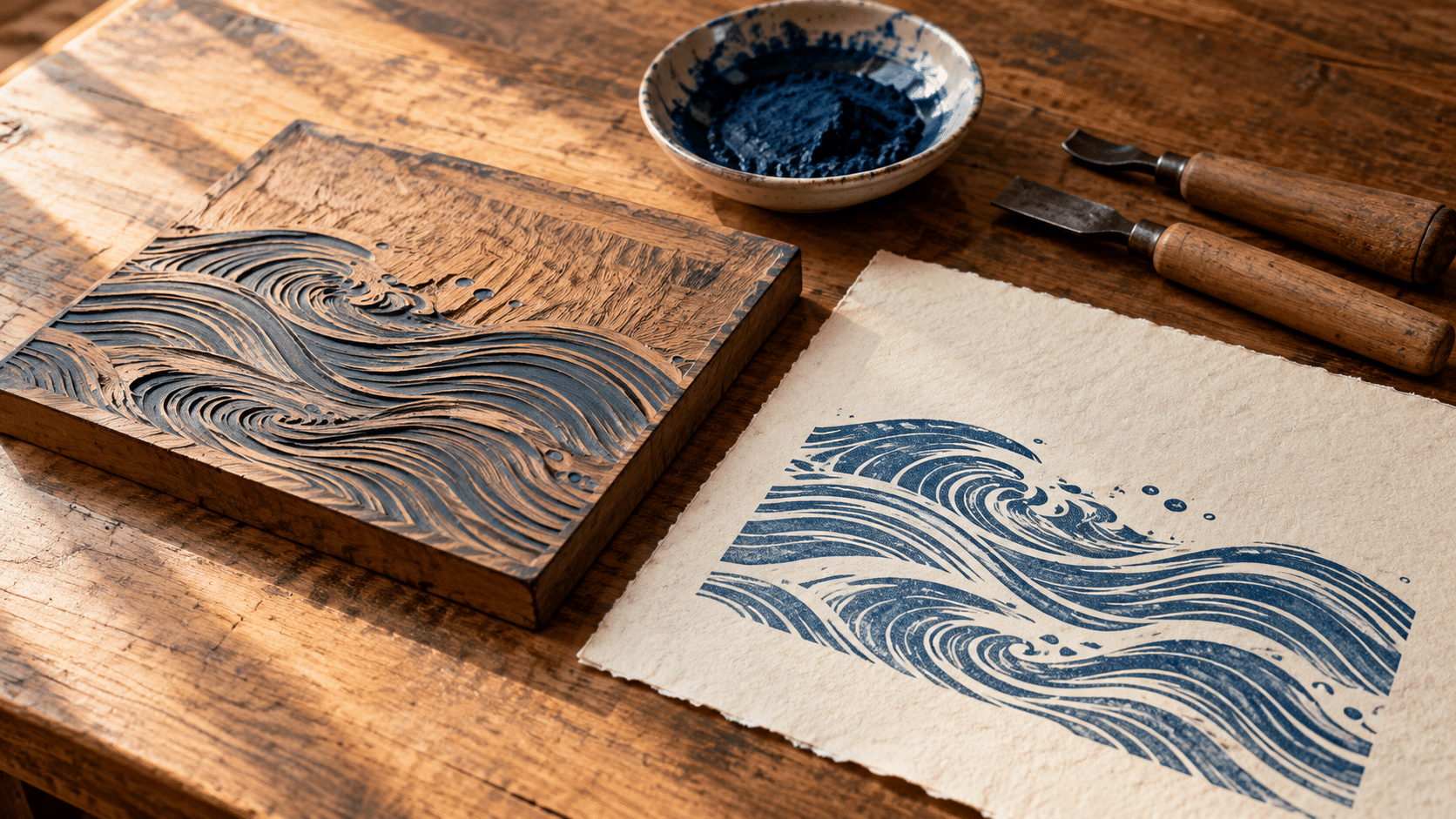
The image carries Hokusai’s name, but its appearance also depended on skilled makers whose names have not survived. In the Met’s examination of the print’s production, Marco Leona explains the contribution of Eijudo’s woodcutters and printers. The workshop combined indigo with imported Prussian blue and layered printed color to achieve the dark and luminous passages of the sea.
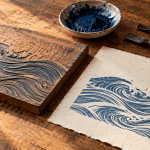
The British Museum’s woodblock-printing demonstration helps make that labor imaginable. A design on thin paper is attached to wood; carving removes the spaces around its lines; ink is applied to the raised surfaces. The original drawing is consumed in making the block.
Knowing this changes how a crisp outline can be appreciated. It is both a decision about shape and the result of careful physical work. Even the space left clear requires preparation. The wave’s apparent spontaneity rests on a sequence of deliberate actions. For a contemporary viewer, this is also an invitation to broaden artistic credit: a celebrated image can preserve the achievement of a collaboration even when history remembers only one participant.
There is more than one original Great Wave
Reproduction belongs to the work’s beginnings. In her British Museum comparison of surviving impressions, Capucine Korenberg explains that there is no single definitive version. Blocks wore down, lines developed breaks, replacement blocks altered details, and some late impressions used a different color for the boats. These variations provide evidence of the design’s life in print.
This complicates the familiar wish to find the one authentic image behind every copy. An impression can be an original historical print while differing from another original historical print. A modern reproduction is a different thing again. Asking which object is being shown, and how it was made, is more useful than assuming that every version has the same status.
There is pleasure in that specificity. Compare two museum images and choose one small area: a boat’s side, a band of blue, or the outline of the distant summit. The exercise turns recognition into observation. Differences that disappear when the work is reduced to a tiny icon become part of its material history when given a little room.
A symbol travels by leaving details behind
The Art Assignment points to the image’s movement through advertising, clothing, tattoos, and digital culture. Its recognizable form can survive dramatic changes of setting. But a symbol’s mobility raises a question about what travels with it. Does a viewer encounter Hokusai’s whole composition, a fragment of its outline, or a new message attached to that fragment?
Try a simple thought experiment. Imagine the wave with the boats removed. Then imagine a version that leaves only the distant mountain. Each selection changes the balance of attention. A threatening encounter can become an elegant pattern; a crowded foreground can give way to stillness. These are interpretive possibilities, rather than claims about a single meaning Hokusai intended.
This makes the print a useful companion for reading visual culture more generally. When an image appears beside a slogan, the slogan helps direct its meaning. When it is cropped, the missing details matter. Familiarity can make those decisions easy to overlook. Asking what has been kept, enlarged, or removed restores some awareness of how a symbol is being used.
Give the familiar image another minute
A rewarding return to the Great Wave needs no hidden code. Begin with what is visible: the shapes, the intervals between them, the small figures, and the direction in which your attention moves. Then separate three questions. What can the picture show? What does historical evidence establish? What meaning are you bringing to it today?
Those questions can coexist without producing a final answer. The print can suggest danger to one viewer, collective persistence to another, and extraordinary formal invention to both. Its specificity keeps those responses grounded: this arrangement of boats, water, sky, and mountain continually offers something against which an interpretation can be tested.
Perhaps the most useful invitation is to resist finishing with recognition. Find the people. Follow the lines. Notice how much survives inside an image that seemed to need only a glance. A powerful symbol remains alive when familiarity becomes an opening for attention.
Original video: Better Know the Great Wave, The Art Assignment / PBS Digital Studios, presented by Sarah Urist Green.