Maybe it is the drawer you have to close with both hands. Maybe it is the shirt you move aside every morning, or the kitchen cupboard that hides the one pan you use. These ordinary encounters can make minimalism interesting long before you have any desire for an empty room. What would you like to find more easily? What are you tired of maintaining? Which belongings still deserve their place in your day?
Pick Up Limes explores the subject in Beginner’s Guide to Minimalism, an original video from 2017 that has passed one million YouTube views. Its chapters include finding a personal reason to begin, keeping meaningful objects and noticing triggers. Those themes offer a starting point for a practical question: how could your possessions better fit your life? The suggestions below are independent Awakening365 reflections, offered as adaptable experiments.
Start with a change you would actually welcome
Before opening a cupboard, describe something you want to be able to do. Perhaps you want to set the table without relocating a stack of papers. Perhaps you would like to get dressed using clothes that fit comfortably, or finish a small repair without searching for the tools. A specific purpose gives you a useful way to decide what belongs.
Try writing one sentence: “I want this space to make it easier to…” Complete it with an activity from your actual week. Then look at the objects that support that activity and the ones that repeatedly get in its way. This approach leaves room for a crowded bookshelf that you love and a well-stocked cupboard that serves your household.
Keep your circumstances in the picture. Renting, sharing a room, working from home and having limited money all affect what makes sense to keep. An extra item can be a sensible reserve when replacing it would be difficult. Your purpose should account for that reality.
Choose a small area with a clear stopping point
Choose one drawer, one shelf or the contents of a bag. Pick somewhere you can finish without spreading the whole household across the floor. Give yourself enough time to put everything back. If the space contains someone else’s belongings, choose another starting point or ask them to join you.
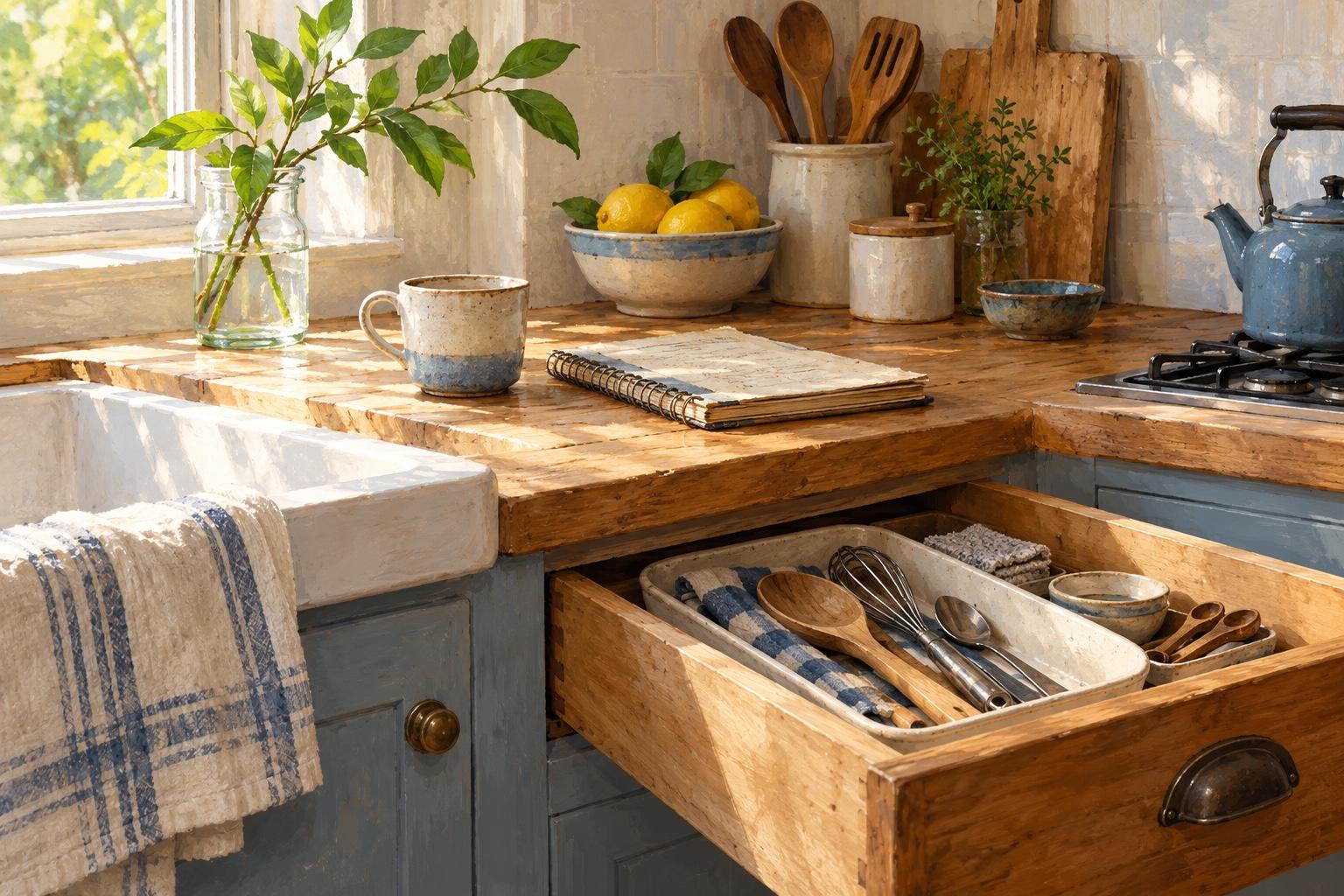
Take a look at what is there. Separate the things that belong elsewhere from those you use in this location. You might discover that the drawer needs fewer unrelated objects rather than an elaborate new organizing system. Put the useful things where you can reach them, using containers you already have if they help.
For belongings you are unsure about, a temporary holding place may be useful. Label it with a date to review, and keep a brief note of what it contains. Leave essential equipment, important documents and things you need regularly accessible. When the review date arrives, decide deliberately; an unopened box alone does not prove that everything inside is expendable.
Let keeping something be a considered choice
Minimalism can become another source of pressure if every object has to defend itself against an arbitrary number. Instead, ask what kind of value a possession has for you. Usefulness is one answer. Pleasure, memory, craft and connection can be answers too. A worn recipe notebook might belong in your kitchen because you cook from it, because it holds someone’s handwriting, or both.
If an object matters, consider whether its current place lets you enjoy or use it. You could move one photograph where you see it, repair a favorite garment or put a musical instrument within reach. Sometimes the worthwhile change is giving an existing possession a more active place in your life.
Allow difficult decisions to take longer. Sentimental belongings can carry feelings that a quick sorting session cannot settle. You may want to keep them, share their stories with family or revisit the question later. Choose a pace you can live with. A clear surface has little value if getting there requires decisions you already expect to regret.
Pause before bringing the next thing home
Once you have made some room, notice what tends to fill it. A sale email, an attractive display or an evening spent browsing can introduce a purchase you had not previously considered. Try identifying the moment when an interesting object becomes an apparent need. Curiosity about that moment can guide your next choice.
For a nonessential purchase, write down the item and what you expect it to do. Revisit the note after a pause that suits the situation. Would you still want it without the discount? Do you already own something that serves the purpose? Where would you keep it, and what maintenance would it require?
Sometimes buying will be the reasonable answer. A replacement that works, equipment for a lasting interest or something that makes an everyday task accessible can earn its place. You might also borrow, repair or buy used when those options are practical. Be especially cautious about buying a collection of organizers before you know what you intend to store.
Respect the people who share the space
Other people may value belongings differently. One person sees a spare chair; another sees a place for a friend to sit. One person wants a clear counter; another needs frequently used equipment within reach. A workable home has to accommodate those differences, including needs that are not immediately visible.
Start conversations with the specific difficulty. “Could we keep enough room here to prepare dinner?” gives someone a concrete problem to discuss. Ask which possessions and arrangements matter to them. Agree on a small shared area or a change you can both try, and leave their personal belongings for them to decide about.
Give outgoing items an equally considered next step. Offer a usable object to someone who wants it, check what a local donation service accepts or use an appropriate disposal route. A bag waiting indefinitely by the door is still an unfinished task. Include the time and effort of passing things on when choosing how much to sort.
Notice what works after the tidy photograph
Return to your chosen area after an ordinary week. Can you find what you need? Is it straightforward to put things away? Did something you moved turn out to be useful after all? These observations are more informative than whether the space still looks exactly as it did when you finished.
If the arrangement keeps breaking down, examine the practical reason. Perhaps an object lives too far from where you use it. Perhaps the storage is awkward to reach. Perhaps the area is serving several purposes, and each needs a little room. Adjust the arrangement before deciding you need to discard more.
You can stop when the change is useful. Enjoy setting the table, finding your keys or reaching for the book you meant to read. There is no requirement to turn the whole house into an ongoing project. Practical minimalism can begin with one honest decision about what to keep, where to put it and whether the next purchase belongs. What small part of your day would you like to make easier?
Watch the original video: Beginner’s Guide to Minimalism: Inspiration to Get Started, by Pick Up Limes.