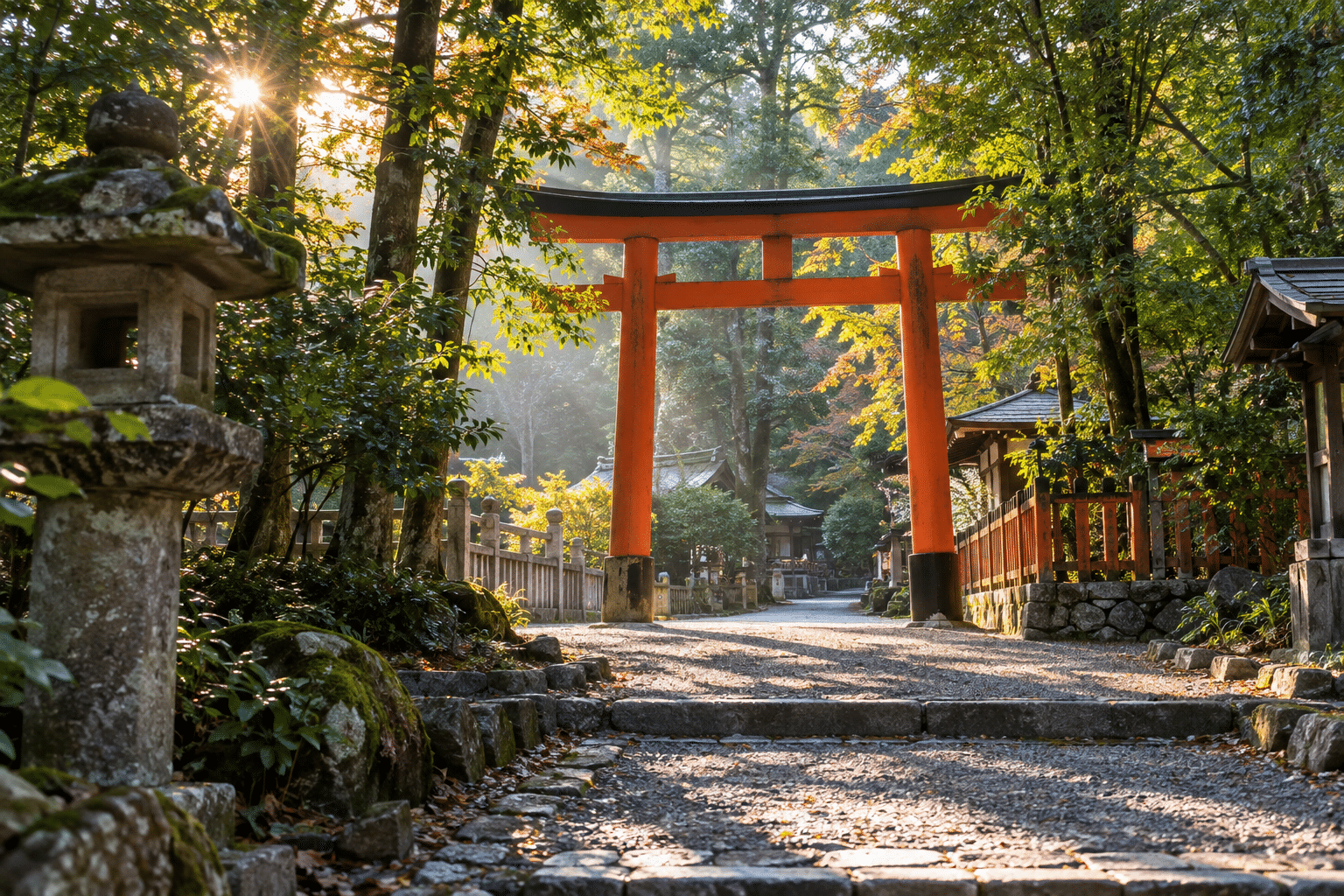
A path bends between trees. Ahead, a torii marks the approach to a shrine. To someone meeting Shinto for the first time, that gate can look like the whole story: a striking object framed by a green landscape. Yet the threshold matters because of the practices and relationships around it. ReligionForBreakfast’s video What is Shinto? offers an accessible introduction to a Japanese religious tradition that has changed over centuries and remains varied in the present. The best way to watch is with curiosity and with care for that variety.
A threshold, not a shortcut
A torii can indicate an entrance to a shrine precinct, where a visitor’s movement becomes more deliberate. The Association of Shinto Shrines’ visitor guidance describes customary ways of entering and paying respect, including a bow before passing through the gate. Such guidance makes more sense as part of an actual visit than as a decorative rule to imitate anywhere. A visitor needs to attend to local signs and to the people who care for the place.
The threshold is useful as an image for an article because it reminds us to slow down before making broad claims. A single short video cannot stand in for every shrine, community, or Japanese person’s experience. Shinto has no single founder and no one creed binding all of its forms. That does not mean it has no teachings or no disciplined practices. It means a tidy one-sentence definition can flatten what is lived in many ways.
Who or what is a kami?
The word kami is often translated as deity or spirit, but neither English word captures all of its uses. The Kokugakuin University Encyclopedia of Shinto explains that kami can be spoken of in relation to natural features, ancestral figures, and other beings or powers held in reverence. It would be misleading to reduce the idea to “nature spirits.” It would be just as misleading to assume that every instance works like a single Western idea of God. Translation can open a door while also leaving important differences on the other side of it.
A common expression refers to “eight million” kami. That is a way of evoking abundance rather than a literal census. It hints at the difficulty of enclosing the sacred in one short list, but a visitor should still ask which kami are honored at a particular shrine and what local histories shape that honor. Respect begins with attention to a specific place rather than with a vague claim that every tree or stone means the same thing to everyone.
A history made through change
The word Shinto can suggest an unbroken, unchanging system stretching back to an immemorial beginning. The history is more complicated. Kokugakuin’s historical account traces changing ways of naming and organizing shrine practices. It is safer to see continuity and change together: people inherited rituals, altered institutions, interpreted old stories, and responded to new political and religious settings. No single date neatly explains every part of the tradition.
Interaction with Buddhism is central to that story. For long periods, practices and institutions associated with kami and buddhas were intertwined. The Encyclopedia of Shinto’s account of their relationship also describes the major separation policies that followed the Meiji Restoration in 1868. If we imagine two sealed traditions that never met, we miss much of what people actually built and experienced. If we imagine only a blend, we miss the real changes that separation brought. History is less elegant than a slogan, and more revealing.
The video is an introduction, so it necessarily compresses this background. That is a reason to use it as an opening, not as the final authority on every period. When a historical claim feels surprising, ask which century it concerns and whether it describes a ritual, an institution, a text, or an entire population. Those are different kinds of claims, and they need different evidence.
Purification, offering, and shared time
Purification is another word that can be misunderstood when lifted from its setting. In Shinto contexts, harae refers to forms of purification understood within religious life. Kokugakuin’s entry on harae describes its ritual meanings and varieties. A visitor may also encounter customary washing at a water basin before prayer, as the shrine association’s guidance explains. The fact that people perform these acts is observable; what they mean spiritually belongs to the tradition and its participants. We should not turn a religious claim about purification into a laboratory claim about health.
Offerings, prayers, and festivals can bring individual visits into a wider communal calendar. They are not interchangeable pieces of a generic “mindfulness” routine. Their forms matter because they connect people to shrines, seasons, local histories, and relationships. The Association of Shinto Shrines’ overview provides one institutional account of that world. Other voices within Japan may explain a particular practice differently. Learning starts when we notice the concrete practice and then ask whose account we are hearing.
Participation and identity are different questions
A person may visit a shrine, take part in a festival, or keep a household practice without using the same religious label that an outside survey would assign. It is easy to confuse participation with identity. A statistic about visits cannot, by itself, tell us what each visitor believes; a statement about personal identity cannot tell us every ritual someone might join. That distinction helps us avoid portraying all Japanese people as Shinto believers or treating Shinto as merely a picturesque feature of Japanese scenery.
ReligionForBreakfast’s presentation, written with scholar Kaitlyn Ugoretz, is valuable because it gives viewers a starting vocabulary and several questions to pursue. The video still has a narrator, a selection of examples, and a limited running time. We can appreciate its clarity while checking fuller accounts for any point we want to repeat. The sponsor segment toward the end is separate from the subject matter and is not evidence about the tradition.
Carry curiosity past the gate
If the video prompts a visit to a shrine, begin with the shrine’s own information. Notice the approach, the posted customs, and the care people give the place. If travel is not possible, choose one term from the video—kami, torii, harae, or festival—and compare how a university reference and a shrine organization explain it. Write down what each source clarifies and what questions remain. This is a more respectful exercise than trying to extract a universal life lesson from a few images.
There is room for personal reflection, too. A threshold can remind us to enter unfamiliar spaces with less haste. But that is our interpretation of an encounter with Shinto, not the tradition’s purpose reduced to a self-help sentence. The real subject is a living and historically shaped set of practices in Japan. The torii may draw our eye; careful listening, reading, and attention to the people and places beyond it can carry us further.