A copper vessel can make an ordinary moment feel considered. Its warm color invites a closer look, and the traditions surrounding it invite questions about how everyday objects shape our lives. When that curiosity turns toward health, a second kind of attention becomes valuable: reading the evidence and checking the actual product. Today’s Flat Earth Shop feature explores both, beginning with Sadhguru’s short reflection on copper vessels and ending with the questions a thoughtful buyer can ask.
What Sadhguru says about copper vessels
In the 33-second video on his official channel, published May 18, 2024, Sadhguru says that storing water in a copper vessel for four to four-and-a-half hours can enhance intelligence, bodily functioning and neurological functioning.
These are spiritual and wellness claims. The clip offers his perspective, without presenting a clinical study demonstrating those outcomes. A viewer can find the ritual interesting while still asking how its health claims have been tested.
The specific time period also deserves care. A precise number can sound like a tested prescription, even when the evidence behind it has not been supplied. The video does not establish a medically validated storage time, a safe copper exposure level or an intelligence benefit. It also provides no product-specific evidence for the bottle discussed here.
Copper has a real nutritional role
Copper is an essential mineral. The NIH Office of Dietary Supplements describes its involvement in energy production, iron metabolism, connective tissue and neurotransmitter synthesis. Adults generally need 900 micrograms a day, with different requirements during pregnancy and breastfeeding. Foods including nuts, seeds, shellfish and whole grains supply copper.
That nutritional role does not establish that adding copper through a vessel improves a well-nourished person’s thinking. A claim about an essential nutrient and a claim about a particular way of consuming it require different evidence.
There is also a balance to respect. NIH notes that excessive copper exposure can cause gastrointestinal symptoms and liver damage, although toxicity is rare in healthy people without inherited problems regulating copper. People with Wilson’s disease have a particular risk of copper toxicity and should follow their clinician’s guidance.
A bottle should never become a way to diagnose or treat a suspected nutrient deficiency. Questions about individual copper needs belong with a qualified healthcare professional.
What the laboratory research actually measured
Copper’s interaction with microbes has attracted serious research. In a 2012 study published in the Journal of Health, Population and Nutrition, researchers deliberately contaminated water with selected diarrhea-causing bacteria and stored it in copper pots for 16 hours at room temperature. Afterward, they could not recover those bacteria using the study’s culture methods.
The experiment is relevant to understanding copper under those test conditions. Its outcome was a laboratory measurement involving specified organisms, water and vessels. It did not measure changes in intelligence, neurological function or illness rates among people drinking from a retail bottle.
The 16-hour experiment also cannot validate the video’s four-to-four-and-a-half-hour claim. The studies would need to address the same question before that comparison could support a conclusion.
For the same reason, this research gives us no basis for promising antimicrobial performance from the current Flat Earth Shop bottle. Do not rely on an unverified vessel to make unsafe water drinkable or replace established water-treatment advice.
The missing step: health outcomes in people
A May 5, 2020 topic brief from the Agency for Healthcare Research and Quality considered the benefits and harms of drinking water from copper vessels. It reported no primary studies addressing the proposed health-outcome question and declined to develop a new evidence review.
This was a topic assessment, rather than a completed systematic review proving either benefit or harm. Its date matters, too: it describes what the program identified at that time.
The useful lesson is about the question being asked. Demonstrating an effect on bacteria in a controlled experiment leaves further work before researchers can claim a meaningful health benefit for people. Neither that experiment nor the AHRQ brief establishes Sadhguru’s claims about enhanced intelligence or neurological functioning.
Why the inside of a vessel matters
For anything intended to hold a drink, the surface touching the liquid deserves attention. A product photograph cannot establish the composition of that surface, the suitability of a coating or the conditions under which the finished item has been evaluated.
Acidity is one reason those details matter. Section 4-101.14 of the FDA’s 2022 Food Code generally prohibits copper and copper alloys from contacting foods below pH 6, giving vinegar, fruit juice and wine as examples. It includes a limited brewing exception. The code’s explanation notes that acidic foods can cause copper to leach into them.
The Food Code is a model for retail and food-service regulation. Its provision is useful safety context, rather than a certification of any consumer bottle. Staying above a particular pH would not, by itself, verify a product’s food-contact suitability. The complete item and its intended use still need documentation.
A closer look at the Flat Earth Shop bottle
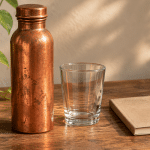
The current Flat Earth Shop copper bottle listing describes a smooth finish, a screw-top lid and an approximate 34-fluid-ounce capacity. Those details explain its visual appeal and generous proportions.
The listing also carries an essential qualification: food-contact suitability and permitted drinks have not been confirmed, and it instructs customers not to use the item for drinks until those details are verified. That qualification should guide any decision about beverage use.
We have no product-specific material testing or food-contact documentation that would resolve that uncertainty. Accordingly, this feature makes no recommendation to drink from the bottle and no claim that it purifies water, provides antimicrobial protection or improves health.
If its appearance appeals to you, consider it on those terms while the practical questions remain open. The product name, its heritage-inspired presentation and research about other copper vessels cannot fill in missing information about this particular item.
Questions worth asking before beverage use
A useful inquiry to a seller can be brief and concrete:
- What materials contact the liquid, including the interior, lid, seal and any coating?
- What food-contact documentation applies to this exact finished product?
- Which liquids, temperatures and contact times does that documentation cover?
- What cleaning methods are supported, and what signs of damage mean use should stop?
Look for answers tied to the actual model and intended use. A broad statement about copper’s history or a study involving different equipment will leave those questions unresolved.
For this Flat Earth Shop bottle, wait for verification before any beverage use. In the meantime, curiosity can remain generous and precise: appreciate the design, explore the tradition and ask for evidence when a claim reaches into health. That kind of attention is a worthwhile daily practice in itself.