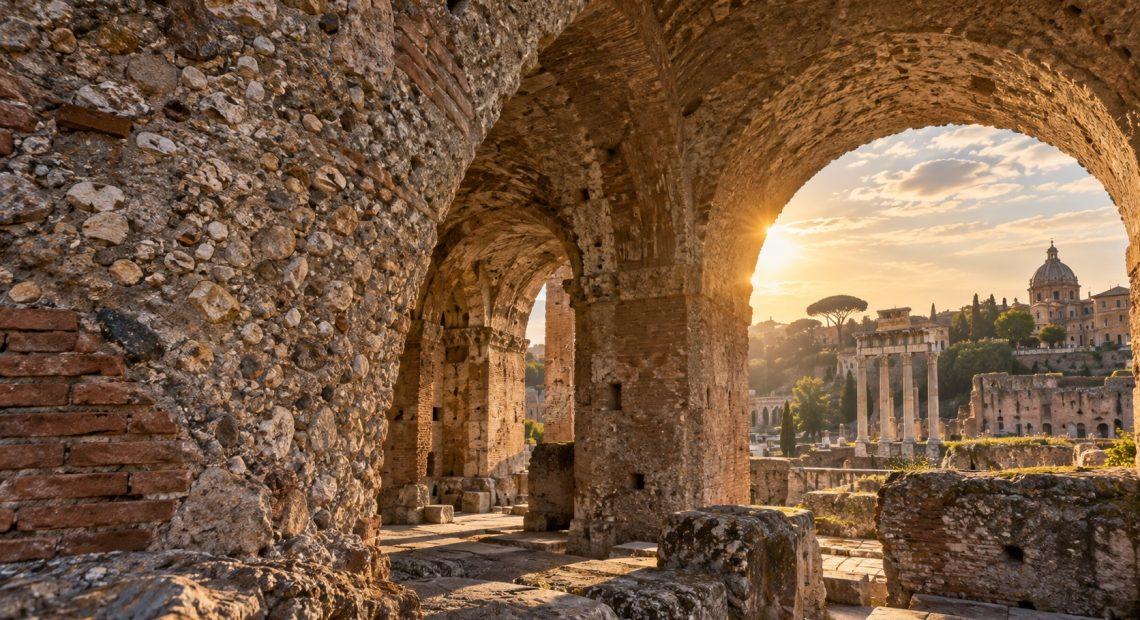
The Pantheon’s dome, Roman harbor walls, and fragments of ancient roads invite a compelling question: how did builders working nearly two thousand years ago create structures that still command attention? It is tempting to call the answer a lost secret. A more useful approach is to examine the materials, the environment, and the patient experimentation behind them. Ancient builders were not using magic. They were solving real engineering problems with the resources available to them.
Practical Engineering’s video “Was Roman Concrete Better?” is a good starting point. It has more than 2.6 million views and makes an important distinction: “better” depends on what the structure needs to do. Modern concrete can be engineered for immense strength, speed, and highly specific applications. Roman concrete was built for a different world, with different ingredients and different demands.
A Material Designed Around Place
Concrete is a composite. A binder holds pieces of stone or other aggregate together. Roman recipes varied by location and purpose, but many used lime and volcanic material known as pozzolan. Builders did not have one universal formula that worked identically for a sea wall, a vault, and a road. Their choices responded to local stone, available fuel, water exposure, construction methods, and the intended life of a structure.
That flexibility matters. When people admire a Roman monument, they often imagine an ancient master formula that modern civilization somehow forgot. Yet the surviving structures are evidence of many decisions made in context. The material was only one part of a system that included design, thickness, foundations, drainage, maintenance, and a willingness to build for long periods of service.
The remains also create a visibility problem. We tend to photograph the most durable examples. The Roman structures that failed, were dismantled, or were rebuilt rarely become viral images. Survival is remarkable, but it does not prove every ancient building outperformed everything constructed today.
What Researchers Found Inside the Mix
Modern analysis has made the story more interesting, not less. Researchers at MIT studied tiny white fragments called lime clasts in samples of Roman concrete. For years, these particles could be dismissed as signs of poor mixing. Their work suggests a different possibility: some Roman mixtures may have used a hot-mixing process that left reactive lime-rich particles within the hardened material.
When small cracks formed and water entered, the particles could provide calcium that later recrystallized, helping to seal the gaps. MIT’s account of the research describes experiments with historically inspired mixtures that support this self-healing mechanism. This is a fascinating finding, but it is not a claim that every Roman wall repaired itself or that ancient concrete was invulnerable. Different recipes, environments, and building histories call for different explanations.
This is the part of lost history that deserves more attention. The mystery is not an unknown civilization with impossible technology. It is the detailed know-how carried by craftspeople and adapted across generations. A tiny white particle in a piece of stone can reveal a manufacturing choice that written records did not fully preserve.
The Sea Changed the Chemistry
Some Roman marine structures present another puzzle. Salt water is harsh on many modern materials, especially when reinforced steel corrodes. Yet certain ancient harbor concretes persisted for centuries in contact with seawater. Research has explored how volcanic ash, lime, seawater, and slow mineral changes interacted in these structures.
That does not mean dropping a Roman recipe into a modern building would solve every durability problem. A modern bridge has different loads, safety standards, construction schedules, and often steel reinforcement. Roman harbor concrete and a high-rise foundation are not interchangeable. What the comparison does show is that materials can evolve after they are placed. The passage of time is part of the chemistry, not merely a countdown to failure.
It also reminds us to ask what we mean by progress. A material optimized for rapid construction may not be optimized for the lowest long-term repair burden. A material with impressive compressive strength may still be vulnerable when water reaches its reinforcement. There is no single score by which to rank all concrete across all uses.
Why Craft Knowledge Disappears
Knowledge can be lost without a dramatic catastrophe. Supply routes change. Quarries close. Skilled workers move. Patronage ends. Building codes and labor costs favor new methods. A technique that depends on one region’s volcanic deposits may never have been practical everywhere. When a society stops making a material, its most precise practical details can fade even while its monuments remain in sight.
That is why archaeology works best when it combines physical samples with written sources and experiments. An ancient author might record ingredients but leave out temperatures, timing, or the texture a craftsperson knew by touch. Microscopes can reveal the result, while experimental builders test whether a proposed process can reproduce it. Neither source of evidence is complete alone.
There is a broader lesson here for anyone drawn to hidden history. Wonder is a useful beginning, but the strongest questions are testable. Which structure are we discussing? What is its date? What are its ingredients? Has a researcher examined the material directly? What alternatives have been ruled out? These questions do not drain the mystery. They bring us closer to the people who actually built the place.
What Modern Builders Can Learn
Today’s engineers are looking at durability, repairability, and the environmental cost of cement. Roman concrete cannot simply replace modern concrete, but historical recipes may inspire new materials. Studying lime clasts, volcanic reactions, and long-term exposure gives researchers more possibilities to test. A good idea from the past becomes valuable when it survives careful measurement in the present.
The story also invites a change in perspective. Modern culture often judges a project at opening day. Ancient structures force us to ask what happens after fifty, a hundred, or a thousand years. Who will maintain it? Can a crack remain small rather than become catastrophic? Are its materials suited to the environment? The best answer may involve modern chemistry, ancient insight, and an honest understanding of both.
There is also a human dimension to durability. A structure lasts when communities decide it is worth repairing, adapting, and protecting. The Pantheon did not survive merely because its ingredients were unusual; its continued use and care mattered too. Materials science can explain how stone resists cracking, but history explains why some buildings remain standing while others become raw material for new construction. To speak of an ancient building as if it defeated time alone is to overlook the generations who kept it in the world.
So the next time an image promises that “they could build better back then,” pause before accepting or rejecting it. Find the specific building, its setting, and the research behind the claim. A surviving dome and a submerged harbor wall are different puzzles. Both become richer when we stop demanding a single secret and begin asking how their makers worked.
Practical Engineering’s video raises the right kind of curiosity. It does not require us to declare ancient builders superior or modern engineers careless. It asks us to compare designs according to their purpose. Roman concrete is extraordinary because it shows how observation, local materials, and long practice can create something enduring. The lost knowledge worth recovering is not a slogan. It is a method: look closely, test the story, and keep learning from what survives.