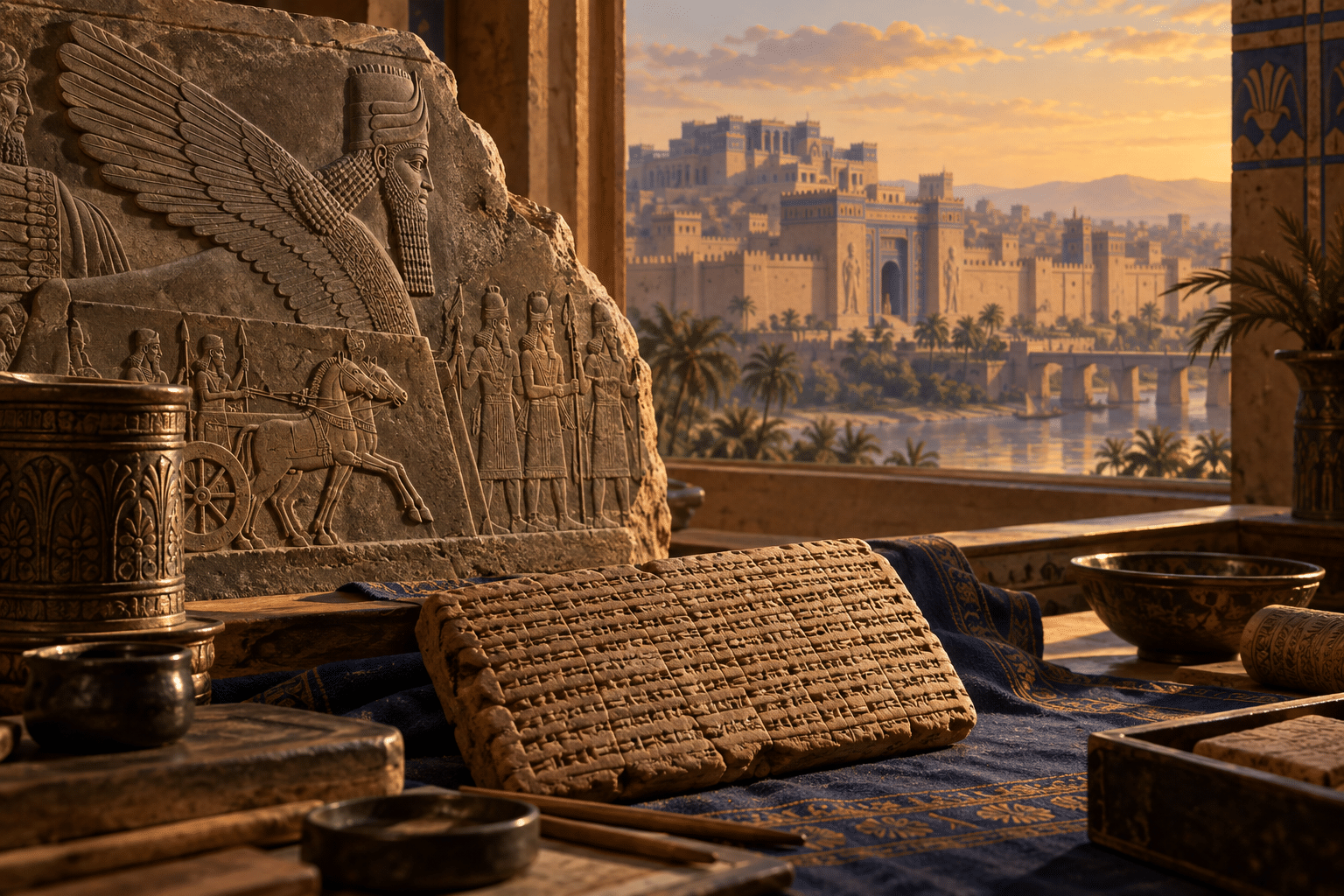
At Nineveh, carved stone and clay tablets preserve a world that once stretched across much of the ancient Near East. The Assyrian empire could project power across enormous distances, yet its capital fell in 612 BCE. A dramatic ending like that encourages a familiar story: a mighty civilization rises, collapses, and disappears. The ruins tell a more interesting tale. They reveal an empire that built roads of command and images of authority, but also gathered books, shaped cities, and left traces that scholars and living communities still interpret today.
Looking beyond the fall
The featured episode of Fall of Civilizations, “The Assyrians – Empire of Iron,” takes time to reconstruct the scale and contradictions of Assyrian power. Its long form suits a history that cannot be explained by one battle or one king. The film is a guided narrative, not an excavation report. It is strongest when it encourages viewers to ask how an imperial system was made, what it demanded from those under its rule, and why its monuments still speak after its political center has gone.
Assyria’s history reaches back far earlier than the final imperial centuries. The late Neo-Assyrian state expanded its control through a combination of armies, administration, diplomacy, and the movement of people and resources. Its rulers represented their victories in inscriptions and palace reliefs. These are precious sources, but they are also statements made by the powerful. A carved scene that celebrates a king’s success tells us what he wanted remembered; it cannot stand alone as a complete account of those who lived under him.
This is one reason the empire resists a simple moral label. Its military campaigns could be brutal, and its rulers did not hide the coercive side of power. At the same time, Assyrian artists and scribes created records of extraordinary skill and range. To acknowledge both is not to excuse conquest. It is to understand that an empire is a human system, carrying knowledge and violence through the same institutions.
Nineveh as a place of power and memory
Nineveh stood on the eastern bank of the Tigris, near modern Mosul in Iraq. It became the Assyrian capital around 700 BCE under Sennacherib. The city’s walls, gates, palaces, and reliefs made authority visible on a monumental scale. A visitor approaching the city would have encountered not only defenses but also a carefully arranged image of order and reach. The ruler’s claim was built into the landscape.
The UNESCO World Heritage Centre’s record for Nineveh describes its cultural importance and the remains of palace reliefs at Kuyunjik. The page is an Iraqi tentative-list submission, so it should be read as a heritage description rather than a full scholarly synthesis. Even in brief form, it shows how a city can hold several layers at once: a political capital, a place of learning, an archaeological site, and part of a modern urban region.
One of the most moving layers is writing. The collection called Ashurbanipal’s Library includes tens of thousands of clay tablets and fragments inscribed in cuneiform. The British Museum’s research project emphasizes the work of identifying which tablets belong to the royal collection and which come from other contexts. That distinction matters. “The library” is a useful name, but it can make a complex archaeological assemblage sound like a modern room with neat shelves and a complete catalogue. The real work involves fragments, provenance, and patient reading.
What a tablet can preserve
Clay seems fragile when imagined beside stone walls, yet baked and buried tablets can outlast kingdoms. They carry literary compositions, scholarly traditions, administrative information, and other kinds of writing from the ancient Near East. Many were copied and collected in a world where knowledge depended on trained scribes. A tablet is therefore both a text and evidence of a chain of people: someone learned the signs, prepared the clay, impressed the marks, and placed the object within a system of use.
A modern reader can easily romanticize this archive as a heroic rescue of wisdom. It was also a royal project. Kings collected knowledge because knowledge served prestige and government as well as curiosity. The same palace that displayed conquest could house learned texts. That tension is useful. It stops us from dividing the past into separate boxes labeled “civilization” and “violence,” as if a state could not cultivate both.
The survival of these tablets was not a secret waiting to be exposed by a single daring claim. Archaeologists, museum staff, and scholars have published and studied the material for generations. There are still difficult questions about individual objects and interpretations. “Still being studied” is a sign of an active record, not evidence that a hidden history has been deliberately kept from view.
How an empire ended
Nineveh’s destruction in 612 BCE was a decisive blow, and the Assyrian imperial structure soon gave way. The date is a useful marker, but it should not be made to do too much work. Political collapse is rarely a single instant. It follows pressures on resources, rivalries, military reversals, and changing alliances, while ordinary life continues unevenly around the places where power breaks. The movie’s long view helps us see the city within that broader pattern.
Nor did the fall of an empire mean the disappearance of every person connected to its name. Contemporary Assyrians trace their heritage to ancient Assyria and maintain distinct languages and cultural traditions. The Assyrian Policy Institute describes a living indigenous community with roots in the region. A statement about the end of a seventh-century BCE state should never be used as shorthand for the extinction of a people. That difference is more than a technical correction; it changes the respect with which we speak about the past and present.
The ruins of Nineveh remain vulnerable to the ordinary and extraordinary pressures faced by heritage sites, from urban change to conflict. Their meaning is not fixed by ancient rulers or modern museums alone. Local people, researchers, and communities who identify with Assyrian heritage all have a stake in how the story is told. A thoughtful historical film can open the door, but it cannot replace those voices.
Reading grandeur with care
When you watch “Empire of Iron,” notice how the visuals work on you. A wide shot of stone walls can make imperial power feel inevitable. A close view of a carved figure can make a long-dead king feel present. These are valuable invitations to imagine, yet they are also storytelling choices. Ask which details come from archaeological evidence, which from royal self-presentation, and which are the filmmaker’s reconstruction. The question deepens the experience rather than spoiling it.
Try also following one object through time. A tablet began as clay handled by a scribe, entered a royal collection or another archive, survived the city’s disasters, was excavated, and became a subject of modern study. Every step changes what we can know. The object is a witness, but it cannot answer questions that no one recorded on it. Historical humility begins at that boundary.
Assyria’s story is not merely a lesson that all power fades. That conclusion is too easy and too distant. It is a reminder that grandeur is made by people, administered by people, and later interpreted by people. The empire’s reliefs and tablets deserve our attention precisely because they can show both ambition and limitation. Nineveh fell; the work of reading it continues. In that ongoing work, the past becomes more than a spectacle of ruins. It becomes a conversation about memory, responsibility, and the lives that outlast a throne.