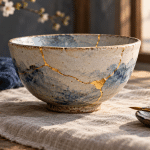
A repaired bowl asks us to look twice. First we notice its familiar shape; then the gold seams interrupt the surface and reveal a history that a flawless finish would hide. Kintsugi, the Japanese craft of repairing ceramics with lacquer and powdered gold, makes that interruption part of the object. The University of Oxford film above follows lacquerware artists Muneaki Shimode and Takahiko Sato during their 2015 Pitt Rivers Museum residency. It offers a patient encounter with skilled work before we turn the bowl into a lesson about our own lives.
Begin with the object
The museum describes a repair process involving lacquer and gold, carried out by artists from Kyoto. That practical description matters. Kintsugi is more than painting a golden line on an undamaged cup, and a short film cannot substitute for the knowledge of a craftsperson. Watch the relationship between the damaged object, the hands repairing it and the time the work requires. The result has a visible history. It has also needed actual material attention, rather than a change in the language used to describe the break.
Let repair mean work
We often admire a finished transformation while overlooking the quieter decisions that make it possible. Which pieces belong together? What needs support? What must wait? Those questions can travel into ordinary life without turning pottery into a medical prescription. A neglected friendship may need a specific conversation. A stalled project may need a smaller next step. Calling something meaningful does not perform that work for us. The bowl offers an image of attention, but we remain responsible for choosing what attention means in our own circumstances.
A seam is not an obligation to explain
Visible repair can be beautiful. That does not mean every person owes the world a visible account of what has hurt them. Objects and people are different, and the metaphor becomes less helpful when it demands a performance of resilience. You can value a repaired bowl while keeping your own story private. You can also decide that a damaged object is beyond your resources to restore. Care includes limits. The useful invitation is to reconsider an automatic judgment about what has value, not to make every loss produce an uplifting ending.
Notice what a slogan leaves out
The New Orleans Museum of Art discusses repaired ceramics in its own collection and others, including a Longquan jar with a visibly repaired finial. Such examples give the idea a concrete setting. Instead of repeating a general phrase about imperfection, look for one detail: a line crossing a surface, an unexpected join, a shape still recognizable after repair. Looking closely slows our rush to declare what an object means. It also reminds us that one craft tradition can carry many personal interpretations without being reduced to a single universal message.
Try a modest practice of attention
Choose one object you already own and have stopped noticing. Describe its material, marks and use before deciding whether it needs anything. Is there a loose screw, a worn cover or a small maintenance task you have postponed? Separate what you can safely do from work that requires a professional. The point is not to imitate lacquer repair with whatever glue is nearby. It is to spend a few minutes replacing vague affection with a clear observation. Sometimes the next step is repair. Sometimes it is simply using and appreciating what is already there.
What the bowl leaves with us
Kintsugi can open a thoughtful conversation about continuity and change, provided we keep the craft in view. Repair does not return an object to a past in which nothing happened. It creates a present in which the object can be encountered again. That is an interpretation rather than a scientific promise, and it is enough. Watch the film once for its story and once for the work. Give the hands, materials and pauses the same attention as the final golden lines.
Sources and further viewing
University of Oxford: Kintsugi at the Pitt Rivers Museum; Pitt Rivers Museum’s description of the 2015 residency and film; New Orleans Museum of Art: Object Lesson on kintsugi.