A number is a beginning, not an explanation
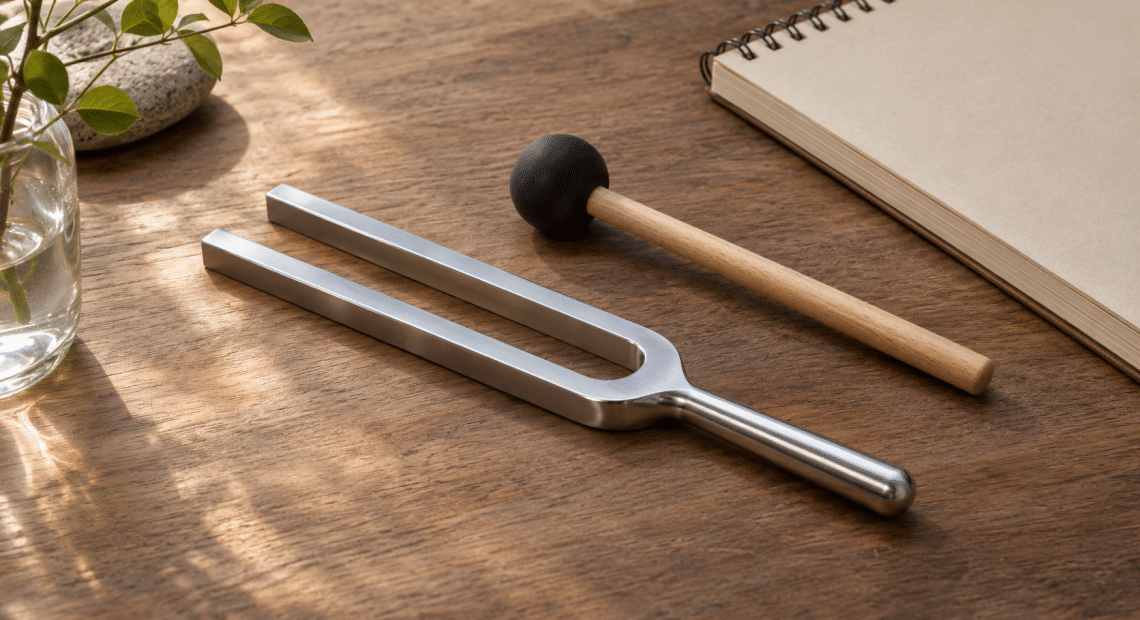
Pick up a tuning fork and the printed number can feel reassuring. Unlike a phrase such as “high vibration,” 128 Hz looks precise. It is precise about one thing: a rate of vibration. The difficulty begins when that useful description is asked to carry an entire story about emotional release, organs or healing. How can we keep the curiosity without letting the label decide what we believe?
This article starts with an ordinary question: what information helps you choose and understand a physical instrument? The answer leaves room for personal ritual and the pleasure of listening. It also leaves room to ask for specifications, notice uncertainty and decline claims that have not been demonstrated. A tuning fork does not become less interesting when its promises become more modest.
Watch a practitioner make an important distinction
In The Why and How of Tuning Forks for Sound Healing, Eileen McKusick explains her approach to forks and discusses weighted and unweighted designs. A particularly useful section begins around 10:38, where she explains why she does not assign one frequency to each organ. That is worth hearing within a field where very specific numbers are often paired with very broad promises.
McKusick is presenting her own practice, not a neutral scientific review. Her explanations of a “biofield” should be understood as the framework of her method rather than established anatomy. The video can help us see an instrument in use while leaving its proposed therapeutic mechanisms subject to independent evidence. Nor does featuring her demonstration mean she endorses the FES products mentioned here.
What hertz actually tells you
A hertz is one cycle per second. A fork described as 128 Hz is intended to vibrate at about 128 cycles per second in its principal mode. That number helps distinguish its pitch from another fork. It does not specify loudness, how long the sound lasts, how strongly the handle vibrates or how comfortable you will find it.
Consider the difference between a recipe’s oven temperature and the whole meal. One measurement matters, but it cannot describe every ingredient or the result on its own. With a fork, material, geometry, construction, activation and handling all belong to the experience. A number printed on a product is also a specification supplied by its seller, not an independent calibration certificate.
The useful difference between pitch and purpose
Two forks can carry different numbers and both serve the same everyday purpose: a brief period of attentive listening. Conversely, two instruments with the same nominal frequency can feel different in the hand. Weighted ends change the way an instrument behaves and may make vibration more noticeable through its stem. That does not turn direct contact into a medically validated treatment.
Before comparing frequencies, decide what you actually want. Are you exploring audible tones, learning about musical intervals or creating a quiet pause? Are exact pitches important, or is the physical design more relevant? These questions make product information useful. Without them, it is easy to keep adding numbers to a collection without discovering what you enjoy about the instruments.
When a frequency becomes a medical claim
There is a clear difference between saying “this fork is listed at 256 Hz” and saying “256 Hz repairs this organ.” The first can be checked with suitable measurement. The second requires good evidence about a health outcome, an effective exposure and the people for whom it works. A story, testimonial or spiritual association does not supply that evidence.
The National Center for Complementary and Integrative Health reviews promising research on some music-based interventions, while emphasizing that findings depend on the condition and intervention studied. This is not a license to transfer every result to tuning forks. Music therapy, a recording, a singing bowl and a fork are different experiences. The sources reviewed here do not establish that buying a particular fork frequency cures disease, clears trauma or repairs DNA.
Two current FES options, two different kinds of information
The FES 4-Piece Tuning Fork Set with Puck Activator lists aluminum-alloy forks at 128, 136.1, 256 and 384 Hz, with an activator and guide. On November 9, the listing showed USD125, nine items available and US-only shipping. Those are useful shopping details. They are not a guarantee that the kit duplicates McKusick’s instruments or produces her claimed results.
The Chakra Sound Journey set offers eight weighted forks and a symbolic chakra theme. It showed USD215, eight available and US-only shipping. Its listing explicitly says exact frequency specifications are unavailable. If a particular pitch is essential, that missing information matters: do not infer frequencies from colours or a chakra name. Prices and availability can change, so check the live destination before ordering.
A comparison you can make without a grand theory
If you already have appropriate instruments, try listening to one at a time in a quiet space. Follow the supplied activation instructions rather than striking a fork hard against an improvised surface. Hold it consistently, keep a comfortable distance from your ears and let the tone fade. Notice whether your interest is in the initial sound, the sustained note or the sensation through the handle.
Write down what you observe before reading the product’s symbolic description. Words such as softer, brighter, longer or more comfortable describe your experience without pretending to diagnose it. On another occasion, compare the same short interval with sitting quietly without a fork. You might prefer either. A useful personal practice need not win a contest against silence.
Leave room for meaning, and for limits
A chakra association or a meaningful number may help someone set an intention. Treating that association as a chosen symbol keeps ownership with the listener. Treating it as a universal biological law makes a different claim, one that must answer to evidence. The distinction protects both honest inquiry and the freedom to find personal meaning.
Keep volume comfortable and stop if you experience discomfort, ringing, dizziness or a headache. Do not increase intensity in search of a stronger “effect.” Persistent symptoms deserve appropriate clinical attention, not another purchase. If a practice involves direct contact or a treatment claim, discuss suitability and qualifications with an appropriate professional.
The best question is not always “which frequency is the most powerful?” It may be “what does this instrument actually offer, and what information is still missing?” When the answer is clear, you can explore sound without asking a small metal fork to carry a promise it cannot prove.
Sources and further reading
- Eileen McKusick: The Why and How of Tuning Forks for Sound Healing (practitioner account).
- NCCIH: Music and Health (research overview and limitations).
- Our earlier article on relaxation, body awareness and tuning-fork evidence.