The unfinished journey may be the most revealing part
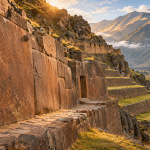
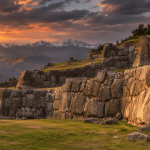
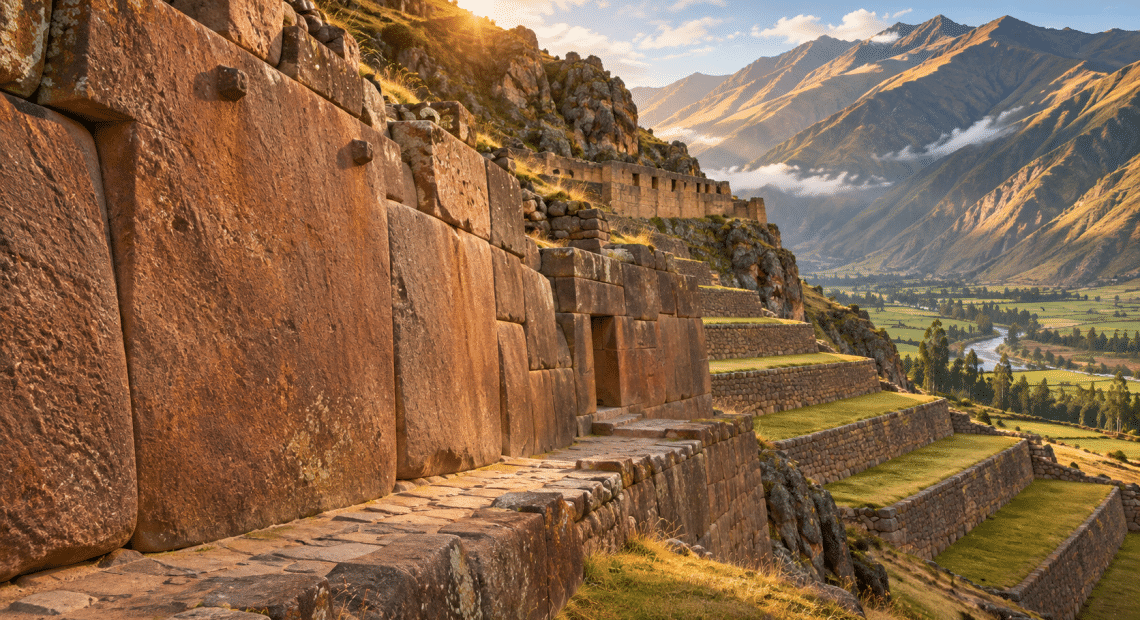
A finished stone wall invites us to admire precision. An unfinished journey invites a different kind of attention. Where did the stone begin? Which way did it travel? Where did the builders stop, and what did they leave behind? At Ollantaytambo, those questions lead beyond the monumental architecture and into the surrounding landscape. The route becomes part of the structure’s story.
In the accompanying UnchartedX video, Ben van Kerkwyk follows the problem of moving enormous blocks through the Andes. His title asks how stones described as weighing 80 tons could have travelled 10 kilometres. Those figures frame the filmmaker’s investigation; they should not become measurements of every block or route simply because they appear in a title. The valuable invitation is to look closely at the terrain and ask what an explanation would actually need to account for.
Watch the landscape as carefully as the stone
The appeal of this fieldwork is its sense of scale. A person beside a block helps us imagine its dimensions. A distant hillside makes transportation feel less abstract. Yet a camera also leaves things outside the frame. It cannot show every change in a route, every earlier ground level or every working arrangement merely by looking across a valley.
As you watch, distinguish three things: the feature being shown, the explanation offered for it, and the evidence connecting the two. An abandoned block is an observable feature. A proposed transport method is an explanation. A claim that a forgotten civilization must have supplied that method is a further conclusion. These statements do not all carry the same evidential weight.
A construction landscape, not an isolated puzzle
The archaeological discussion does not begin with the assumption that the stones appeared without a history. In its investigation of Inca engineering, PBS’s NOVA followed a route between Ollantaytambo and quarry areas across the valley. The programme documented abandoned blocks and considered their relationship to quarrying and transport. That makes the surrounding evidence essential, rather than background scenery.
This is a useful change of perspective. Instead of asking only, “How could anyone move that?”, we can ask which surfaces, routes and working traces belong together. The stronger explanation is the one that accounts for more of the evidence with fewer unsupported additions. An extraordinary achievement deserves a detailed investigation, not an automatic choice between complete certainty and complete mystery.
What experiments can establish
Architectural historian Jean-Pierre Protzen’s published research examined Inca quarrying and stonecutting, including the use of hammerstones. His work matters because it turns a general claim about what simple tools can accomplish into a question that can be tested. A tool may look ordinary while the skill required to use it well is anything but ordinary.
An experiment has limits, however. Showing that a method can shape a particular piece of stone does not establish every stage of a monumental building project. Conversely, a modern attempt that struggles does not prove that experienced historical workers could never have succeeded. The participants, preparation, working time and precise task all matter. Good experimental archaeology makes its conditions visible so that others can judge what the demonstration supports.
Moving downhill is not the same as moving safely
Transport is more than overcoming weight. It involves starting movement, controlling direction, stopping movement and protecting the people involved. A downhill section may reduce one difficulty while increasing another. An incline, bend or river crossing creates a different problem from hauling on relatively level ground.
NOVA’s reconstruction was instructive partly because it did not go perfectly. Its team’s descent with a much smaller, irregular boulder ended badly, while a river-crossing attempt proved more manageable than expected. Neither outcome closes the historical question. Together, they show why a memorable success or failure should not be treated as a complete reconstruction of the ancient undertaking.
For viewers, the practical lesson is to resist scaling up a demonstration by imagination alone. A proposal for an immense block needs more than a convincing animation. It needs an account of control, contact surfaces, route geometry and the sequence of operations.
Could earlier builders have been involved?
The possibility of earlier construction is a legitimate historical question when it is posed as something to investigate. It becomes a problem when the impressive size of a stone is treated as its date. Size does not identify a builder. A surprising surface does not, by itself, establish an unknown machine. Admiration and attribution are different tasks.
To strengthen an earlier-builder hypothesis, we would want evidence that helps distinguish it from competing explanations: securely contextualized finds, construction relationships, reliable dating of associated materials, or a demonstrated break between building phases. A hypothesis becomes more useful when it tells us what observations would support it and what observations would count against it.
This also keeps alternative history open to discovery. If every unusual feature is automatically evidence for a lost civilization, the explanation becomes difficult to test. Asking for stronger evidence is not refusing the question. It is giving the question a chance to produce an answer that others can examine.
Unfinished does not automatically mean catastrophe
An abandoned stone can feel like a moment frozen in time. The temptation is to imagine a single dramatic interruption that explains everything nearby. That may make a compelling story, but a compelling story is not yet a chronology.
There are many conceivable reasons work might stop, change direction or leave material unused. Listing possibilities does not tell us which one happened here. Nor should different unfinished features be assigned to the same event without evidence connecting them. The responsible question is not simply whether a catastrophe could interrupt construction. It is whether this particular landscape preserves evidence for that particular explanation.
Give human knowledge its full dimensions
Another assumption deserves attention: that a society without our machinery must have lacked sophisticated engineering knowledge. Knowledge can be practical, collective and learned through repeated work. It need not resemble a modern instruction manual to be precise.
That observation is not a substitute for explaining the stones. It is a reminder not to underestimate the people before beginning the investigation. Equally, respecting Inca achievement does not require pretending that every logistical detail has been settled. We can recognize a substantial archaeological explanation while remaining interested in unresolved stages, competing reconstructions and better measurements.
A better question to take away
Ollantaytambo rewards curiosity that moves between the monument and its unfinished surroundings. The blocks along a route are not merely leftovers from the impressive part. They may help us ask more exact questions about the work itself.
Watch the video for its close encounters with the landscape, then return to the distinction between observation and interpretation. Which claim depends on a measurement? Which depends on an assumption about tools or labour? What new evidence would change your view? These questions preserve the wonder without asking wonder to serve as proof. The achievement remains remarkable whether the next discovery confirms an existing reconstruction or requires historians to revise it.
Sources and further exploration
- UnchartedX: HOW were 80 ton granite blocks moved 10km in the Andes? — the featured field investigation and interpretation.
- UnchartedX’s original video announcement — creator provenance and context.
- PBS NOVA: Secrets of Lost Empires — Inca — archaeological discussion and reconstruction attempts.
- Jean-Pierre Protzen, Inca Quarrying and Stonecutting, 1985 — research on quarrying and shaping techniques.