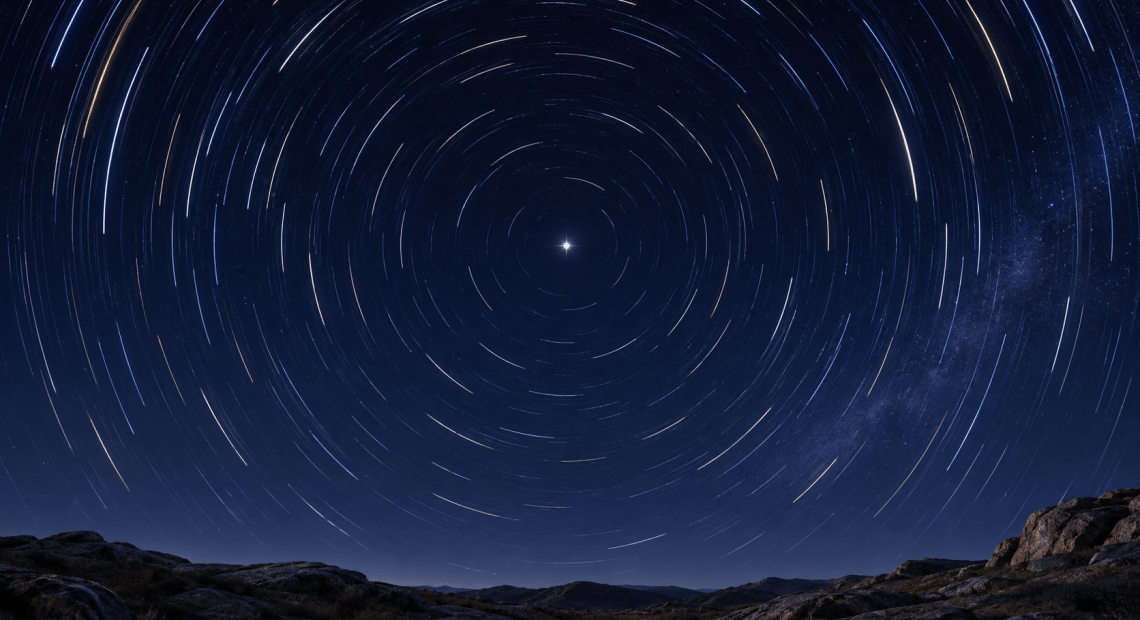
There is something compelling about a point of light that seems to hold its place while the rest of the night sky changes around it. Polaris invites attention. Before it becomes an argument, a diagram or a comment-section battle, it is a star you can look for yourself.
Eric Dubay’s video, “Polaris Proves the Flat Earth,” places that star at the centre of a much larger claim. The title presents Polaris as proof against the globe model. This article takes the claim seriously enough to examine it, but not to assume its conclusion. The video is the starting point for inquiry, not a substitute for measurement.
The important distinction is between what we observe and what we infer. A star appearing almost stationary is an observation. Concluding that the ground beneath us must therefore be flat is an interpretation. To move from one to the other, we need an explanation that works beyond a single image or a single location.
A nearly still star is not a completely still star
Polaris lies close to the north celestial pole, the direction in the sky toward which Earth’s northern rotation axis points. Its proximity makes its nightly movement small compared with that of stars farther from the pole. It is not positioned at the exact centre, so long exposures can reveal a small circular path rather than absolute stillness. NASA’s explanation also notes that Polaris is not the brightest star in the sky, despite its familiar name and navigational importance.
That distinction matters because “almost unchanged to the eye” and “motionless in space” are different statements. A photograph may conceal a small change because of its exposure length, resolution or framing. Conversely, an impressive star-trail image can reveal a pattern without establishing the mechanism that produced it.
Ask what the image shows before deciding what it proves. How long was the exposure? Where was the camera? Is the frame centred on Polaris or on the pole? Can another observer reproduce the result? These questions do not weaken an investigation. They give it a foundation.
The test changes when you change location
The useful next question is not simply whether Polaris appears stable during one night. It is how high Polaris appears above the horizon when the observer moves north or south.
Its elevation provides an approximation of northern latitude. In ordinary navigation terms, an observer farther north sees it higher; an observer closer to the equator sees it lower. NASA describes this relationship in its reference-systems material. It is approximate because Polaris is near, rather than precisely on, the celestial pole.
The Open University gives a concrete example: from southern England, Polaris appears around 52 degrees above the horizon, corresponding to roughly 52 degrees north latitude. Its educational diagram places the pole overhead at the North Pole and at the horizon at the equator. These are idealised reference positions, not a promise that every casual photograph will yield an exact angle.
This is where a persuasive visual argument becomes a measurable comparison. An explanation must account for the changing angle, not merely the star’s recognisable position in the northern sky.
What would count as a better explanation?
A strong model makes predictions before the observations are collected. It should say what an observer will measure at one location, how that measurement changes elsewhere, and what would count against the model.
The conventional spherical-Earth explanation connects the observer’s local horizon, latitude and viewing direction. It accounts for the observed relationship between latitude and the celestial pole’s elevation. Polaris’s apparent stability is therefore not an unexpected problem for a rotating Earth: it is part of the predicted sky pattern.
A proposed flat-surface explanation needs the same level of specificity. Where is the star in that model? What height or distance is being proposed? What angle should someone measure at several known locations? Does the same geometry work for all those locations without changing the assumptions after each result?
There is no need to ridicule someone for asking these questions. But there is also no reason to lower the standard of evidence because an alternative feels liberating. An unfamiliar explanation earns confidence by predicting observations, not by being unfamiliar.
The North Star has a history
Another important distinction is between a familiar feature within a human lifetime and a permanent feature across all time. Earth’s rotation axis undergoes a slow change in orientation called precession, with a cycle of approximately 26,000 years. As a result, the star nearest the northern pole changes over long periods. Polaris has not always occupied its present role.
This does not mean you should expect to notice a dramatic shift next week. It means a claim about an eternally fixed North Star must engage with astronomical records and long-term measurements, rather than treating a few nights of consistency as evidence about every era.
Scale matters. A conclusion about one evening should not silently become a conclusion about thousands of years. The same discipline applies to photographs, ancient accounts and modern simulations: each has a context, a purpose and limits.
Try an observation journal instead of another argument
You can approach the subject without beginning with a declaration of loyalty to either side. Start with a notebook, a safe observing spot and a clear view toward the northern sky.
Record the date, time, location, weather and how you identified Polaris. Sketch the horizon and nearby stars. If you photograph them, keep the original files and record the camera settings. Repeat the observation rather than relying on a single striking frame.
For angle measurements, use a properly understood instrument and record its limitations. A phone reading can be a useful starting point, but a precise-looking number is not automatically an accurate one. Calibration, the reference horizon and the observer’s technique all deserve attention.
If you compare results with someone at another latitude, agree on the method first. Share unsuccessful attempts as well as successful ones. A blocked horizon, haze or an uncertain star identification should be written down, not edited away because it disrupts the story you hoped to tell.
Stay curious without turning curiosity into certainty
The value of Dubay’s title as a discussion prompt is that it invites people to look up and ask questions. Its conclusion, however, is not established by the observations discussed here. Polaris’s position and its relationship with latitude are consistent with the spherical-Earth explanation; the star’s apparent near-stillness does not demonstrate a flat Earth.
You can appreciate the beauty of the northern sky without claiming more than the evidence supports. You can question an explanation while still allowing an answer to challenge your expectations.
That is a more demanding form of independent thought than repeating either a familiar textbook sentence or a confident video title. Watch, compare, measure and keep the distinction between evidence and interpretation visible. The sky does not need our certainty. It asks for our attention.
Sources and further observation
- Eric Dubay: Polaris Proves the Flat Earth — featured argument, not scientific validation.
- NASA: What Is the North Star?
- NASA: Reference Systems
- OpenLearn: Navigating by the Stars