Few historical names awaken the imagination like the Library of Alexandria. We picture shelves of scrolls, scholars in conversation and a world of questions still open. Then the familiar image changes: flames rise, wisdom disappears and humanity stands before an absence it cannot measure. It is a powerful story. Yet the desire for a dramatic ending can obscure the more difficult, uncertain history behind it.
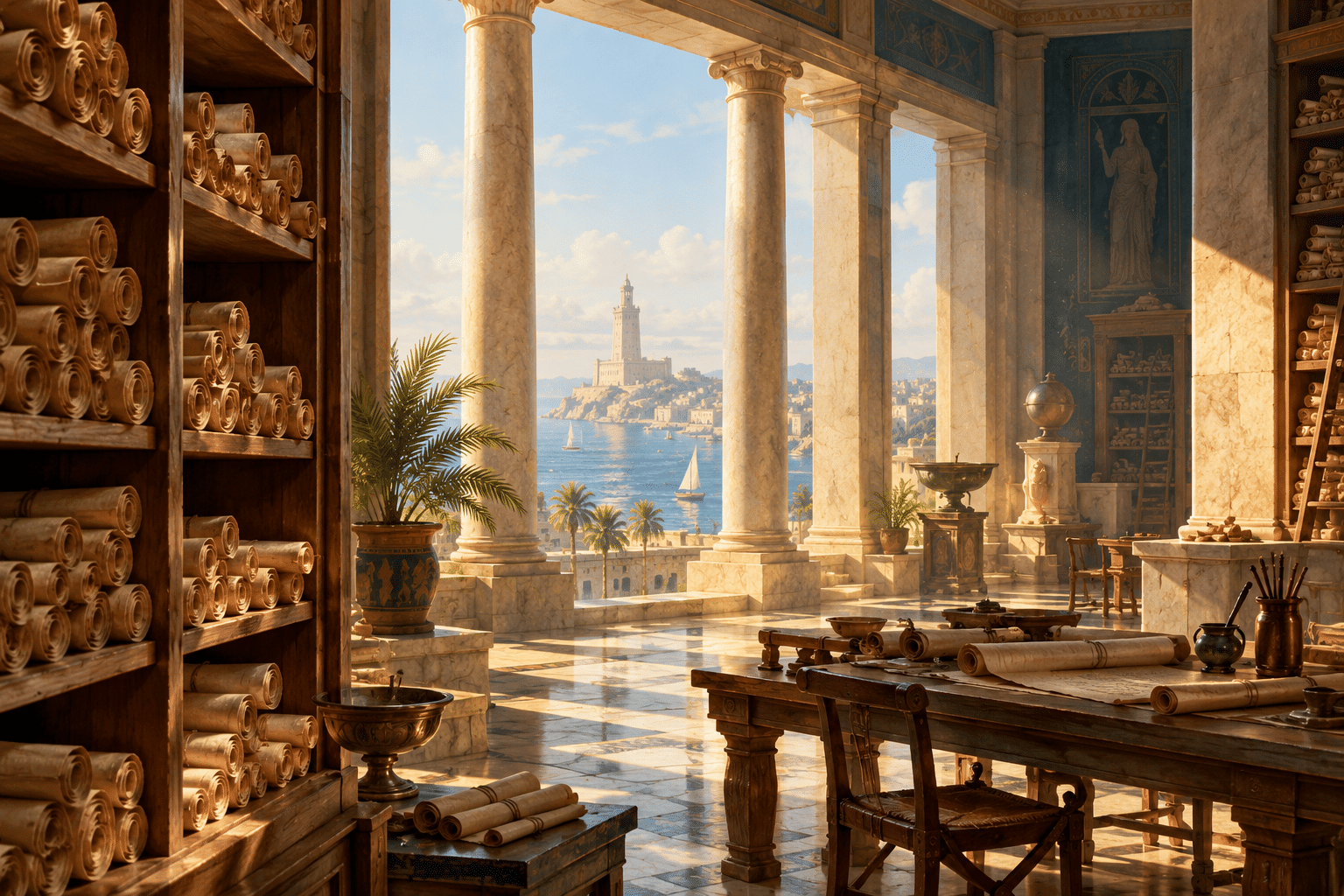
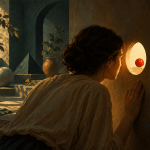
In the video above, toldinstone explores how much was lost with the library and why its disappearance cannot be reduced confidently to one event. The discussion invites us to separate what the evidence supports from what later storytelling makes memorable. Our illustration is an imagined reading room, not an archaeological reconstruction. The reflections below are a modern response to the subject, rather than a claim to recover the thoughts of its ancient readers.
Beyond a single night of fire
The library developed under the Ptolemaic rulers of Egypt and was associated with the scholarly institution called the Mouseion. Its collection included papyrus scrolls, and its exact size is uncertain. Accounts connect losses with Caesar’s Alexandrian war in 48 BCE, but the extent of that damage is disputed. Later conflict and the continuing need for institutional support complicate the story further. We cannot identify one secure moment when everything vanished.
The modern Bibliotheca Alexandrina has treated the library’s fate as a research question requiring careful examination of textual and archaeological evidence. Its international seminar considered episodes under different rulers, the Serapeum and later traditions about destruction. That breadth itself is instructive: a contested history deserves more than a convenient villain and a confident caption. Explore the Bibliotheca Alexandrina’s research seminar.
For a reader drawn to lost history, uncertainty need not make the subject less meaningful. It can make our encounter more honest. A gap in the record is an invitation to investigate, but it does not establish that any particular imagined explanation is true. Curiosity becomes stronger when it can tolerate an unanswered question.
Why the missing shelf moves us
Imagine opening a book and discovering that several pages have been removed. The gap would be frustrating even if you knew nothing about the missing sentences. You would wonder whose voice had been interrupted, which argument had become impossible to follow and whether a small detail might have changed the meaning of everything around it.
That feeling offers one way to approach a lost collection. We do not need to imagine secret machines or a suppressed key to all existence. A vanished poem would matter because someone shaped it. A forgotten argument would matter because someone tried to understand a question. Cultural loss includes the disappearance of ordinary human differences, not only the absence of spectacular discoveries.
There is a kind of humility in allowing a lost work to remain unknown. We can grieve the possibility of what is missing without claiming possession of it. The empty shelf does not have to become a screen for our preferred beliefs. It can remain a reminder that our present view of the past is incomplete.
Preservation is an ongoing relationship
A library is easy to imagine as a place where knowledge simply rests. Consider instead how many decisions stand between a thought and a future reader. Someone must decide to keep the record, organize it, maintain access and explain enough context for another person to make sense of it. A collection depends on people continuing to find that work worthwhile.
We can see a small version of this in our own homes. A box of photographs may survive while the names on the backs remain unwritten. An old recording may exist on a device nobody can operate. A family recipe may be familiar to one person and mysterious to everyone else. Possession and preservation are related, but they are not identical.
The practical question is therefore larger than whether something has been saved. Can it be found? Can it be read? Does anyone know where it came from? Is there enough context to distinguish a memory from a later interpretation? These questions are modest, but they turn appreciation for the past into present responsibility.
The discipline of a careful reader
When a historical claim feels immediately satisfying, pause long enough to notice why. Does it confirm something you already believe? Does it make a complicated event feel manageable? Does it offer a single explanation for several different absences? Emotional resonance can be part of why a story matters to us, while still being separate from evidence that it happened.
A useful reading practice is to write down three things: the claim, the source supporting it and what remains uncertain. If a source reports an ancient account, distinguish that report from independent confirmation. If an author offers an interpretation, let it remain an interpretation. Careful language does not drain history of wonder. It gives wonder a firmer place to stand.
That discipline also makes room for revision. We can become attached to an explanation because it once opened our eyes. Later evidence may ask us to change it. There is no betrayal in doing so. The value of a question does not depend on our first answer surviving forever, and intellectual independence includes the freedom to reconsider our own convictions.
A small archive of your own
Choose one piece of knowledge you would genuinely miss if it disappeared. It might be a grandparent’s account of a childhood place, a photograph with no date or a set of notes that helped you understand a difficult period. Begin with something small enough to handle thoughtfully, rather than promising to preserve an entire life at once.
Record what you know and identify what you are guessing. Include a name, date or source when you can verify it. Keep an additional copy somewhere appropriate, and make sure the person who may need it knows where to look. If another person’s private story is involved, ask before sharing it. Care for knowledge includes care for the people represented by it.
You might also take one question to a local library, archive or museum. Ask how the collection is maintained or what would help future readers. An institution that seems permanent from the outside may depend on ordinary acts of attention. Reading, accurate description and responsible support are ways of participating in its continuity.
Wonder with responsibility
Alexandria can remain a symbol of lost knowledge without becoming proof of every claim made in its name. As a symbol, it asks what we treasure, what we neglect and which voices we allow to disappear from view. As a historical subject, it asks us to work carefully with the evidence. Those invitations can enrich one another while remaining distinct.
Perhaps awakening here begins with a change of posture: less certainty about what we cannot recover, more attention to what we can still protect. We may never know the full contents of those vanished shelves. We can nevertheless meet the books, memories and questions within our reach with greater patience. The past is not restored by imagining that nothing was lost. It is honored by caring more faithfully for what remains.