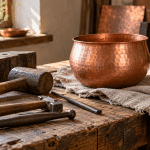
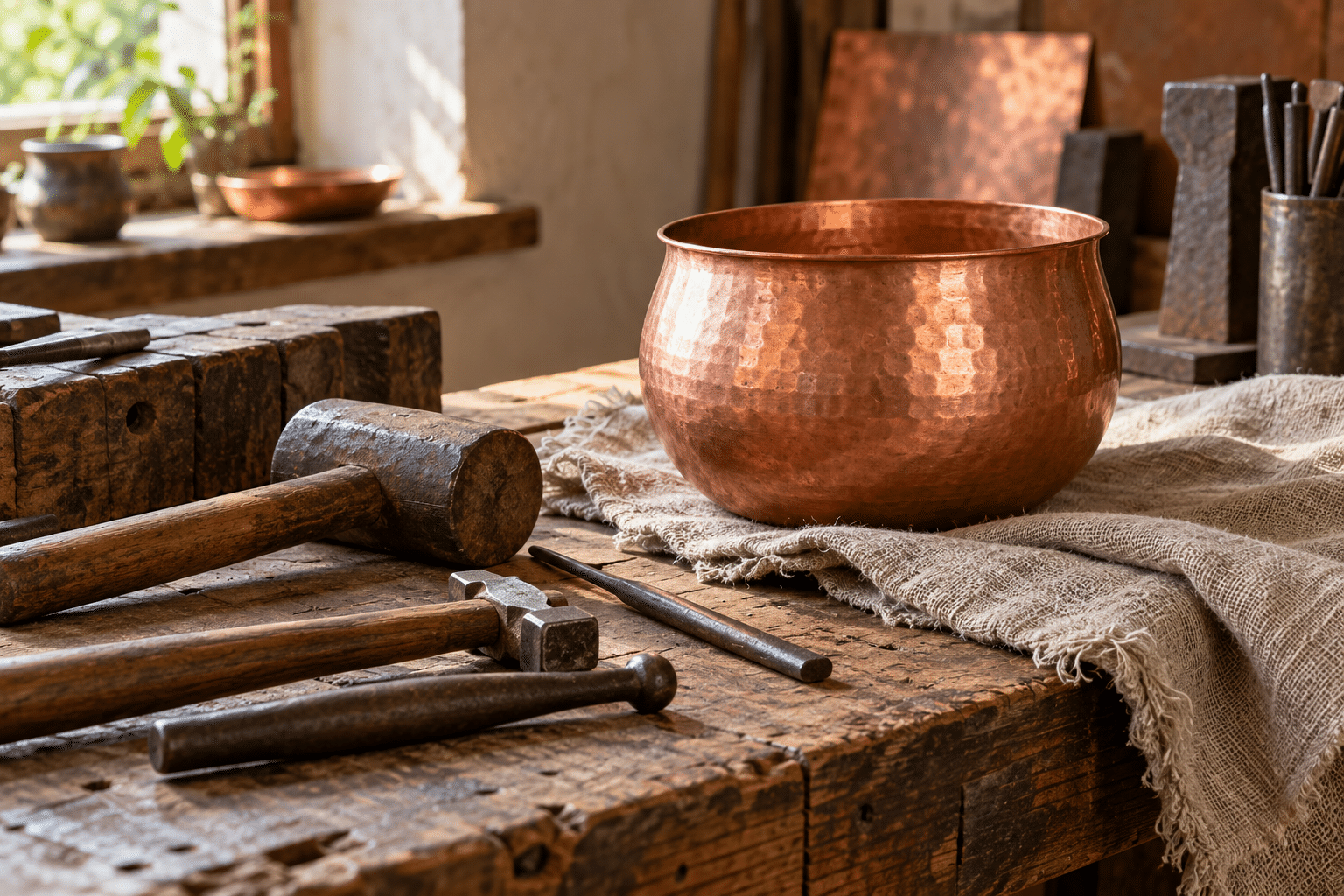
Some objects ask us to slow down before we have even used them. A copper vessel catches the morning light, its surface holding warm reflections that shift as we turn it in our hands. We notice its weight, the curve of its rim, the small decisions that made it possible. For a moment, an ordinary household object becomes a doorway into a different relationship with the material world: one built around attention, skill and care.
The Eater film above visits Jim Hamann of Duparquet Copper Cookware. It follows a maker who restores and produces copper pots, giving viewers a close look at work often hidden behind a finished object. His cookware is the subject of the film; it is separate from the Flat Earth Shop item recommended below. What connects them here is an invitation to notice material and purpose, rather than an assertion that they share a maker or manufacturing method.
The intelligence of the hands
Watching a craftsperson work reveals how incomplete our everyday idea of knowledge can be. Knowledge is not only something written in a book or explained in a sentence. It can also appear as a small adjustment, a measured pause or the decision to stop applying pressure. In a workshop, understanding takes physical form. A tool meets a surface, and the maker responds to what actually happens.
Firsthand reporting by Serious Eats describes copper cookware being formed from a metal disc on a lathe. A roller gradually presses it against a shaped form; manual control requires practice. That modest description is enough to change how we see a pan. The finished curve represents many responsive decisions. The smoothness we take for granted may be the visible outcome of patient, skilled attention. Read the workshop report.
There is a reflective lesson here without needing to turn a workshop into a mystical place. We can ask where our own lives would benefit from that kind of responsiveness. Perhaps we have been forcing a conversation, rushing a meal or treating a difficult project as though effort alone should settle it. Craft reminds us to notice feedback. More pressure is not always the same as more understanding.
Beauty that can be used
A useful object has an unusual intimacy. It enters our routines quietly, appearing beside the sink or on the table while larger events occupy our thoughts. Over time, its meaning may come from repetition rather than price. We remember who gave it to us, the place where we found it or the unhurried mornings in which it has played a part.
This is one way to understand an intentional ritual: a familiar action performed with fuller awareness. There is no need to claim that a particular metal changes consciousness or carries a guaranteed energetic effect. Setting down a phone, preparing a place at the table and noticing the object already in front of us are choices we can make directly. Their significance comes from our participation.
Nor does thoughtful living require purchasing something new. A repaired bowl, an inherited spoon or a simple glass may serve the same invitation. When a new object is useful, we can choose with greater curiosity. What is it made from? How should it be used? Can its maker explain its construction? Will we still want to care for it after the excitement of acquiring it has passed?
Patina, use and honest care
Copper’s changing surface offers a particularly clear reminder that ownership is a relationship over time. The shop’s care guidance notes that raw copper darkens and develops a patina. That appearance can be appreciated or cleaned according to suitable instructions. A photograph taken on the first day is only one moment in an object’s life.
It is tempting to make every sign of age into a spiritual lesson. A more grounded approach allows beauty and practical judgment to coexist. A changing exterior and an interior requiring attention are different matters. Read the instructions, inspect the vessel and ask the seller when uncertain. Respect for a material includes respecting its limits.
For unlined copper drinkware, the distinction is important. The FDA Food Code restricts copper contact with foods below pH 6, including fruit juice and wine, because acidic foods can leach copper. Do not use an unlined copper cup for lemon water, juice, cocktails or other acidic drinks. The recommendation here is about design and everyday use, not a method of obtaining health benefits. See FDA Food Code section 4-101.14.
Flat Earth Shop recommendation
FES recommendation — Pure Copper Tumbler, Extra-Thick 16 oz
For readers specifically looking for a copper vessel, Flat Earth Shop lists this approximately 473 ml tumbler with a smooth exterior and an unlined copper interior. On October 19, 2026, the live page listed US$143 and 10 items in stock. Availability and price can change.
View the copper tumbler at Flat Earth Shop →
US shipping only. The current shipping policy limits delivery to United States addresses. It lists US$6 shipping below US$80 and free standard shipping for orders of US$80 or more.
Follow the seller’s instructions: plain, room-temperature water; gentle hand-washing and drying; no acidic drinks. Do not use it while green deposits remain inside or drink water with a strong metallic taste. This is a design and craftsmanship recommendation, with no claim of healing, treatment, detoxification or guaranteed energetic effects.
A small practice of stewardship
It can help to make care easy to remember. Keep the appropriate cloth nearby, learn which cleaner the maker recommends and give the object a place where it can dry properly. When maintenance fits the rhythm of a home, it becomes less likely to feel like an exceptional chore. The same question can guide larger decisions: are we choosing something whose needs we understand and can realistically meet? An object can be beautiful and still be wrong for our household. Thoughtful ownership includes the freedom to recognize that before buying, without turning desire into an obligation.
Choose one useful object you already own. Give it a few minutes of undivided attention. Clean it in the way its material requires. Look at the places where its shape changes and consider the work those details involved. If it needs repair, identify one realistic next step. If it no longer serves you, consider whether someone else could use it.
Then notice how that small action feels compared with the impulse to replace it immediately. You do not have to arrive at a grand conclusion. The practice is simply to become a more present participant in the life of something you use. Care becomes concrete when it moves from an attractive idea into an ordinary action.
Awakening can sometimes begin at this modest scale. We recognize that the world around us is filled with decisions, materials and human effort. We become a little less hurried in our judgments and a little more willing to maintain what matters. The vessel on the table remains a vessel. Yet our way of meeting it can become more deliberate, grateful and awake.