
A water tower is easy to recognize and surprisingly easy to overlook. Its outline may carry a town’s name, mark a highway exit or appear above the trees on a familiar journey. Beneath that ordinary silhouette sits a question worth asking: why spend so much effort lifting something as heavy as water when the people who need it are mostly on the ground?
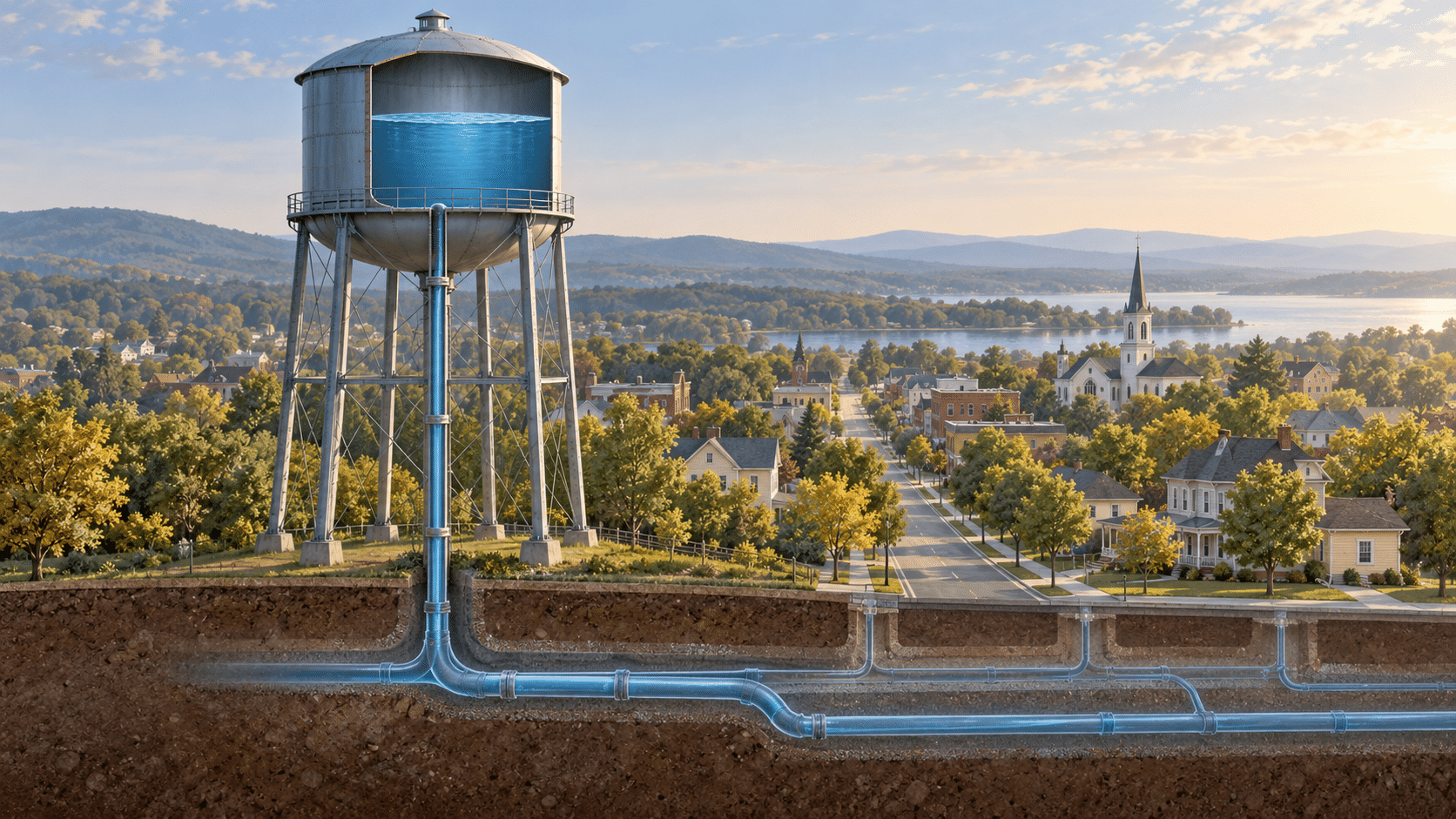
In How Water Towers Work, Grady Hillhouse of Practical Engineering explains how elevated storage helps a community manage changing demand and maintain pressure. His creator-published explanation offers a useful starting point for looking beyond the structure. The larger lesson concerns timing: supplying enough water over a whole day and delivering it at the moment someone opens a tap are different engineering problems.
Why an average day needs room for peaks
Picture a neighborhood waking up. Showers, breakfast preparation and other household activities overlap. Later, many residents leave, and demand eases. Hillhouse uses this daily rhythm to explain storage: a tank can receive water when supply exceeds immediate use, then contribute water when demand rises. It creates a buffer between two changing rates.
A daily total conceals those variations. Imagine judging a restaurant’s staffing only by dividing its orders evenly across opening hours. The calculation may describe the average workload while saying little about the lunch queue. Water service presents a similar planning question: what must happen during the busiest interval, and what preparation can happen beforehand?
Consider two communities using the same total amount of water. If one spreads consumption through the day while the other concentrates it in a few hours, their daily totals alone cannot describe the storage each needs. The comparison shows why useful infrastructure measurements need a timescale: volume answers how much, while flow describes how quickly it must arrive.
Real design also considers emergencies. The EPA’s sanitary-survey guide calls for storage capacity assessed through engineering studies or applicable standards, accounting for domestic needs, firefighting where provided, and conditions such as pump outages. A tower does not make an average-demand calculation sufficient by itself. Its value depends on how storage, pumping and the rest of the network work together.
Height gives stored water another job
Elevation adds a second benefit. The Village of Bensenville’s explanation of its water towers describes how water stored above the distribution system uses gravity to provide pressure. The important relationship is the height of the water surface compared with the place receiving water. A tower’s decorative roof tells us little about that relationship.
Hillhouse emphasizes that elevated storage also holds gravitational potential energy. Where pumps lift the water, they supply that energy first; gravity makes it available later. There is no energy windfall. The useful achievement is moving some of the work to an earlier moment, while keeping water ready to flow.
This makes a tower an interesting answer to a practical design question: can the arrangement of a system do part of the work its machinery would otherwise perform continuously? The answer still involves construction, controls and upkeep. Yet the everyday shape itself carries a function. Looking at it this way turns an apparently oversized container into a carefully positioned part of the service.
A hillside changes the pressure question
Now imagine the same neighborhood climbing a hill. For a shared water surface, a higher tap has less vertical distance below it than a lower tap. The idealized gravity contribution to pressure therefore differs, even though both households belong to the same community.
The EPA guide discusses separate pressure zones for places with varying terrain and asks operators to check both minimum and maximum pressures. Its distribution guidance also describes booster pumps and pressure-reducing valves. Serving higher ground and avoiding excessive pressure lower down can require different measures within the same system.
That is a useful correction to the instinct that a higher tower or a more powerful pump must always improve service. A change that helps one location may create a new constraint elsewhere. The interesting design target is adequate performance across the area being served. From the street, we see individual structures; the engineering task is to understand their relationships. A tower’s height only becomes meaningful when we also consider the landscape and the network around it.
A reserve gives operators time to respond
Stored water can support demand while pumping is temporarily unavailable, as Bensenville’s utility explains. That is a valuable capability during a disruption, but the reserve remains finite. How much useful time it provides depends on what is available, how quickly it is being drawn down and whether replenishment can resume.
Think of an outage as a sequence of questions. What has stopped? Which services can continue? What resources are being consumed while repairs proceed? What restores normal operation? A reserve helps bridge that sequence; its usefulness is best judged against a specific interruption rather than a general promise of reliability.
The EPA’s power-resilience resources address backup power, generator preparedness, communications and coordination with electricity providers. That broader planning matters because stored water is one available layer of protection. A meaningful resilience discussion should connect each safeguard to a failure it can address and identify what still depends on people, equipment or outside assistance. The most reassuring account is a clear plan with understood limits.
More storage brings a water-age trade-off
If a reserve is useful, why not make it enormous? Water quality supplies part of the answer. The EPA’s water-age management fact sheet explains that excessive time in a distribution system can reduce disinfectant residuals and encourage conditions associated with microbial growth and disinfection byproducts. These are operating risks to manage, rather than an automatic consequence of using a tower.
The same guidance identifies practices such as improving tank turnover, mixing and system operation. Capacity and circulation belong in the same conversation. A design must consider both the water needed for unusual events and how stored water will move through the system during ordinary ones.
There is also physical care. The EPA’s storage-facility guidance identifies damaged screens, open hatches, sediment and biological buildup among concerns addressed through inspection and cleaning. The tower’s calm appearance gives little indication of this work.
That distinction deserves attention when communities discuss infrastructure spending. The visible purchase is a tank; the continuing responsibility is a functioning service. Asking how an asset will be operated and maintained makes a proposal more concrete. It also gives proper weight to the routine work that keeps an impressive structure useful long after construction ends.
Reading a town’s skyline differently
Bensenville offers a tangible example: its utility reports two elevated towers, each holding 500,000 gallons, alongside ground-level and underground storage. Even this short inventory reveals a system assembled from different parts. One familiar landmark cannot tell the whole story of where a community’s water waits or how it reaches a tap.
For a closer look at your own area, start with the utility’s public system information and annual water-quality report. Ask what provides storage, how elevation influences delivery and how maintenance is explained. These questions turn curiosity about a skyline into a more grounded understanding of a public service.
The enduring ingenuity of a water tower lies in combining timing, height and capacity in one structure. Its success also rests on decisions and care we cannot see from the road. Watch Practical Engineering’s original How Water Towers Work, written and presented by Grady Hillhouse, for the visual explanation that begins this closer look.