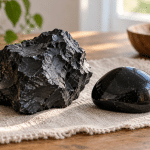
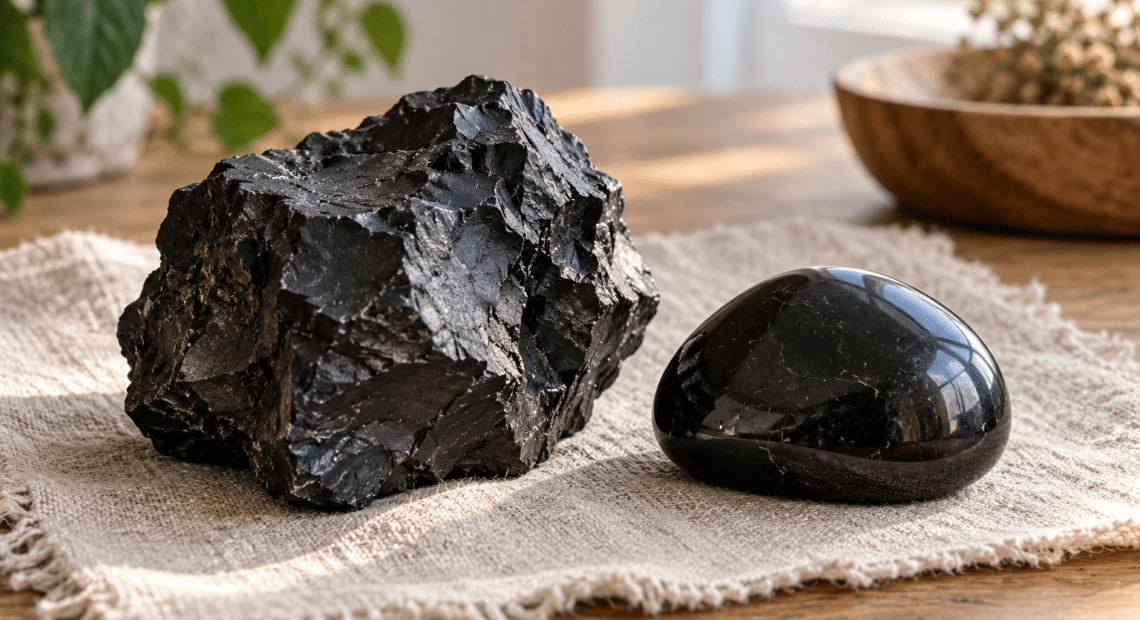
A black stone can invite a surprisingly long look. Its polished face catches a window; a rough edge absorbs the same light. Before attaching a story to it, there is something to notice: surface, weight, shape, the difference between what you can see and what you have been told. Shungite offers a useful place to practise that distinction.
For people drawn to meaningful objects, curiosity need not end where evidence begins. A stone can belong in a personal ritual without becoming a medical device. It can remind you to pause without being responsible for your thoughts. The more clearly we describe the object, the more freely we can choose the meaning we bring to it.
Begin with carbon, but do not stop there
The original Periodic Videos film above explores carbon through samples and structural models. Graphite, diamond and other forms demonstrate why an element’s name is only the beginning of a material description. Arrangement matters. So do the other substances present. Two dark objects do not become interchangeable merely because both contain carbon.
The Royal Society of Chemistry’s carbon entry provides a foundation for understanding the element and its different forms. That background helps us ask more precise questions about a carbon-bearing rock. What is its composition? Which sample was analysed? What property was measured, and under what conditions?
Shungite should not be imagined as a single perfectly uniform substance. In a 2021 mineral-processing study, researchers investigated a particular shungite sample containing carbon, silica, iron and sulfur. Their work examined ways of separating components. It did not test the effects of keeping a decorative stone beside a person.
The distinction between a tested sample and an entire product category matters. A published analysis does not certify the composition of every stone carrying the same trade name. Nor does a laboratory treatment become a household instruction. Read research for what it actually investigates; resist the temptation to borrow its technical vocabulary for an unrelated promise.
Let the object remain interesting without exaggeration
A polished stone offers a different experience from an unfinished specimen. Reflections move across one surface; small irregularities interrupt another. A pyramid introduces edges and repeated triangular faces. These are ordinary observations, but ordinary does not mean empty. Much of our relationship with objects begins through sustained attention to such details.
People may associate dark stones with grounding, protection or steadiness. Those associations can be understood as spiritual beliefs or personal symbolism. They are not established simply by identifying carbon in a material. If grounding means returning your attention to the present task, describe that practice. If it means a measurable physical effect, the claim requires evidence specific to that effect.
There is no need to turn either kind of language into a contest. Someone can value a contemplative object while declining unsupported health claims. Another person may appreciate only its appearance. A thoughtful description leaves room for both responses, without insisting that the stone carries the same meaning for everyone.
Choose a piece for its stated qualities
Flat Earth Shop’s Shungite Pyramid — Monument of Focus is one example within the current shungite collection. The listing offers polished and unpolished finishes and several sizes, depending on the option. It describes individual natural markings and presents the piece for decorative or contemplative use.
Those are concrete reasons to compare options. Consider the space where it will stand, the dimensions listed for your chosen variant and whether you prefer a reflective or less finished surface. A photograph communicates a design; natural markings may vary. The listing currently limits delivery to the United States, so check the selected option and delivery terms before ordering.
The care instructions are also part of the object. This product is not intended to treat drinking water; the listing says to keep it away from drinking water and handle it gently. Decorative use should remain decorative use. Neither the video nor the cited mineral study establishes that a purchased pyramid purifies water, shields its owner from electromagnetic exposure or treats a health condition.
Choosing without those promises can make the decision more honest. You are considering a mineral accent, a geometric form and a possible reminder of an intention. None requires a dramatic account of invisible forces. A modest description gives you something clearer to evaluate when the object arrives.
Build a practice around attention, not an expectation
If a stone belongs on your desk, give it a small, defined role. At the beginning of a writing session, look at one face or edge and name the task you intend to do. Then begin the task. The action is yours. The object serves as a cue, rather than an explanation for whatever happens next.
After several days, ask whether the cue helped you remember. Perhaps it did; perhaps you stopped noticing it. Either answer is useful. Move it, change the routine or let it remain simply decorative. A personal ritual becomes more flexible when it does not depend on proving that its object possesses a special power.
You can also separate observation from interpretation in a notebook. Write what you directly noticed, what you felt and what explanation occurred to you. These are different entries. Feeling calmer after a pause is an experience worth describing; it does not identify a mineral mechanism or show which part of the situation produced the change.
Try one further exercise before making a purchase. Describe the piece to a friend without using the words energy, healing or powerful. You might mention its dimensions, finish, dark color, angular silhouette and the place where you would display it. If that account still interests you, the object has a role independent of a promise you cannot verify.
Then describe the meaning you would like to give it in the first person. Rather than announcing what the stone does to everyone, explain what it might remind you to do. This small change in grammar keeps responsibility and possibility in view. You can invite a moment of reflection without making your private association into a rule about the physical world.
Keep questions open and claims proportionate
When a material attracts a striking claim, follow the chain of evidence. Does the source discuss a rock, a purified component, a manufactured composite or a finished consumer object? Does it measure a physical property, or investigate an effect on people? Those differences can disappear in an advertisement, yet they determine what a result can support.
A useful question is what information would change your description. A reliable composition report might alter what you say about a specimen. A clearer photograph might change your expectations of its finish. Neither would automatically support a claim about wellbeing. Different questions require different evidence, and uncertainty is an acceptable place to pause.
Shungite can remain a compelling object within those limits. Its visual character invites attention; its material complexity invites questions; its place in a personal space can be chosen deliberately. The stone does not have to carry every story placed upon it. Sometimes the more meaningful practice is learning to see what is there before deciding what it means.