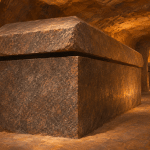
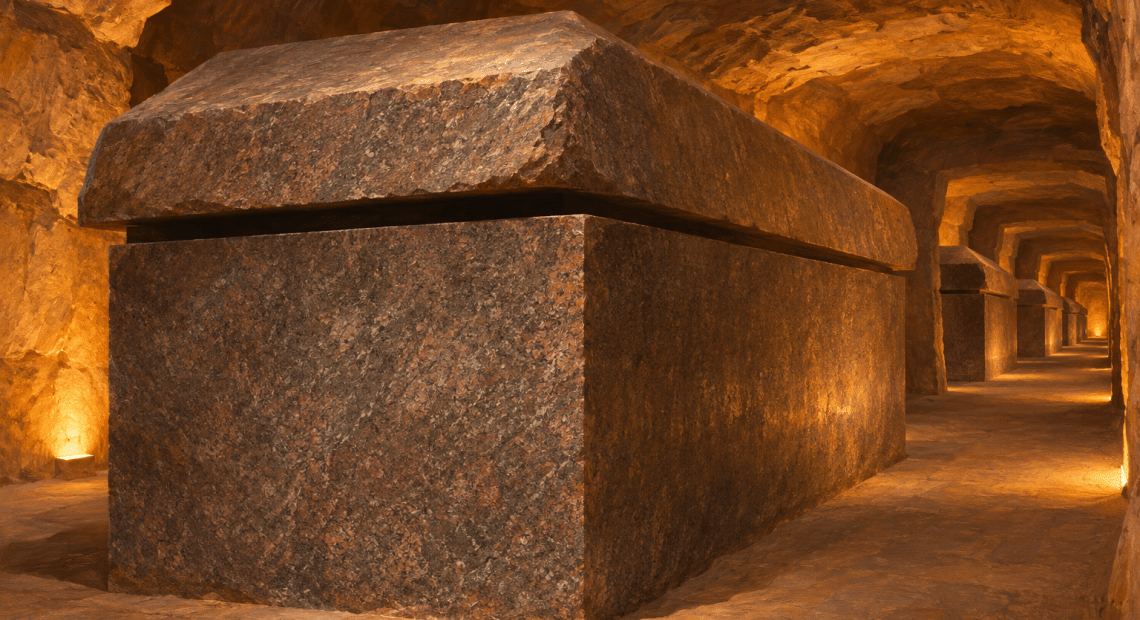
Beneath Saqqara, enormous stone containers occupy underground chambers with a presence that photographs struggle to convey. Their scale immediately raises practical questions: how were they shaped, moved, and installed? Their appearance raises another, more provocative possibility. Could Egypt’s famous builders have inherited objects made by an earlier civilization?
That is the challenge explored in UnchartedX’s film about the Serapeum’s stone boxes. It is an intriguing starting point, provided we distinguish an impressive object from a demonstrated historical conclusion. The boxes deserve serious attention. So does the evidence connecting their surroundings to the sacred Apis bulls.
There is a timely reason to revisit the subject on November 11. Archaeologist Paul T. Nicholson dates Auguste Mariette’s entry into the Serapeum to November 12, 1851. On the eve of that anniversary, the site offers an opportunity to ask how discovery becomes explanation, and where genuine uncertainty remains. Read Nicholson’s archaeological account.
UnchartedX’s case for an earlier technology
Published in February 2019, The Incredible Precision of the 100 ton boxes in the Serapeum of Saqqara… Chapter 3 examines quarrying, construction, and the claimed precision of the containers. In his accompanying article, creator Ben van Kerkwyk argues that the objects could not have been produced through the handworking methods conventionally attributed to dynastic Egypt. His proposed explanation is inheritance from an earlier, unidentified period. The creator’s original post states that interpretation directly.
This is an alternative-history argument, not an established archaeological finding. Even the familiar “100-ton boxes” label should be handled carefully: a headline is not a measurement report for every container. Weight estimates, whether they include lids, and the dimensions of individual examples should be specified before comparisons become meaningful.
What the archaeological context tells us
Egypt’s Ministry of Tourism and Antiquities identifies the Serapeum as the burial place of sacred Apis bulls associated with Ptah at Memphis. Its account describes use from Amenhotep III’s reign into the Ptolemaic period, selected bulls receiving privileged treatment, and elaborate burial ceremonies following mummification. It also records royal offerings and inscriptions. See the ministry’s monument description.
That religious setting matters. The conventional explanation does not begin with someone looking at a large empty container and guessing “bull coffin.” It draws on a wider funerary landscape and objects documenting the cult.
For example, the Louvre preserves an Apis funerary figurine from the Serapeum, catalogued to the Ramesside period on stylistic grounds. A separate basalt stela from the site carries an epitaph naming Apis and Ptolemy VI. These are tangible pieces of the historical setting, not modern captions attached to mysterious stones. View the figurine’s catalogue record. View the inscribed stela.
Could Egyptian use conceal an older origin?
Supporters of the inheritance hypothesis can reasonably distinguish an object’s use from its manufacture. A later inscription or burial does not, by itself, prove when the surrounding stone was first worked. Reuse is a possibility worth testing.
But possibility is not positive evidence. To establish that these containers originated in a lost civilization, researchers would need evidence for that earlier production history, not simply doubts about the later one. Secure archaeological relationships, diagnostic manufacturing traces, or independently datable associated material would be more persuasive than visual impressions alone.
The distinction cuts both ways. Identifying a funerary purpose does not automatically reconstruct every workshop procedure. Yet uncertainty about a particular procedure does not remove the funerary evidence. “How was it made?” and “What was it used for?” are related questions, but they require different kinds of answers.
Precision needs measurements, not just adjectives
The strongest version of the alternative argument concerns geometry: flat surfaces, controlled corners, and relationships between adjoining faces. These are testable properties. They deserve more than either astonishment or dismissal.
A useful investigation would name each container, map the areas measured, identify the instruments, and publish calibration and uncertainty. Measurements should cover unfinished or irregular surfaces as well as strikingly smooth ones. A small accurate patch cannot establish that an entire chamber-sized object meets the same tolerance.
It would also help to separate surface finish from dimensional accuracy. A reflective surface can impress the eye without demonstrating that every opposing face is parallel. Conversely, a rough-looking object can contain carefully controlled dimensions.
Calling workmanship “machine-like” describes a resemblance. Identifying a machine requires additional evidence about the process that produced it. The opportunity here is not to suppress the question, but to make the question precise enough that competing explanations can be compared.
Ancient tools were more sophisticated than the caricature
Debates about Egyptian stoneworking often become a contest between modern machinery and a supposedly helpless copper chisel. Actual research describes a more varied toolkit and acknowledges unresolved questions.
Conservator Anna Serotta’s study of Egyptian sculpture combines tool-mark imaging, ancient tools, experiments, and consultation with stone carvers. It reports that copper or bronze percussion tools are ineffective on hard stone, pointing instead toward stone percussion tools. That is different from claiming Egyptians could not work hard stone at all. The study also emphasizes disagreements about tools and surface textures. Read “Reading Tool Marks on Egyptian Stone Sculpture.”
Abrasives further complicate the picture. Metropolitan Museum researchers identified corundum-rich material and corroded bronze particles within a drill hole on an Amarna limestone fragment. They interpreted the combination as evidence for a bronze tubular drill working with a hard abrasive mixture. Read the museum’s analysis.
This fragment is not a Serapeum box, and it does not explain the complete manufacture of one. Its relevance is narrower: Egyptian technical capability cannot be reduced to the hardness of a metal tool acting alone. Materials, abrasives, technique, and accumulated craft knowledge all belong in the discussion.
What would move the debate forward?
For the lost-civilization hypothesis, the decisive advance would be evidence that uniquely favors an earlier manufacturing tradition over skilled Egyptian production. A proposed mechanism should generate predictions: particular tool marks, consistent tolerances, identifiable residues, or workshop remains that investigators can search for.
For conventional reconstructions, the challenge is to explain the sequence with comparable specificity. Which operations shaped the exterior, hollowed the interior, and finished the surfaces? What evidence supports the movement and installation stages? Where does a reconstruction demonstrate feasibility, and where does it remain a proposal?
Neither side benefits from treating unanswered questions as victories. A convincing account must explain the difficult details while also accounting for the inscriptions, objects, and religious history around them.
Wonder without a premature verdict
The Serapeum invites curiosity because the achievement is substantial, whatever its final technical explanation. UnchartedX’s film offers an energetic challenge to familiar assumptions. Archaeology supplies essential context that any alternative must address.
The most rewarding approach is to watch with two questions in mind: what has actually been observed, and what has been inferred from it? Keeping those questions separate leaves room for discovery without turning speculation into fact. The stones are extraordinary enough to deserve that care.