A singing bowl can look effortless in someone else’s hands. The mallet travels around the rim, a tone gathers, and the sound seems to continue by itself. Then you try it. There is a scrape, a brief ring, perhaps a stubborn little rattle. You circle faster, grip harder, and wonder what you are missing.
That moment is a useful place to begin. A bowl is a musical object with a physical response to contact. Learning its sound involves listening, adjusting, and noticing what your hands actually do. You do not need to interpret a hesitant tone as a sign about your energy, concentration, or ability to meditate.
This exploration focuses on the mechanics of playing: what makes the bowl vibrate, why chatter happens, and how to approach a clearer sound without turning practice into a test.
Watch a practical demonstration first
Shakti Sound Meditation’s How to Play a Singing Bowl is an established introductory demonstration, originally published in 2008. It offers a visual companion to written instructions. Bodhisattva Trading Company also maintains a playing guide featuring Shakti.
Watch once without trying to copy every movement. On a second pass, choose one detail to observe: how the bowl is supported, where the mallet meets it, or how the player moves around the rim. A demonstration becomes easier to use when it gives you one manageable question.
The sound begins with a moving bowl
Striking and rubbing are two ways of putting a bowl into vibration. In their experimental work on singing bowls, physicists Denis Terwagne and John W. M. Bush investigated the movement of bowl walls and, in water-filled experiments, the waves that movement produced. Their research connects singing-bowl acoustics with the behavior of standing bells and wine glasses. You can find the paper through MIT’s research repository.
The distinction matters when watching dramatic demonstrations of water jumping inside a bowl. Such images show a physical interaction under particular conditions. They do not demonstrate that playing a bowl reorganizes the body’s water or treats a medical condition.
For ordinary playing, the useful question is simpler: what changes when you change the contact? Treat the instrument as something you can get to know through small comparisons, rather than something whose response you must explain through a spiritual theory.
Why the rim sometimes chatters
Rim playing involves friction, often described through a stick-slip mechanism. Contact between the moving mallet and the bowl helps sustain vibration. A smooth circular movement can therefore produce a continuing tone rather than the brief impulse of a strike.
In a 2015 experimental study of singing-bowl chatter, Samantha R. Collin, Chloe L. Keefer, and Thomas R. Moore investigated what happens when that interaction becomes less stable. Their findings linked chatter with the mallet briefly losing contact as the vibrating rim moves. Increased speed or reduced applied force can contribute to this behavior.
That gives the familiar rattle a practical explanation. It can be feedback about movement and contact, rather than evidence that the bowl needs more force in every direction. The research studied a particular bowl and setup, so its measurements are not a universal recipe for every instrument.
Your task is to notice the transition: when does a tone begin, when does the rattle arrive, and which small adjustment changes it?
Begin with support and a gentle strike
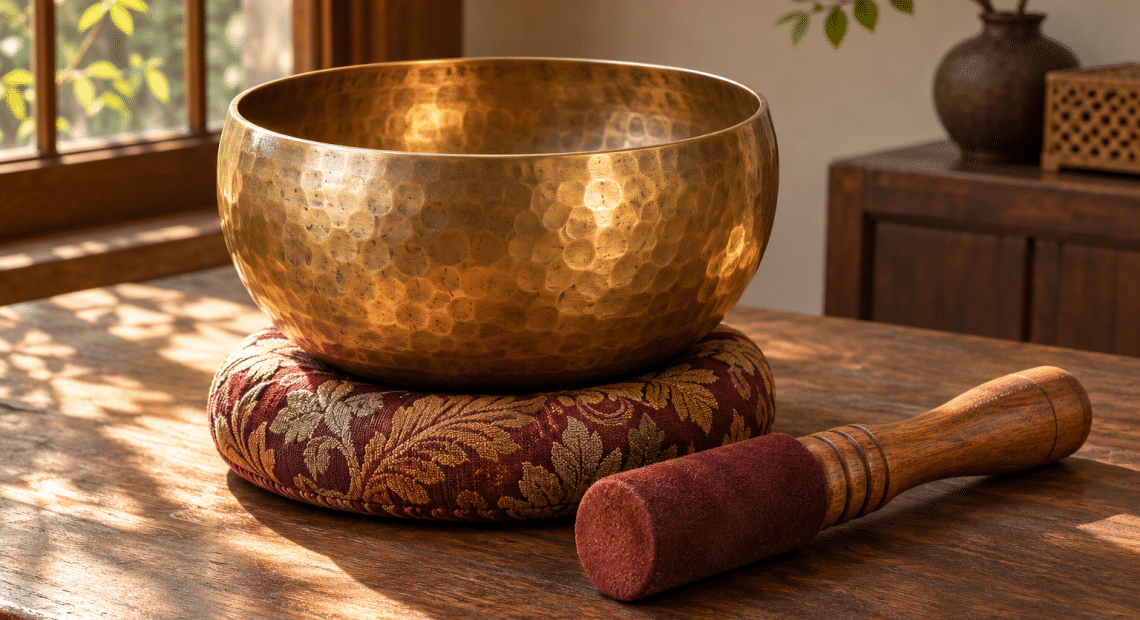
Before attempting a continuous tone, make sure the bowl feels secure. Bodhisattva’s guide recommends an open palm for larger hand-held bowls and fingertip support for smaller ones. For movement around the rim, it describes an upright mallet and a comfortable movement of the arm rather than a cramped rotation of the wrist.
Himalayan Bowls’ playing instructions explain that touching the bowl’s sides can damp its sound. They also recommend a cushion on a hard surface to prevent unwanted rattling against the support. Begin with a gentle side strike near the rim and listen before repeating it.
Give yourself permission to stay with striking. You can learn a great deal by comparing the beginning of a sound with its fading tail. A continuous tone is one playing technique, not a requirement for enjoying the instrument.
Make one adjustment at a time
For rim playing, Himalayan Bowls recommends slow movement with even pressure. If the mallet rattles, slow down and make contact more consistent. A hand positioned close to the rim can make control easier. The guide also notes that mallet materials influence the sound, with wood and leather producing different emphases.
Use those suggestions as the beginning of a small listening experiment:
- Choose a baseline. Make one comfortable attempt and notice the result without immediately correcting it.
- Name one observation. “The tone stopped halfway around” is more useful than “I cannot do this.”
- Change one thing. Try a slightly slower movement while keeping the rest of your approach similar.
- Compare, then pause. Decide whether the result became clearer, rougher, or simply different.
You might keep a tiny practice note: “Slower circle, less chatter.” A sentence is enough. The aim is to remember a useful adjustment, not to score your performance or create another demanding routine.
If repeated attempts become frustrating, put the mallet down. Returning later with a clear question can be more useful than making twenty increasingly forceful circles.
Choose for the experience you actually want
A listing can tell you a bowl’s dimensions, finish, and included accessories. It cannot fully communicate how that particular instrument will feel in your hand or sound in your room. Avoid choosing solely by a photograph, a mystical label, or the expectation that every bowl should behave like the one in a demonstration.
Flat Earth Shop’s Turquoise Pause is listed as a handcrafted Nepalese bowl approximately 3.5 inches across, supplied with a cushion, wooden mallet, and storage pouch. Its product page specifies United States delivery only. The listing does not establish a particular therapeutic frequency or guarantee a sustained rim tone.
Let curiosity lead the practice
Keep the sound comfortable, leave distance between the bowl and your ears, and stop if playing feels unpleasant. Follow the product’s care instructions; both featured listings advise gentle use, a soft dry cloth, and dry storage.
You may bring an intention, prayer, or personal symbolism to the experience. Those meanings belong to your practice. They do not need to become scientific claims about the sound.
Sometimes the most satisfying discovery is modest: your hand relaxes, the circle slows, and a rough rattle becomes a steadier tone. You have learned something about an instrument through attention. That is already a worthwhile reason to listen.