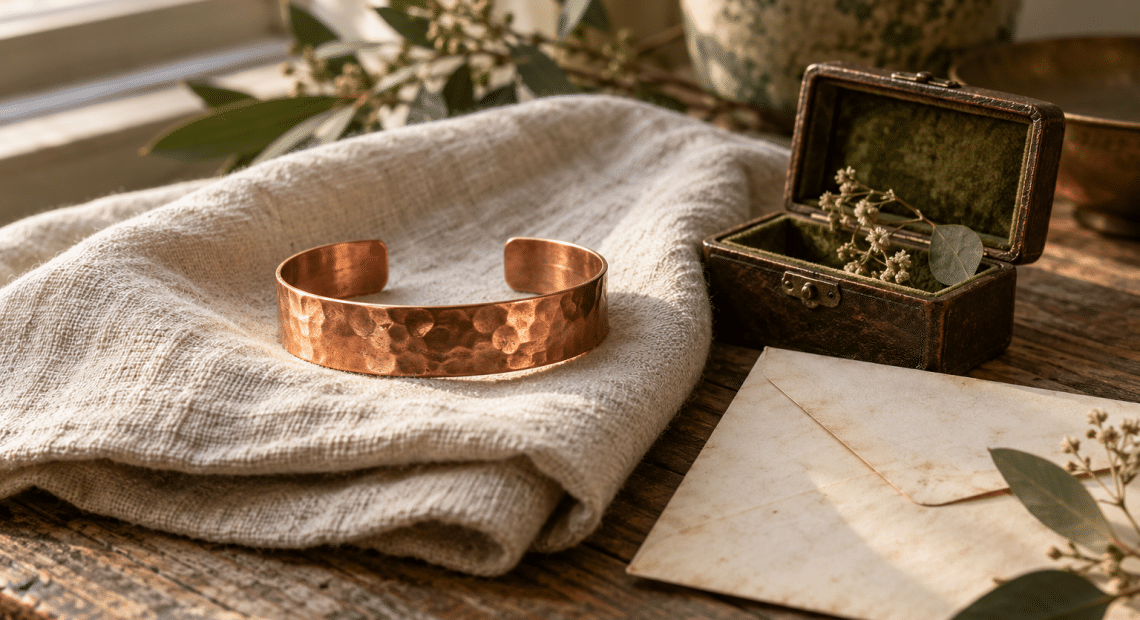
Before a bracelet becomes part of an outfit, it may already belong to a story. Someone gave it to us at a turning point. We chose it after a difficult year. We liked its shape before we had any explanation for why. The object sits against the wrist, visible during ordinary gestures, carrying a meaning that nobody else is required to recognize.
Copper cuffs offer a useful starting point for exploring this relationship between adornment and intention. Their open form, warm color and visible surface invite a close look. Yet the interesting question is not what a metal promises to do to us. It is what we choose to remember, express or practice when we put something on.
Black Beard Projects’ original film above follows the making of bracelets from copper pipe. Watch it as a maker’s account, with its own tools and decisions. The bracelet shown is not the Flat Earth Shop bangle discussed later, and the creator is not being presented as its supplier. The connection is the experience of looking beyond a finished accessory to the choices that give it form.
The difference between wearing and displaying
A piece of jewelry can be seen by other people while still having a private purpose. A plain band might remind its wearer of a promise. A textured cuff might mark a decision to stop waiting for permission to enjoy a personal style. There need not be a public announcement, a universal symbol or a correct interpretation.
This distinction matters when we speak about intentional living. An intention becomes more useful when it describes an action we can recognize. Be more present is an appealing phrase; let the other person finish speaking is something we can attempt this afternoon. An accessory may serve as a reminder, but the act remains ours. Wearing the reminder does not complete the commitment.
Consider the moment your hand reaches for a door, a cup or a phone. The cuff enters your field of view. You might use that ordinary interruption to remember a small choice: answer with care, pause before agreeing, or notice the person beside you. This is a suggested personal practice, not an established effect of copper.
Let the maker’s work remain its own story
The film makes the transformation from pipe to bracelet visible. Its appeal comes partly from that change of context: something associated with utility becomes something worn. We can appreciate the maker’s decisions without assuming that every copper cuff follows the same process or has the same composition, finish or purpose.
It is also possible to watch a workshop without turning it into a weekend instruction sheet. Heat, sharp edges and tools belong to a skilled process. The reflective invitation here is to observe how a form emerges, rather than to improvise unfamiliar techniques. Admiration does not require imitation.
What do you notice first: the finished shine, the open shape, the marks left by the work, or the time between one stage and the next? Different answers reveal different kinds of interest. Some people want a discreet object they can forget they are wearing. Others enjoy a piece that keeps drawing their attention. Neither preference needs a spiritual ranking.
History can deepen curiosity without supplying a borrowed identity
The Metropolitan Museum of Art holds a Peruvian Hammered Copper Band dated 1450–1530 CE, catalogued as hammered copper and classified among metal ornaments. That specific record shows one historical use of this material in adornment. It does not establish a single meaning for copper jewelry across time. See the museum’s object record.
A modern cuff does not inherit that object’s cultural identity simply because both contain copper. Respectful curiosity leaves room for differences in place, maker, wearer and occasion. We can learn from a documented object without claiming an ancient lineage for a purchase or inventing a ceremony to make it seem more significant.
The same restraint applies to symbolism. You may see an open circle as a reminder that your life is unfinished. Someone else may see a practical design that makes a bracelet easier to put on. The first is a personal interpretation; the second concerns form. We lose nothing by saying clearly which kind of statement we are making.
A gift can begin a conversation
If you give someone a cuff, allow the recipient to choose what it means. You can explain why you thought of them without asking them to adopt your interpretation. Perhaps the open shape reminded you of a new beginning, or the simple finish suited their taste. A thoughtful note can make that connection clear while leaving the object free of an emotional debt.
Receiving a meaningful object also leaves room for choice. You may wear it often, save it for particular occasions or discover that it does not feel like you. Gratitude and personal preference do not have to cancel each other. The relationship matters more than a rule about how the gift must appear on your body. Adornment becomes more generous when it makes room for the person who will actually wear it.
A current FES option, described plainly
For readers looking specifically for copper adornment, Flat Earth Shop lists the Copper Bangle — Solar Arc. The current page describes solid 10-gauge copper, a hand-forged hammered finish and an overlapping adjustable design, approximately 2 mm thick, with a listed fit for 7–8.5-inch wrists. On October 24, 2026, it showed US$80 and eight items in stock. Price and availability can change.
The product is currently marked for United States delivery only. Read its measurements and care guidance before deciding whether it suits you. Its appeal here is its material, form and potential personal meaning. No claim is made that wearing it treats pain, changes bodily energy or protects against electromagnetic fields. View the current Solar Arc bangle at FES.
Choose a meaning that leaves you free
A meaningful accessory should not become another test you can fail. Forgetting to wear it does not invalidate a promise. Taking it off does not remove your ability to act thoughtfully. The object can accompany an intention without becoming responsible for your character or your future.
If you already own a bracelet, begin there. Ask what you associate with it and whether that association still serves you. Perhaps a gift now feels like an obligation. Perhaps a simple piece has become more important through years of ordinary use. You are allowed to change the story, keep it private, or let an object remain beautiful without asking it to represent anything.
When choosing a new piece, separate desire from explanation. Do you enjoy wearing it? Does it fit your life? Is the story you are telling about it honest? A purchase does not have to become a transformation. Sometimes the most deliberate decision is to enjoy a small detail without surrounding it with promises.
Tomorrow, when you dress, notice one thing you choose rather than put on automatically. It may be a cuff, a scarf or an old watch. Give its meaning a clear sentence, then let the sentence lead toward an action. What we wear can become a quiet expression of attention. What we do gives that expression its substance.