In 2019, a glowing ring around a dark center appeared on screens around the world. It was introduced as the first image of a black hole. The picture felt almost impossible: how can a camera show something famous for not allowing light to escape? The answer is both more precise and more astonishing than the headline. We are not looking at the black hole itself. We are looking at light and shadow shaped by its gravity.
Veritasium’s “How to Understand What Black Holes Look Like”, viewed more than ten million times, helps unpack that distinction. The image came from the Event Horizon Telescope, an international collaboration that coordinated radio telescopes around Earth. It shows the region around the supermassive black hole at the center of galaxy Messier 87, often called M87. The image invites wonder, but understanding its limits makes it more powerful.
A Shadow, Not a Solid Surface
A black hole is a region of spacetime with an event horizon: a boundary beyond which light cannot escape to a distant observer. It does not have a bright surface for a telescope to photograph. Matter around it, however, can become extremely hot and emit radiation. Some of that radiation reaches us after traveling through a region where gravity bends its path.
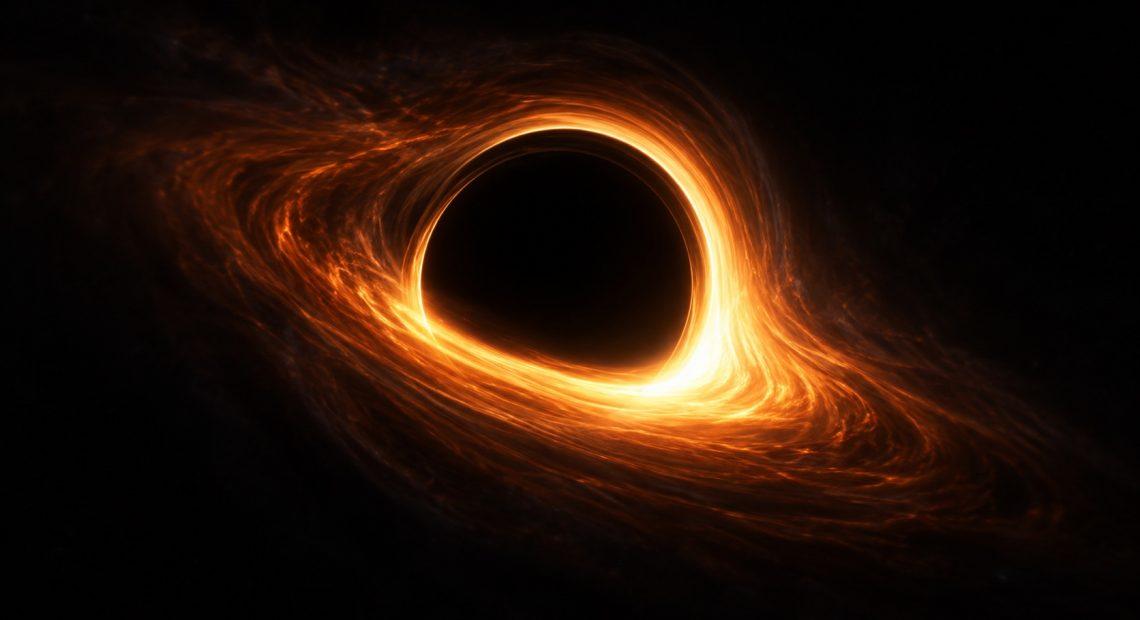
The dark center of the famous picture is commonly called the black hole’s shadow. It is related to, but larger than, the event horizon itself. Light paths near the black hole are distorted and some light falls inward. The bright ring is produced by radiation from hot material around the black hole, shaped by the geometry of spacetime and by the motion of that material. The image is therefore evidence about the black hole and its surroundings, not a portrait of a visible black sphere.
This distinction matters because images can feel more direct than they really are. A photograph of a tree is also an interpretation of light captured by an instrument, but the scales here are extreme. The M87 image combines signals gathered by many observatories, careful synchronization, processing, and independent checks. It is an achievement of measurement as much as photography.
A Telescope the Size of Earth
The Event Horizon Telescope did not put one gigantic mirror in space. It linked radio telescopes separated by vast distances through a technique called very-long-baseline interferometry. Each station recorded signals with precise timing. Researchers later combined those records to reconstruct information that no single telescope could collect alone.
Why go to so much trouble? The black hole region in M87 appears tiny from Earth. Its apparent size demands extraordinary angular resolution. Spreading the telescopes across the planet provided the necessary baseline. Even then, the resulting image was not a simple snapshot from a phone camera. The collaboration had to account for calibration, limited coverage, noise, and choices in image reconstruction.
The Event Horizon Telescope’s original announcement explains that the dark feature and surrounding ring are consistent with a black-hole shadow. That careful wording is valuable. Scientists did not merely choose the most dramatic-looking picture. They compared the observations with predictions, tested different reconstruction methods, and looked for features that remained stable.
Why the Ring Is Not Perfectly Even
The ring in the M87 image is brighter on one side. The surrounding matter is moving rapidly, and radiation from material moving toward us can appear brighter than radiation from material moving away. Gravity also redirects light. These effects help explain why the ring looks lopsided rather than like a uniformly illuminated doughnut.
It is easy to mistake an image for a complete map of an object. In reality, the brightness tells us about emission, motion, and our viewing angle together. A different black hole, a different orientation, or a different observing wavelength can create a different appearance. The black hole does not glow orange in visible light as the published color scheme may suggest. Color helps communicate the intensity of radio observations to human eyes.
This is not a flaw or a trick. Astronomy routinely translates signals that humans cannot see directly into images we can study. X-ray pictures, infrared maps, and radio images all use conventions. The honest question is whether those conventions are explained and whether the underlying measurements can be checked.
The Difference Between Seeing and Knowing
The black hole image also opens a philosophical question: what does it mean to see something? We cannot stand next to M87. We cannot watch the event horizon with our eyes. Yet we can build instruments whose signals are tested against physical models and against each other. Knowledge arrives through layers of tools, inference, and scrutiny.
That makes the image more interesting than a simple proof-by-picture. Before 2019, researchers already had substantial evidence for black holes from the motion of stars, hot gas, gravitational waves, and other observations. The new image added a distinctive kind of evidence: a resolved structure at the scale where strong gravity dominates. It did not make every question about black holes disappear. It gave researchers another way to ask better ones.
Skepticism belongs in this story, provided it is disciplined. Ask how the data were recorded. Ask why the image has its shape. Ask what alternative explanations were tested. Ask which parts are measured and which are visual conventions. These questions lead toward understanding. Simply rejecting the image because computers helped make it would ignore how much modern observation depends on instruments and computation.
Why This Discovery Still Matters
The M87 image required cooperation across countries, institutions, and specialties. Astronomers, engineers, software researchers, and technicians all contributed. No lone observer could have produced it. That is a reminder that truth-seeking can be collaborative, even when the subject appears profoundly mysterious.
It also shows the value of being precise about uncertainty. The result supports the picture of a black hole predicted by general relativity, while leaving room for further measurements and refinements. Science at its best does not ask us to stop wondering. It turns wonder into experiments that others can repeat and challenge.
The story is especially relevant in an age when a compelling visual can spread faster than its explanation. The famous ring is real observational work, but understanding it requires more than sharing the picture. Ask what wavelength was observed, what the colors mean, how the telescopes cooperated, and which parts of the result remain uncertain. Those questions help us separate a scientific image from an illustration that merely looks scientific. They are useful habits far beyond astronomy.
There is room for humility on both sides of the screen. Researchers work hard to make distant phenomena intelligible, and viewers need not pretend the explanation is simple. A difficult image can invite careful learning instead of instant certainty.
When you look again at the orange ring, imagine the journey behind it: radio waves traveling across space, arriving at telescopes around Earth, and being assembled into an image of light near a gravitational boundary. We are not seeing into the black hole. We are seeing what the universe lets us know about its edge. That is enough to change how we think about both sight and discovery.
Watch: How to Understand What Black Holes Look Like — Veritasium