A broken stone can hold more than a complete-looking story. The Rosetta Stone has missing edges, an absent upper section, and three surviving bands of writing. Its importance does not come from an untouched message delivered across time. It comes from the possibility of comparison: one surviving passage helping readers approach another.
For anyone drawn to lost history, that is a powerful invitation. Sometimes the past becomes clearer through a patient link between things already in view. Before searching for a dramatic secret, we can ask what an object actually says, who wanted it said, and how we know we are reading it correctly.
Listen to the object before the legend
In the video above, British Museum curator Ilona Regulski explains the stone using a replica. This distinction matters: the object on her table makes the inscription easier to discuss, but it is not the original. Her presentation follows the decree’s contents and shows how much a familiar museum icon can reveal when we slow down.
The stone carries a priestly decree issued in 196 BC, during the reign of Ptolemy V. It is written in three scripts but two languages: hieroglyphic and Demotic render Egyptian, while the third text is Greek. That distinction, confirmed by the museum’s collection record, prevents an easy mistake. Three visual forms do not automatically mean three different languages.
The content concerns a relationship between royal authority and a priestly council. The text presents the king favorably and grants religious honors. Regulski describes temple gifts, tax concessions, statues and festivals among its subjects. We are encountering an official account of power, not a neutral diary of everything happening in Egypt.
A public decree, not a private revelation
There is a pleasing reversal here. What became an extraordinary key to ancient writing began as a document intended for public display. Its concluding instructions call for copies to be set up in temples. The decree was meant to be seen within the institutions of its own world, even if the ability to read parts of it later became difficult.
This does not make the stone ordinary in the dismissive sense. An administrative or ceremonial text can disclose a great deal. It shows what a ruling order wanted to emphasize, which audiences it addressed, and how religion and government spoke through shared forms. Details that once served a particular occasion can become clues for much larger questions.
It also reminds us to read praise as praise. When an inscription announces generosity or victory, the claim is evidence of the message being promoted. Understanding the event itself can require other records. Careful curiosity does not discard the document; it asks what kind of document it is.
How comparison opened a door
Scholars could read the Greek, giving them a route into the Egyptian passages. Yet a parallel text was a starting point, not an instant translation machine. The scripts required sustained work, and Egyptian writing could not be reduced to the assumption that each image stood for one whole idea.
The museum’s decipherment timeline places Thomas Young and Jean-François Champollion within this longer effort. Champollion announced his breakthrough in 1822. His knowledge of Coptic, a later form of Egyptian, helped connect the ancient signs to a language rather than treating them as pictures detached from speech.
Think of the difference between recognizing a pattern and understanding a sentence. Repeated shapes can suggest where to look. Names can provide footholds. But a proposed reading becomes convincing when it works beyond the first attractive example. The discovery has to travel: another inscription, another word, another context.
The missing parts still matter
Regulski repeatedly distinguishes what survives from what can be reconstructed. Other copies and related decrees help scholars approach damaged passages and the stone’s lost upper section. A reconstruction can be well supported without becoming the same thing as an intact surviving object.
That is a useful habit for exploring any ancient civilization. Ask whether an image shows the artifact, a modern replica, an artist’s reconstruction, or a suggested restoration. All four can be valuable, but they answer different questions. Confusing them can turn an interesting interpretation into an apparent fact.
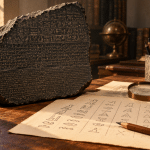
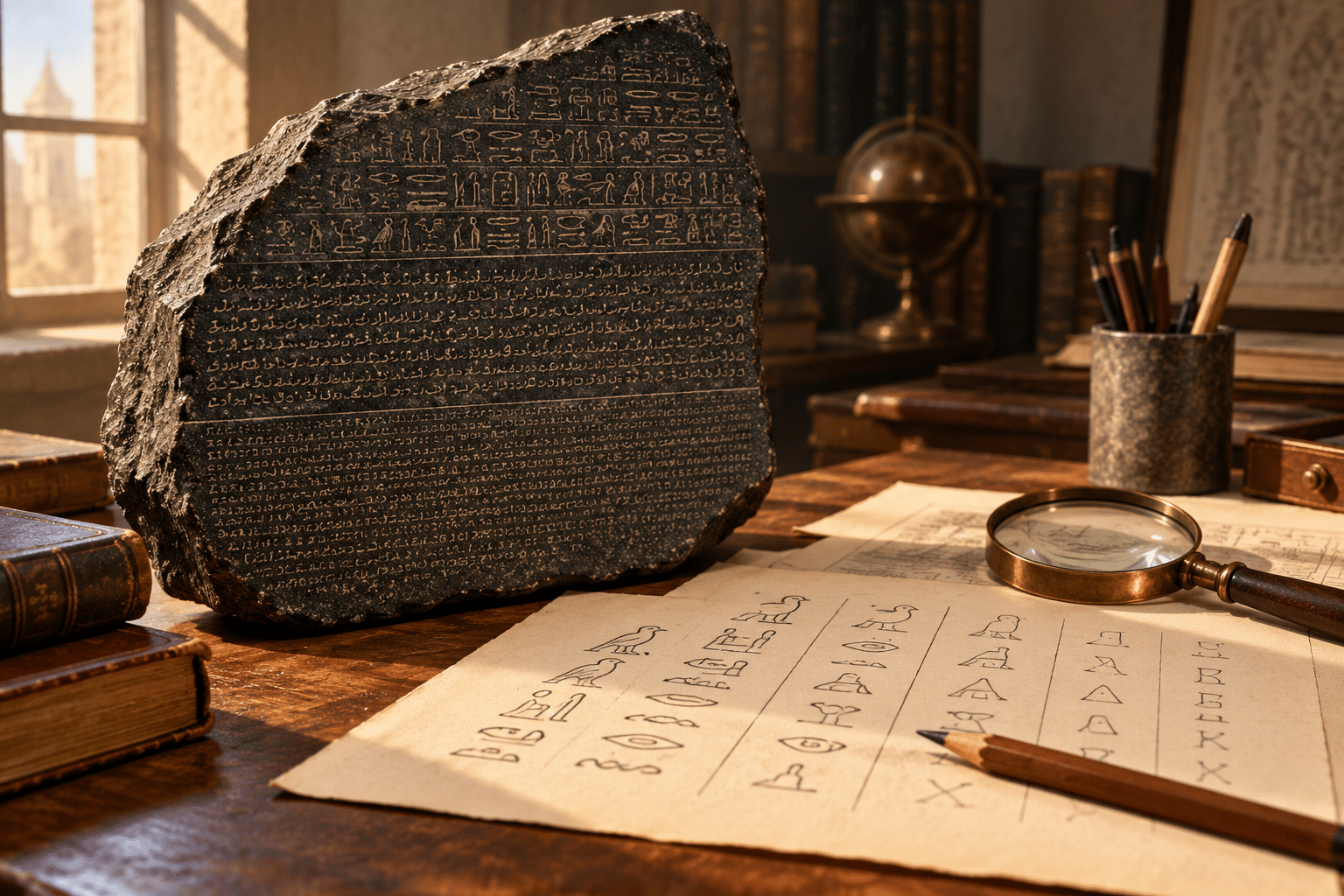
The original illustration accompanying this article is an imagined scene of study. Its marks are illustrative rather than a usable transcription. It invites reflection on decipherment; it should not be consulted as evidence for the stone’s exact appearance or text. For the actual inscription, return to the museum’s photographs and collection documentation.
Recovering history also means asking about its journey
The stone was found in 1799 by soldiers of Napoleon’s army near Rashid, called Rosetta by the French. It later came into British possession following the French defeat in Egypt and has been displayed at the British Museum since 1802. The museum outlines this history in its introduction to the object.
Those dates belong alongside the story of decipherment. A museum label is a meeting point between an ancient object’s first setting and the later institutions that collected, moved and interpreted it. Asking about that journey helps us avoid telling the history of discovery as though the object had no home before it entered a European collection.
We can appreciate a scholarly achievement while continuing to examine the circumstances around it. Respect for evidence includes provenance: where something was found, what happened to it, and which parts of that history are documented. Wonder grows more responsible when it remembers the people and places involved.
There is another distinction worth keeping. A language becoming unreadable to later scholars does not mean its speakers possessed an unexplainable technology or that every difficulty was deliberately imposed. Knowledge can become hard to recover when practices change and the chain of teaching is interrupted. The work of decipherment addresses a specific obstacle: how to connect surviving marks with words and meanings. It does not settle every question about the society that produced them. One successful reading can open a field of inquiry without closing it. This makes the achievement more interesting, because each recovered passage offers further questions that can be investigated in their own right.
A practice for the curious reader
Try approaching the next historical claim with three notes. First, record the surviving evidence. Second, record the interpretation built from it. Third, record the questions still open. You might discover that a confident headline combines these three levels into one sentence.
Then ask what would change your mind. Another dated inscription? A clearer photograph? A translation checked against parallel texts? Naming a possible test keeps curiosity active. It gives an idea somewhere to go beyond the excitement of first hearing it.
The Rosetta Stone does not offer proof of every story told about ancient Egypt. It offers something more durable: an example of understanding made possible through comparison, language and revision. Its broken surface reminds us that an incomplete record can still teach us, provided we do not fill every gap with whatever we most wish to find.
Look closely, listen carefully, and let the past remain larger than the first explanation. A lost voice returns most clearly when we give it room to say something we did not already expect.